
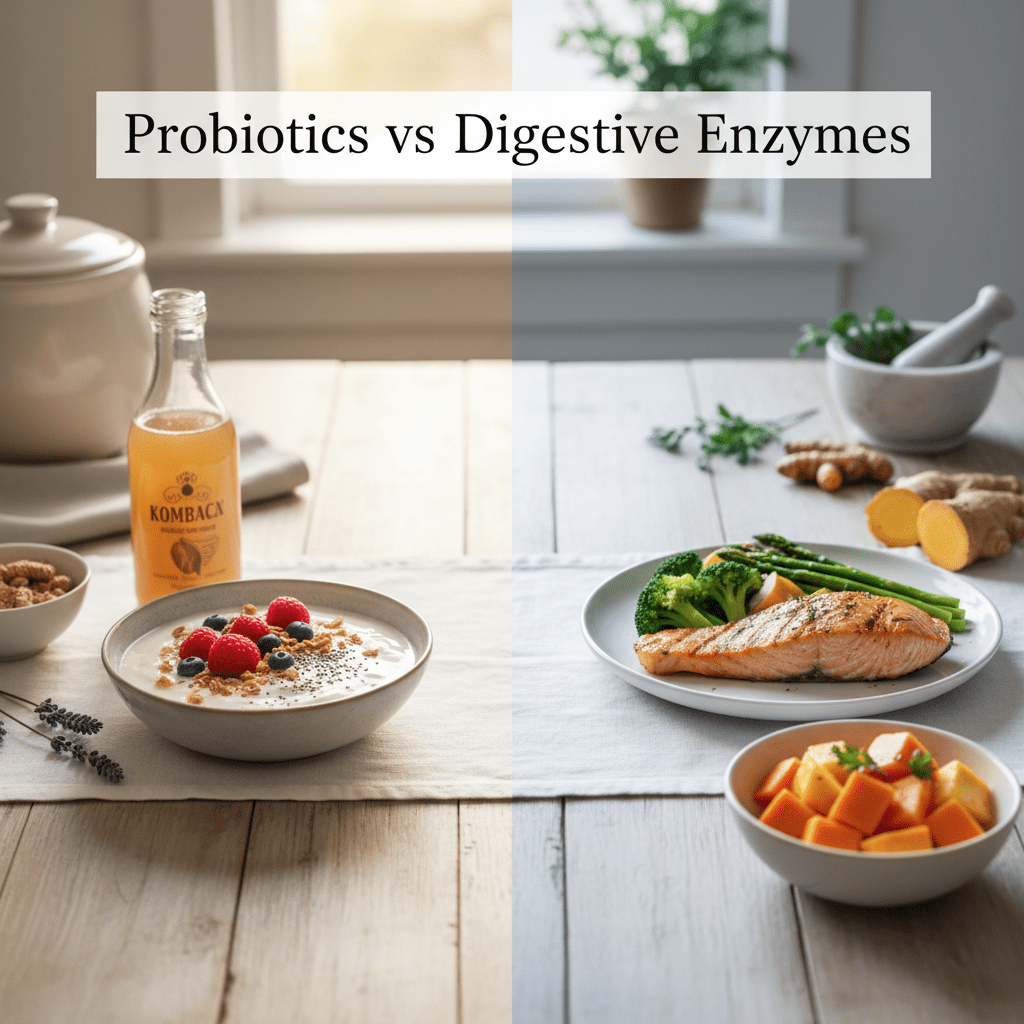
If you are comparing probiotics vs digestive enzymes, you are probably trying to solve a very practical problem. Maybe you feel bloated after meals. Maybe certain foods sit heavily. Maybe your digestion feels inconsistent and you are not sure whether you need more microbial support, better food breakdown, or both.
The important thing to know is that these supplements do different jobs. Probiotics are live microorganisms meant to help support the balance of your gut microbiome. Digestive enzymes are compounds that help break down food components like protein, fat, carbs, lactose, and fiber. That means the better choice depends less on hype and more on your goal, budget, tolerance, ingredient preference, convenience needs, and daily tradeoffs.
In simple terms, probiotics are usually the better fit when you want more longer-view gut balance support. Digestive enzymes are usually the better fit when your problem feels more connected to what happens during or right after meals. This guide breaks down the differences so you can choose the more useful option instead of buying the wrong category.
If you want to explore related gut-support reading after this comparison, you can also check DietaryHabit’s guides on Saccharomyces boulardii supplements, Lactobacillus salivarius supplements, and how supplements are absorbed in the body.
Probiotics vs Digestive Enzymes at a Glance
- Probiotics: live microorganisms that may help support microbiome balance, digestive regularity, and overall gut resilience over time.
- Digestive enzymes: proteins that help break down parts of food so digestion may feel easier and more efficient during meals.
- Best for after-meal heaviness or food breakdown support: Digestive enzymes
- Best for broader microbiome support: Probiotics
- Best for faster, meal-timed use: Digestive enzymes
- Best for a longer-term gut-health routine: Probiotics
What Are Probiotics?
Probiotics are live bacteria or yeasts used to help support the ecosystem inside your gut. You will usually see them sold as capsules, powders, gummies, or specialty strains. Different products may contain different organisms, and that matters because not every probiotic is built for the same goal. Some are positioned for daily digestive balance. Others are marketed for travel, antibiotic-associated disruption, or specific strain-driven benefits.
From a buyer perspective, probiotics make the most sense when you want support that is less about a single meal and more about your overall gut environment. They are often chosen by people dealing with inconsistent digestion, a desire for more regularity, or a general sense that their gut feels “off.” They also appeal to shoppers who want something that feels more foundational instead of reactive.
The tradeoff is that probiotics can be less predictable. Results may depend on strain choice, storage, timing, and individual response. They usually require more patience than digestive enzymes, which is why some buyers end up disappointed when they expect an immediate dramatic effect.
What Are Digestive Enzymes?
Digestive enzymes help break food down into smaller pieces your body can use more easily. Common examples include amylase for carbohydrates, protease for protein, lipase for fat, lactase for lactose, and specialty enzymes aimed at fibers or hard-to-digest food components.
In practical use, digestive enzymes are often the better fit when your issue feels tied to specific meals, richer foods, dairy, beans, or heavy mixed plates. They are usually taken right before or with food, which makes them easier to understand for buyers who want a direct use case: eat, take, see whether that meal goes more smoothly.
That convenience is a real advantage. If you are the kind of person who does not want an all-day supplement routine, digestive enzymes can feel more targeted and lower-friction. The tradeoff is that they do not replace the role of a healthy microbiome. They help with food breakdown, not the broader balance of gut bacteria.
The Core Difference: Gut Balance vs Food Breakdown
The easiest way to think about probiotics vs digestive enzymes is this:
- Probiotics work on the ecosystem side. They aim to support the balance of microbes in your digestive tract.
- Digestive enzymes work on the mechanical side. They help break down food while you eat and digest it.
If you are bloated because your meals are hard for you to process, digestive enzymes may be the more logical first step. If your digestion feels off more generally, especially over weeks or months, probiotics may be the better category to explore first. Many people confuse these two jobs and buy a probiotic when what they really want is mealtime support, or buy enzymes when the deeper issue seems more microbiome-related.
Which Is Better for Bloating and Gas?
This depends on when the bloating shows up and what seems to trigger it. If you feel uncomfortable mainly after larger meals, restaurant food, dairy, high-fat meals, or foods you know are harder on your stomach, digestive enzymes often make more sense. Their value is tied to digestion in the moment.
If your bloating feels more random, ongoing, or linked to a generally unsettled gut pattern, probiotics may be more relevant. They are not a magic fix, but they are the category more commonly used when the goal is broader digestive balance rather than a single-meal rescue strategy.
So for bloating after meals, enzymes usually win. For general digestive balance, probiotics usually have the stronger logic.
Which One Fits Your Goal, Budget, and Tolerance Better?
Your buying decision should not be based on marketing language alone. It should be based on what kind of routine you will actually follow and tolerate well.
Choose probiotics if you want:
- A broader gut-health angle rather than meal-specific support
- A daily routine that may help support microbiome balance over time
- A supplement category with more long-term positioning
- A strategy that feels less tied to specific foods and more tied to overall gut consistency
Choose digestive enzymes if you want:
- Help with richer meals or foods that feel harder to digest
- A supplement you can use right before or with meals
- A more direct, practical trial where you can judge the result quickly
- A lower-commitment option instead of a full daily microbiome routine
Budget also matters. Probiotics can be more expensive over time, especially if you experiment with multiple strains or premium formulations. Digestive enzymes may feel more cost-efficient if you only use them with certain meals. On the other hand, if you end up taking enzymes multiple times every day, the cost gap can narrow.
Tolerance matters too. Some people do not love the trial-and-error side of probiotics, especially if a formula does not feel like a match. Digestive enzymes are often easier to test quickly, but that does not mean they are automatically gentler for everyone. People with medical conditions, medication use, or pancreatic and gallbladder concerns should be more cautious and should involve a qualified healthcare professional when needed.
Can You Take Probiotics and Digestive Enzymes Together?
Yes, in many cases people do use both because they serve different purposes. A common real-world setup is using a probiotic as part of a daily gut-support routine and a digestive enzyme only with heavier meals or foods that tend to cause discomfort.
That said, combining supplements is not always the smartest starting point. If you begin both at the same time, it becomes harder to tell what is helping, what is unnecessary, or what is causing side effects. For most buyers, it is more practical to start with the category that best matches the main problem and only layer in the second option if there is a clear reason.
Who Should Pick Which?
Probiotics may be the better fit if:
- You want support for broader gut balance rather than single-meal comfort
- You are comfortable giving a product more time to judge results
- You prefer a daily wellness-style routine
- You are shopping with microbiome support in mind
Digestive enzymes may be the better fit if:
- Your symptoms show up mostly during or after meals
- You want to target heavier foods, dairy, fat, or mixed meals
- You prefer convenience and faster feedback
- You do not want to commit to another every-day supplement unless it proves useful
Our Verdict: Probiotics vs Digestive Enzymes
There is no universal winner in the probiotics vs digestive enzymes debate because they are built for different jobs. If you want support for the microbiome and overall gut balance, probiotics are usually the better category. If you want help with breaking down meals and reducing food-related digestive discomfort in the moment, digestive enzymes are usually the better choice.
For many buyers, the smartest question is not “Which one is stronger?” but “What exactly am I trying to fix?” If the answer is meal-related heaviness, enzymes often make more sense. If the answer is broader digestive inconsistency or a desire for microbiome support, probiotics are usually the better first look.
The shortest version: probiotics are the better gut-balance tool, while digestive enzymes are the better mealtime tool.
FAQ: Probiotics vs Digestive Enzymes
Are probiotics better than digestive enzymes for bloating?
Not always. Digestive enzymes may make more sense if bloating shows up after meals. Probiotics may be more relevant if your digestion feels generally unsettled over time.
Do digestive enzymes replace probiotics?
No. Digestive enzymes help break down food, while probiotics are used to support the gut microbiome. They do not do the same job.
Can you take probiotics and digestive enzymes together?
Many people do, but it is often better to start with one category first so you can judge what is actually helping.
Which is better for daily use?
Probiotics are more often used as a daily routine product. Digestive enzymes are more often used around meals, although some people do take them more regularly depending on their needs.
Which is better if you want something simple?
If your issue is clearly meal-related, digestive enzymes are usually simpler because the use case is straightforward. If your goal is broader gut support, a probiotic may still be the better fit even though it usually requires more patience.
References
- National Center for Complementary and Integrative Health. Probiotics: What You Need To Know.
- Harvard Health Publishing. Should you take probiotics?
- Cleveland Clinic. Digestive Enzymes and Digestive Enzyme Supplements.