
We only recommend products we love and that we think you will, too. We may receive a portion of sales from products purchased from this article.

Medically reviewed by Dr. A.S.M. Masum Billah, MBBS

Lactobacillus salivarius is one of the few probiotic species with meaningful research tied to oral microbiome balance, gum health, and immune interaction, rather than vague “gut support” claims. The key is strain visibility and realistic dosing—both of which vary widely between products.
Below are the 10 best Lactobacillus salivarius supplements, ranked based on strain disclosure, CFU transparency, formulation quality, and real-world use.
Best Lactobacillus Reuteri Supplements
What Lactobacillus salivarius Actually Does (And What It Doesn’t)
Lactobacillus salivarius is not a generic “gut probiotic.” Its most consistent human evidence relates to oral microbiome balance, with secondary effects on immune signaling and gut ecology.
What research suggests it may help support:
- Oral health: competition against odor-producing bacteria, plaque-associated microbes, and inflammatory oral species
- Gum comfort: modulation of local inflammatory responses in the mouth
- Immune interaction: short-chain signaling that influences mucosal immunity
What it does not reliably do alone:
- Act as a laxative
- Replace multi-strain gut probiotics for IBS or antibiotic recovery
- Permanently colonize the gut without continued intake
This is why products that name the strain and disclose CFU matter more than flashy totals.
Oral Health vs Gut Health: How to Choose the Right Formula
Many readers assume probiotics work the same everywhere. They don’t.
If your goal is oral health (bad breath, gum issues):
- Look for named salivarius strains (WB21, BLIS K12, UCC118)
- Lower CFU taken daily and consistently often works better
- Lozenges or capsules are both acceptable, consistency matters more than form
If your goal is gut support:
- Salivarius works best as part of a blend
- CFU matters less than tolerance and strain diversity
- High-CFU products should be introduced gradually
This explains why Toniiq excels for focused use, while blends like Klaire Labs or NOW suit broader microbiome goals.
CFU Myths: Why Higher Isn’t Always Better
More CFU does not automatically mean better results.
- 100B CFU can help when the strain survives digestion
- 500M–2B CFU can still be effective for oral outcomes
- Overloading too fast often causes bloating, gas, or early discontinuation
What matters more:
- Viability at expiration
- Strain identity
- Delivery method
- User tolerance
This is why some users do better with Metagenics or Vitamatic than with ultra-high-dose formulas.
How Long Does Lactobacillus salivarius Take to Work?
This depends on use case, not marketing claims.
- Breath freshness / oral comfort: 7–21 days
- Gum response: 3–6 weeks
- Digestive balance: 2–4 weeks
If nothing changes after a month:
- The strain may not be right for your goal
- The dose may be too high or too low
- Delivery format may be poorly tolerated
Switching formulation, not just brand, often solves the issue.
Who Should Be Careful With Probiotics Like L. salivarius
Most healthy adults tolerate salivarius well. Still, caution matters.
Consult a clinician before use if you:
- Are immunocompromised
- Have a central venous line
- Are undergoing chemotherapy
- Have severe chronic illness
Possible side effects (usually temporary):
- Gas or bloating
- Mild stomach discomfort
- Changes in stool frequency
Reducing dose or taking every other day usually resolves this.
Capsule vs Lozenge vs Shelf-Stable: What Actually Matters
Capsules
- Best for gut delivery
- Easy to dose
- Most common
Lozenges / oral formats
- Better oral contact
- Useful for halitosis or gum concerns
- Require patience and consistency
Shelf-stable probiotics
- Convenient for travel
- Lower CFU
- Focus on resilience, not intensity
There’s no single “best” format—the right one is the one you’ll take consistently.
Expert Takeaway
Lactobacillus salivarius works best when treated as a targeted probiotic, not a cure-all.
Choose based on:
- Strain clarity
- Realistic CFU
- Your goal (oral vs gut)
- Your tolerance level
Consistency beats intensity. Always.
Top 10 Best Lactobacillus Salivarius Supplements
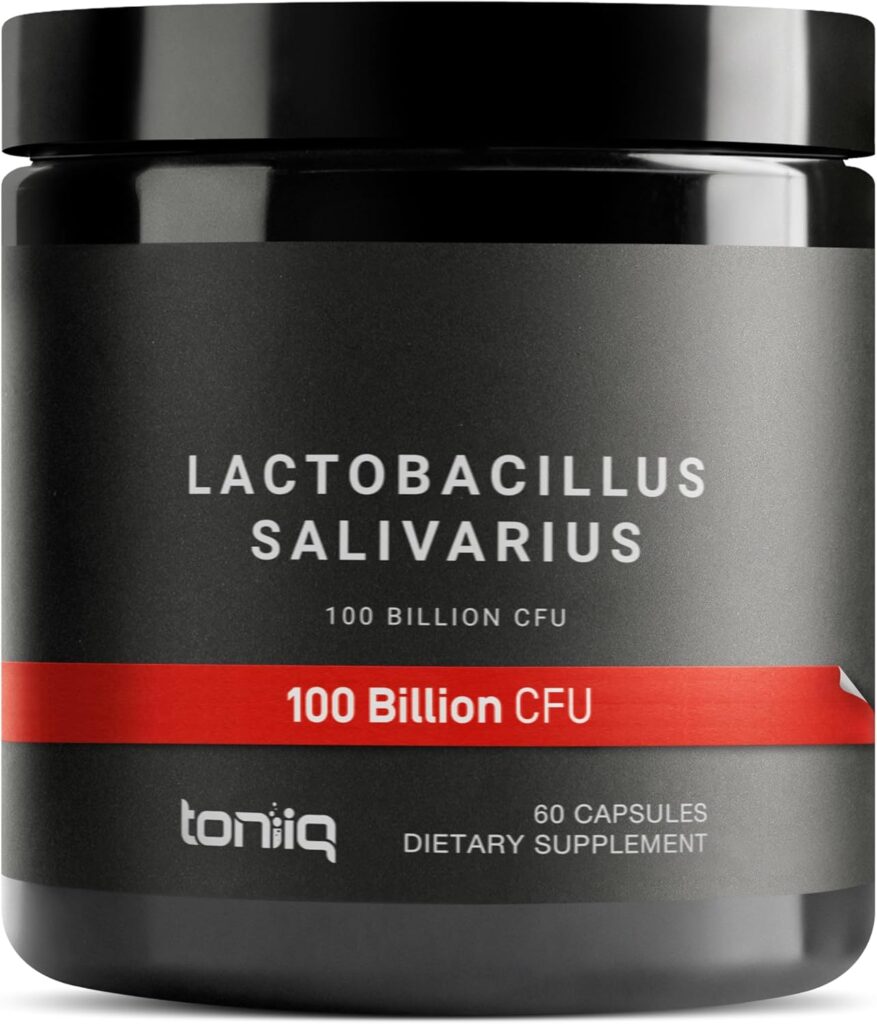
1. Toniiq Lactobacillus Salivarius
Key Ingredients & Dosage
- Lactobacillus salivarius: Over 100 billion CFU per serving
- Form: Delayed-release capsules
This is a single-species probiotic, which matters because research outcomes are strain- and dose-dependent. The delayed-release capsule is intended to improve survival through stomach acid.
What Makes It Stand Out
- Focused single-species formula
- Very high stated CFU per serving
- Delayed-release design for survivability
This is best suited for users specifically targeting oral health, breath quality, and microbial balance, not just general digestion.
Safety & Side Effects
Most healthy adults tolerate this well. Temporary gas or bloating may occur during the first week due to microbial adjustment.
Avoid or use only with professional guidance if immunocompromised.
How to Take It
- Label guidance: 2 capsules daily
- Pro tip: Taking with a light meal may reduce GI sensitivity.
Pros & Cons
Pros
- High CFU
- Single species clarity
- Clean positioning
Cons
- Potent for beginners
- Higher cost than blends
Customer Feedback
Users frequently mention improvements in breath freshness and gum comfort within a few weeks, along with better digestive regularity.
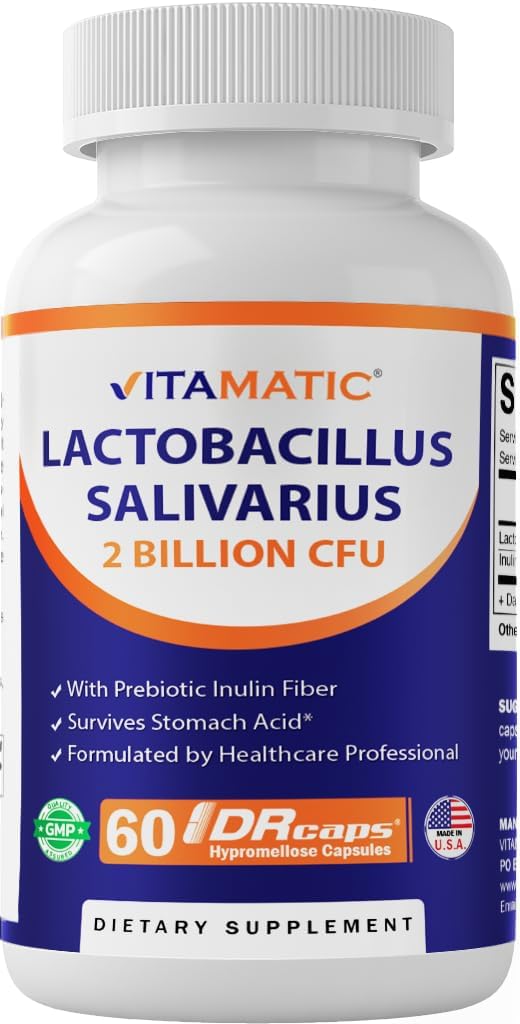
2. Vitamatic Lactobacillus Salivarius
Key Ingredients & Dosage
- Lactobacillus salivarius: Typically 2–3 billion CFU per serving
- Form: Capsule
Vitamatic uses a moderate, conservative CFU level, making it more approachable for daily, long-term use.
What Makes It Stand Out
- Beginner-friendly dosing
- Clear species disclosure
- Often priced affordably for routine supplementation
This is a solid choice for maintenance support rather than aggressive microbial intervention.
Safety & Side Effects
Lower CFU products are generally easier to tolerate. Mild gas may occur initially but usually resolves quickly.
How to Take It
- Label guidance: 1 capsule daily with food
- Pro tip: Morning dosing helps assess tolerance before bedtime use.
Pros & Cons
Pros
- Gentle dose
- Easy daily use
- Good value
Cons
- Lower CFU than top-ranked options
- No delayed-release capsule
Customer Feedback
Users often report steady, subtle improvements without digestive discomfort, making it popular among probiotic-sensitive individuals.
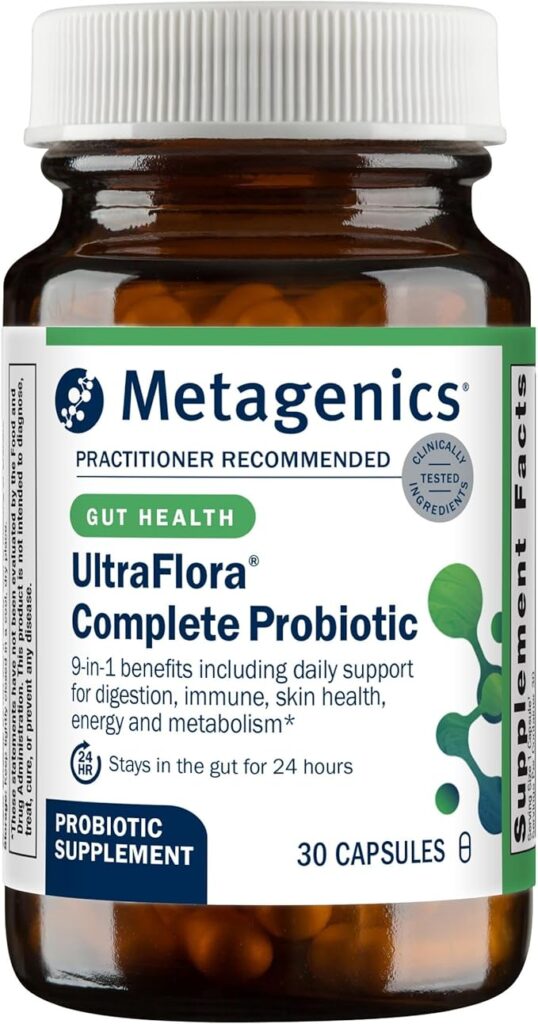
3. Metagenics UltraFlora® Integrity
Key Ingredients & Dosage
- Lactobacillus salivarius UCC118™: 100 million CFU, guaranteed at expiration
- Form: Vegetarian capsule
This product uses a patented, clinically studied strain, which is rare in the probiotic space.
What Makes It Stand Out
- Strain-specific (UCC118™)
- CFU guaranteed through expiration
- Practitioner-trusted brand
This appeals to users prioritizing clinical alignment over raw CFU numbers.
Safety & Side Effects
Extremely well tolerated due to lower dose. Suitable for long-term use under professional guidance.
How to Take It
- Label guidance: 1 capsule daily
- Pro tip: Separate from antibiotics by a few hours.
Pros & Cons
Pros
- Clinically characterized strain
- High manufacturing standards
- Minimal side effects
Cons
- Lower CFU impact
- Higher cost per CFU
Customer Feedback
Often recommended by clinicians for gentle, evidence-driven probiotic support, especially in sensitive users.
4. Klaire Labs Ther-Biotic® Complete

Key Ingredients & Dosage
- Lactobacillus salivarius: 2 billion CFU per capsule
- Total CFU: 25 billion per capsule (multi-strain)
- Form: Vegetarian capsule with inulin (prebiotic)
This is one of the few blends that clearly discloses per-strain CFU, which immediately puts it ahead of many competitors.
What Makes It Stand Out
- Per-strain CFU transparency, including L. salivarius
- Professional-grade manufacturing standards
- Balanced CFU level that avoids overload
This suits users who want measured, evidence-aware probiotic support, especially if they’ve reacted poorly to high-CFU products.
Safety & Side Effects
Generally well tolerated. Mild gas may occur during the first week. As with all probiotics, those with compromised immunity should consult a clinician first.
How to Take It
- Label guidance: 1 capsule daily with food
- Pro tip: Refrigeration helps maintain viability over time.
Pros & Cons
Pros
- Transparent strain dosing
- Balanced CFU profile
- Trusted clinical brand
Cons
- Blend rather than single strain
- Higher cost than mass-market options
Customer Feedback
Users often highlight digestive stability without bloating, especially when switching from stronger formulas.
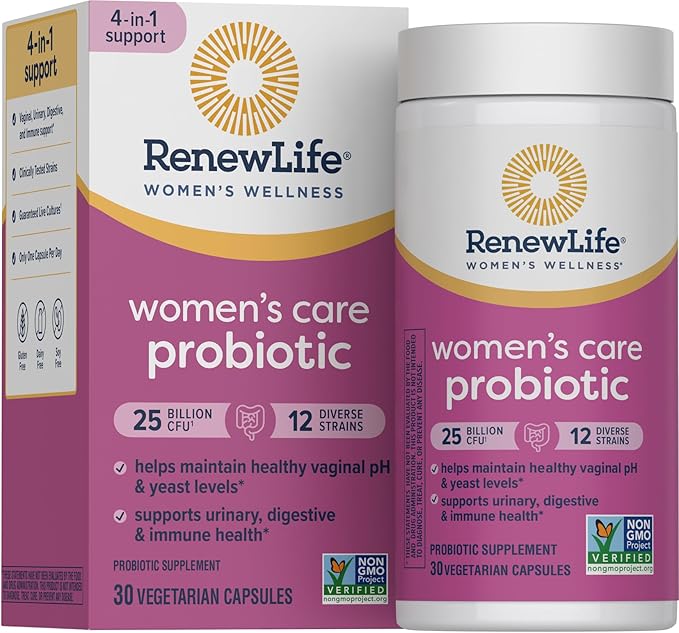
5. Renew Life Ultimate Flora Women’s Formula
Key Ingredients & Dosage
- Lactobacillus salivarius (HA-118): 500 million CFU per capsule
- Total CFU: 25–50 billion (product-specific)
- Form: Acid-resistant vegetarian capsule with prebiotic fiber
This formula is notable because it lists the salivarius strain and its CFU, rather than hiding it inside a total count.
What Makes It Stand Out
- Named L. salivarius strain with disclosed CFU
- Acid-resistant capsule design
- Includes prebiotic fiber to support colonization
This works well for people who want gentle oral and gut microbiome support, especially women sensitive to aggressive probiotics.
Safety & Side Effects
Low salivarius CFU reduces the risk of GI discomfort. Transient bloating may still occur during early use.
How to Take It
- Label guidance: 1 capsule daily
- Pro tip: Take consistently at the same time each day to stabilize response.
Pros & Cons
Pros
- Strain-level transparency
- Gentle dosing
- Good tolerability
Cons
- Lower salivarius CFU
- Broader blend may dilute targeted effects
Customer Feedback
Many users report improved digestive comfort and fewer issues with bloating compared to higher-dose blends.
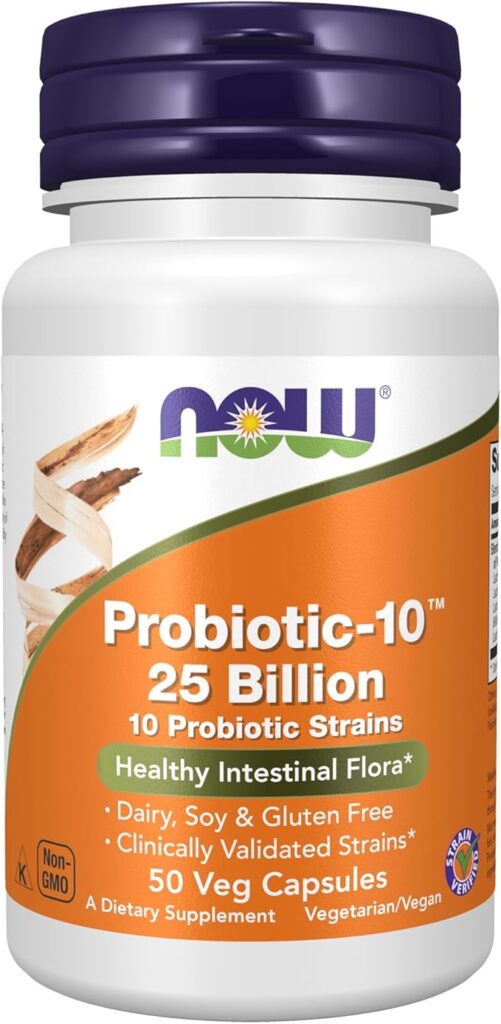
6. NOW Foods Probiotic-10
Key Ingredients & Dosage
- Lactobacillus salivarius (Ls-33): included in blend
- Total CFU: 100 billion per capsule
- Form: Vegetable capsule with FOS prebiotic
NOW lists the exact strain code (Ls-33), which is better than generic naming, but does not disclose per-strain CFU.
What Makes It Stand Out
- High total CFU for broad microbial coverage
- Named salivarius strain
- Accessible pricing and wide availability
This product is more suitable for general microbiome diversity than highly targeted salivarius-specific goals.
Safety & Side Effects
High CFU blends may cause bloating or gas during the first 7–10 days. Dose reduction can help.
Avoid use without guidance if immunocompromised.
How to Take It
- Label guidance: 1 capsule daily
- Pro tip: Start every other day if sensitive, then increase.
Pros & Cons
Pros
- High CFU
- Named salivarius strain
- Good value
Cons
- No per-strain CFU disclosure
- May feel too strong initially
Customer Feedback
Users often report noticeable digestive changes quickly, sometimes requiring dose adjustment during the first week.
7. Garden of Life Dr. Formulated Probiotics Once Daily

Key Ingredients & Dosage
- Lactobacillus salivarius: included (strain disclosed at species level)
- Total CFU: 30 billion per capsule
- Form: Vegetarian capsule with organic prebiotic fiber
This is a strain-forward blend where L. salivarius is part of a balanced Lactobacillus profile rather than the sole driver.
What Makes It Stand Out
- Uses prebiotic fibers to support colonization
- CFU guaranteed through expiration (brand-level practice)
- Designed for daily maintenance, not aggressive intervention
This works best for users seeking steady microbiome balance rather than targeted oral outcomes.
Safety & Side Effects
Generally well tolerated. Prebiotic fibers may cause mild gas in the first few days.
People with severe immune compromise should consult a clinician.
How to Take It
- Label guidance: 1 capsule daily, with or without food
- Pro tip: Consistency matters more than timing with this formula.
Pros & Cons
Pros
- Balanced daily formula
- Added prebiotic support
- Easy once-daily dosing
Cons
- No per-strain CFU for salivarius
- Less targeted for oral health
Customer Feedback
Users often mention smoother digestion and fewer stomach issues when taken consistently.
8. Garden of Life Dr. Formulated Probiotics Fitbiotic
Key Ingredients & Dosage
- Lactobacillus salivarius: included
- Total CFU: 50 billion per capsule
- Form: Vegetarian capsule with prebiotic blend
Fitbiotic is positioned for people with higher metabolic demand, but its probiotic impact depends on the full strain mix.
What Makes It Stand Out
- Higher CFU than Once Daily
- Includes L. salivarius alongside metabolically relevant strains
- Clean-label positioning
This is more suitable for active individuals wanting broader microbial diversity.
Safety & Side Effects
Higher CFU increases the chance of transient bloating during the first week.
How to Take It
- Label guidance: 1 capsule daily
- Pro tip: Start every other day if probiotic-sensitive.
Pros & Cons
Pros
- Higher CFU
- Broad strain diversity
- Suitable for active lifestyles
Cons
- Salivarius not dose-isolated
- Can feel strong initially
Customer Feedback
Many users report improved digestion during training phases, though some scale back dosing early on.
9. Garden of Life Dr. Formulated Probiotics Women’s 50 Billion

Key Ingredients & Dosage
- Lactobacillus salivarius: included
- Total CFU: 50 billion per capsule
- Form: Vegetarian capsule with organic prebiotic fiber
This formula emphasizes female microbiome balance, with salivarius contributing to the overall Lactobacillus profile.
What Makes It Stand Out
- Designed for women’s microbiome needs
- Prebiotic-supported formulation
- Once-daily simplicity
Best suited for women who want general digestive and immune balance, not targeted oral probiotic effects.
Safety & Side Effects
Generally well tolerated. Mild bloating may occur early due to fiber content.
How to Take It
- Label guidance: 1 capsule daily
- Pro tip: Take with food if GI sensitivity occurs.
Pros & Cons
Pros
- Women-focused formulation
- High CFU
- Added prebiotics
Cons
- Salivarius not highlighted
- Less targeted use-case
Customer Feedback
Users often note improved digestive comfort and fewer irregularities over time.
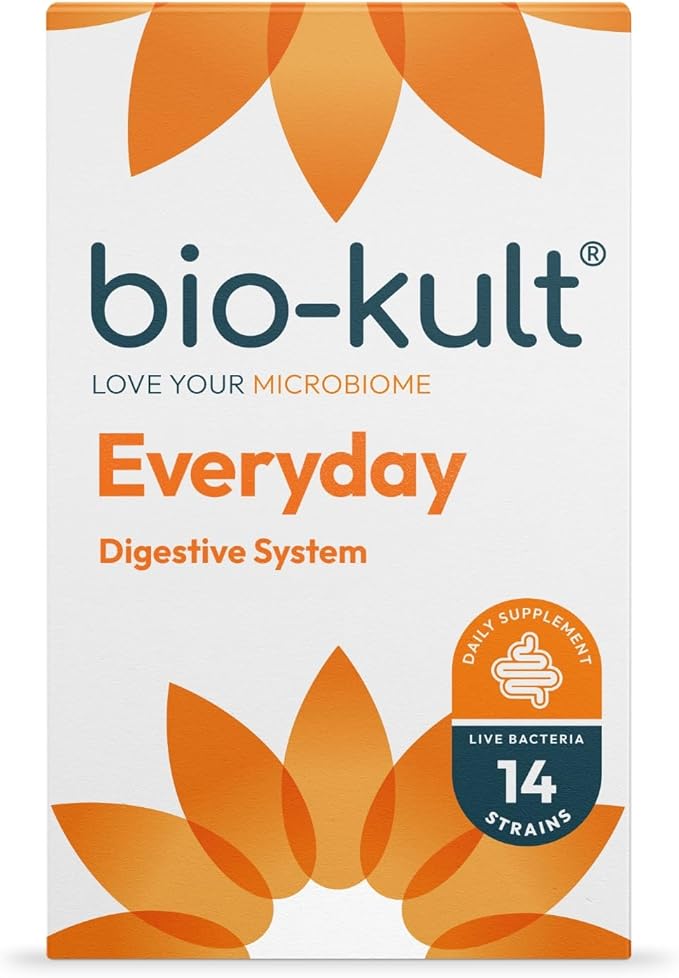
10. Bio-Kult Multi-Strain Probiotic
Key Ingredients & Dosage
- Lactobacillus salivarius PXN 57: included
- Total CFU: ≥2 billion per capsule (total, not per strain)
- Form: Capsule, shelf-stable
Bio-Kult uses a lower-CFU, shelf-stable approach, relying on strain resilience rather than raw numbers.
What Makes It Stand Out
- Shelf-stable without refrigeration
- Named L. salivarius strain
- Gentle daily use profile
This is better for maintenance and travel, not intensive microbiome shifts.
Safety & Side Effects
Low CFU reduces the risk of side effects. Well tolerated by most users.
How to Take It
- Label guidance: 1–2 capsules daily with food
- Pro tip: Suitable for long-term, low-intensity use.
Pros & Cons
Pros
- No refrigeration needed
- Gentle dosing
- Named strain
Cons
- Low CFU
- Not ideal for targeted outcomes
Customer Feedback
Users appreciate the convenience and gentle nature, especially while traveling.
Conclusion
Lactobacillus salivarius stands apart from generic probiotics because its benefits are strain-specific, dose-dependent, and goal-driven. Whether your focus is oral health, immune balance, or gentle gut support, choosing a product with clear strain disclosure, realistic CFU levels, and consistent daily use matters more than chasing inflated numbers.
When selected thoughtfully, L. salivarius supplements may help support microbial balance without overwhelming the system—making them a smart, targeted addition to an adult wellness routine.
Frequently Asked Questions
1. What makes Lactobacillus salivarius different from common probiotic strains?
Unlike broad Lactobacillus strains used mainly for digestion, Lactobacillus salivarius is especially active in the oral cavity and upper GI tract. Certain strains can adhere to oral surfaces, compete with odor-producing bacteria, and interact with local immune responses. This makes it more relevant for oral health and breath quality, rather than general bowel regulation.
2. Does Lactobacillus salivarius work on its own, or does it need other strains?
It can work on its own for targeted goals, especially oral health. However, for gut-wide microbiome balance, it performs better alongside complementary strains like Lactobacillus acidophilus or Bifidobacterium species. That’s why some blends are more effective for digestion, while single-strain products suit focused use.
3. Can Lactobacillus salivarius help with gum inflammation?
Based on available human and in-vitro data, certain strains may help modulate local inflammatory responses in the gums by influencing bacterial balance. This does not replace dental care, but consistent use may support gum comfort and microbial balance over time.
4. Why do some Lactobacillus salivarius supplements list low CFU numbers?
Because effectiveness is strain- and location-dependent, not purely dose-dependent. For oral applications, lower CFU taken consistently can be effective, especially if the strain adheres well to oral tissues. Higher CFU is not always necessary and may increase side effects without added benefit.
5. Is Lactobacillus salivarius suitable for people with sensitive digestion?
Often, yes. Many users who react poorly to high-CFU gut probiotics tolerate salivarius-focused formulas better, particularly at lower doses. Starting with a moderate CFU and increasing slowly is the safest approach for sensitive individuals.
6. Can Lactobacillus salivarius affect sleep or mood?
Indirectly, it may. By influencing oral and gut microbiota, salivarius can affect inflammatory signaling and gut-brain communication. However, it is not a primary sleep or mood probiotic, and any such effects are secondary and individual-dependent.
7. Should Lactobacillus salivarius be taken in the morning or at night?
There’s no strict rule. Morning dosing works well for digestion-focused use, while evening dosing may be preferred for oral health routines. Consistency matters more than timing, especially with probiotics.
8. Can I take Lactobacillus salivarius while fasting?
Yes. Probiotics generally do not break a fast calorically. However, some people experience less stomach discomfort when taken with food, so personal tolerance should guide timing.
9. How do I know if a Lactobacillus salivarius supplement is actually effective?
Signs vary by goal. For oral health, users may notice improved breath freshness or gum comfort within a few weeks. For gut support, changes are usually subtler—such as improved tolerance to foods or steadier digestion. Lack of change after 4–6 weeks may indicate the strain or format isn’t a good fit.
10. Can Lactobacillus salivarius replace regular dental hygiene or gut treatments?
No. It is a supportive tool, not a replacement for brushing, flossing, dental care, or medical treatment. Its role is to support microbial balance, not to cure infections or disease.