
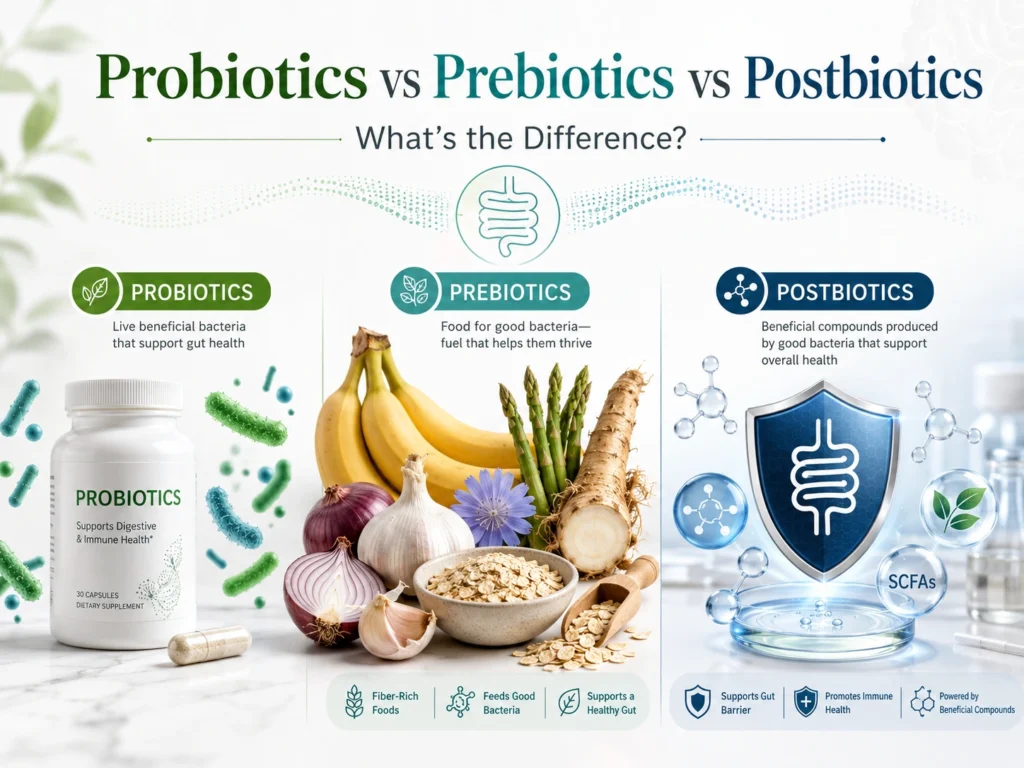
Probiotics, prebiotics, and postbiotics are all connected to gut health, but they are not the same thing.
Probiotics are live beneficial microorganisms.
Prebiotics are substances, usually certain fibers, that feed beneficial microbes.
Postbiotics are preparations made from inanimate microorganisms and/or their components that may provide a health benefit.
The easiest way to remember it:
Probiotics = the helpful microbes
Prebiotics = food for helpful microbes
Postbiotics = beneficial microbial byproducts or inactivated microbial preparations
That sounds simple, but here is where most people get confused: not every yogurt is a true probiotic, not every fiber is a prebiotic, and not every “gut health” supplement has meaningful human evidence.
So before buying the next expensive gut health capsule, it helps to understand what these three terms actually mean.
What Are Probiotics?
Probiotics are defined as live microorganisms that, when taken in adequate amounts, provide a health benefit to the host. The NIH Office of Dietary Supplements uses this definition and notes that probiotics are mainly bacteria, although some yeasts are also used. Probiotics may be found in certain fermented foods, added to foods, or sold as dietary supplements.
In plain English, probiotics are the “live good bugs” people usually think of when they hear the phrase gut health supplement.
Common probiotic organisms include:
- Lactobacillus-related species
- Bifidobacterium species
- Saccharomyces boulardii
- Bacillus species
- Streptococcus thermophilus
But here is the important part: probiotics are not just about the species name. They are often strain-specific. NIH explains that probiotics are identified by genus, species, and strain designation, and that clinical recommendations need to be strain-specific because different strains may behave differently.
That means a product labeled “Lactobacillus probiotic” is not automatically the same as another product labeled “Lactobacillus probiotic.” The strain, dose, and purpose matter.
What Are Prebiotics?
Prebiotics are not bacteria. They are substances that beneficial microbes can use.
The International Scientific Association for Probiotics and Prebiotics defines a prebiotic as a substrate that is selectively utilized by host microorganisms and confers a health benefit. The same consensus statement explains that a substance must have documented health benefits to properly be considered a prebiotic.
In simpler words, prebiotics are like fertilizer for certain helpful microbes already living in or on your body.
Most prebiotics are types of carbohydrates or fibers, although research has expanded beyond the old idea that prebiotics must only be carbohydrates. Common examples include:
- Inulin
- Fructooligosaccharides, or FOS
- Galactooligosaccharides, or GOS
- Lactulose
- Resistant starch
The World Gastroenterology Organisation lists inulin, FOS, GOS, and lactulose among commonly known prebiotics. It also notes that other substances, such as resistant starch and polyphenols, are being studied as candidate prebiotics.
You can get prebiotic-type fibers from foods such as onions, garlic, leeks, asparagus, bananas, oats, legumes, and some whole grains. Supplements may use ingredients like inulin, acacia fiber, partially hydrolyzed guar gum, resistant starch, or GOS.
What Are Postbiotics?
Postbiotics are newer in the gut health conversation, and the term is often misunderstood.
The ISAPP consensus definition describes a postbiotic as a preparation of inanimate microorganisms and/or their components that confers a health benefit on the host. The panel also clarified that postbiotics are deliberately inactivated microbial cells, with or without metabolites or cell components, and that their health benefits should be confirmed in the target host.
The key word is inanimate. Postbiotics are not live like probiotics.
A postbiotic may include:
- Inactivated microbial cells
- Cell wall fragments
- Microbial components
- Certain preparations that include metabolites
- Heat-treated or otherwise inactivated microbial preparations
However, purified microbial metabolites alone and vaccines are not considered postbiotics under the ISAPP definition.
This matters because many brands use the word postbiotic loosely. A product should not be called a postbiotic just because it sounds modern. It should have a defined microbial preparation and evidence showing a benefit.
Best Lactobacillus Reuteri Supplements
Probiotics vs Prebiotics vs Postbiotics: Simple Comparison
| Feature | Probiotics | Prebiotics | Postbiotics |
|---|---|---|---|
| What they are | Live beneficial microorganisms | Substances used by beneficial microbes | Inanimate microbial preparations or components |
| Are they alive? | Yes | No | No |
| Main role | Add or deliver helpful microbes | Feed selected beneficial microbes | Provide benefits from non-living microbial preparations |
| Common examples | Lactobacillus, Bifidobacterium, Saccharomyces boulardii | Inulin, FOS, GOS, resistant starch | Heat-treated microbial cells or microbial components |
| Found in foods? | Some yogurts and fermented foods may contain live microbes | Many high-fiber plant foods | Some fermented or processed products may contain postbiotic-like components |
| Supplement form | Capsules, powders, liquids, gummies | Fiber powders, capsules, synbiotic blends | Capsules, powders, functional foods |
| Biggest buying mistake | Choosing only by CFU count | Taking too much too fast and getting gas | Assuming every “postbiotic” has strong evidence |
The Best Analogy: Garden, Fertilizer, and Compost
Think of your gut like a garden.
Probiotics are like adding selected helpful plants to the garden.
Prebiotics are like feeding the soil so helpful plants can grow better.
Postbiotics are like useful compounds left behind from microbial activity.
This analogy is not perfect, but it helps explain the basic difference.
A probiotic supplement tries to introduce specific live organisms.
A prebiotic tries to support organisms that are already there.
A postbiotic tries to deliver non-living microbial preparations that may still interact with the body in useful ways.
Are Fermented Foods the Same as Probiotics?
Not always.
This is one of the biggest myths in gut health.
Some fermented foods contain live cultures, but not all fermented foods contain proven probiotic microorganisms. NIH explains that some fermented foods, such as sourdough bread and many commercial pickles, are processed after fermentation and do not contain live cultures when consumed. NIH also notes that foods like kimchi, kombucha, sauerkraut, miso, many cheeses, pickles, and raw unfiltered apple cider vinegar may contain live cultures but do not typically contain proven probiotic microorganisms.
So the honest answer is:
Fermented food can be good food. But fermented food is not automatically a probiotic.
For a food or supplement to be considered a probiotic, the live microorganism should be identified and shown to provide a health benefit in adequate amounts.
Which One Is Better: Probiotic, Prebiotic, or Postbiotic?
There is no universal winner.
It depends on the person, the symptom, the product, and the evidence behind the ingredient or strain.
Choose a probiotic when:
A probiotic may make sense when you want a targeted live strain for a specific purpose, such as digestive support after antibiotics, occasional irregularity, or bloating support. The World Gastroenterology Organisation notes that probiotic effects are strain-specific and dose-specific, and that benefits should be linked to specific strains or strain combinations at effective doses.
This is why a good probiotic article or review should not just say, “This has 50 billion CFU.” It should ask:
- Which strains are included?
- Is the dose listed through expiration?
- Is there human evidence for the target use?
- Is it single-strain or multi-strain?
- Does it need refrigeration?
- Is the brand transparent about strain names?
Choose a prebiotic when:
A prebiotic may be useful when your goal is to support your existing gut microbes through diet or fiber intake.
Prebiotics can be especially attractive for people who want a food-first approach. But they can also cause gas or bloating, especially if someone starts with a large amount too quickly. This does not always mean prebiotics are “bad.” It often means the dose, type, or timing needs adjustment.
For sensitive stomachs, some people may tolerate certain prebiotic fibers better than others. This is where comparison articles like inulin vs acacia fiber, PHGG vs psyllium husk, and low-FODMAP prebiotics can become very useful.
Choose a postbiotic when:
A postbiotic may be interesting for people who want a non-living microbial preparation. Since postbiotics do not need to be alive, they may offer formulation and shelf-stability advantages. However, the benefit still needs to be shown for the specific postbiotic preparation.
That is the key point: postbiotic does not automatically mean better than probiotic.
It means different.
What About Synbiotics?
A synbiotic combines live microorganisms with a substrate used by host microorganisms.
ISAPP defines synbiotics as a mixture comprising live microorganisms and substrate(s) selectively utilized by host microorganisms that confers a health benefit on the host.
In practical supplement language, a synbiotic often means:
Probiotic + prebiotic in the same product
But again, quality matters. A good synbiotic should not just sprinkle in a tiny amount of fiber for label appeal. The formula should make sense.
There are two broad possibilities:
- Complementary synbiotic: the probiotic and prebiotic each have their own evidence.
- Synergistic synbiotic: the prebiotic is specifically chosen to support the included probiotic strain.
For readers, the simple buying rule is this:
Do not buy a synbiotic only because the label looks more complete. Buy it because the strains, dose, and prebiotic ingredient make sense for your goal.
How to Choose a Probiotic Supplement
When comparing probiotics, do not judge by CFU alone.
NIH explains that CFU means colony-forming units, or the number of viable cells. Many supplements contain 1 to 10 billion CFU per dose, while some contain 50 billion CFU or more. However, higher CFU counts are not necessarily more effective than lower CFU counts. NIH also advises looking for CFU at the end of shelf life, not just at the time of manufacture.
Look for:
- Full strain names, not just broad species names
- CFU listed through expiration or use-by date
- Clear serving size
- Storage instructions
- Third-party testing when available
- No exaggerated disease-cure claims
- Evidence for your specific goal
A probiotic with fewer CFU but better strain transparency may be more trustworthy than a mega-dose product with vague labeling.
How to Choose a Prebiotic Supplement
For prebiotics, the question is not “How many billions?” because prebiotics are not live microbes.
Instead, look at:
- The type of prebiotic fiber
- The dose per serving
- Whether it is likely to cause gas or bloating
- Whether it fits your diet pattern
- Whether you are sensitive to FODMAPs
- Whether it mixes well if it is a powder
Common supplement ingredients include inulin, FOS, GOS, acacia fiber, resistant starch, and partially hydrolyzed guar gum.
A beginner-friendly approach is to start low and increase slowly, especially if you already experience bloating.
How to Choose a Postbiotic Supplement
Postbiotic labels can be tricky because this is a newer category for consumers.
Look for:
- The microbial source
- Whether the organism is inactivated
- The amount per serving
- The specific claimed benefit
- Human evidence for that exact preparation
- Transparent labeling rather than vague “gut health complex” language
A postbiotic is not automatically more advanced just because it sounds scientific. The product still needs evidence.
Can You Take Probiotics and Prebiotics Together?
Yes, many people take them together, and many products are designed as synbiotics.
But more is not always better.
If you already have bloating, gas, IBS-like symptoms, or a sensitive stomach, adding a high-dose probiotic and a large dose of prebiotic fiber at the same time may make it difficult to know what is helping or irritating you.
A practical approach is:
Start with one change first.
Give your body time to adjust.
Then add the second if needed.
For example, someone may begin with a gentle prebiotic fiber from food, then consider a strain-specific probiotic later. Another person may use a probiotic after antibiotics and add prebiotic foods once their digestion feels steadier.
Are Probiotics, Prebiotics, and Postbiotics Safe?
For generally healthy people, common probiotics are unlikely to cause harm, and side effects are usually minor, such as gas. However, NIH notes that probiotics have been linked to rare cases of serious infections, mostly in people who were severely ill or immunocompromised. NIH also notes that the World Gastroenterology Organisation advises restricting probiotic use in people with compromised immune function or serious underlying disease to strains and indications with proven efficacy.
Prebiotics are usually food-like fibers, but they may cause bloating, gas, abdominal discomfort, or stool changes, especially when started too aggressively.
Postbiotics are not live microbes, but that does not mean every product is automatically safe for every person. The safety and benefit still depend on the specific preparation and intended use.
Speak with a healthcare professional before using these products if you are pregnant, immunocompromised, severely ill, using a central venous catheter, buying for a premature infant, or managing a significant medical condition.
Doctor’s Note
The gut health market often makes everything sound simple: take a capsule, fix your microbiome, feel better.
Real biology is not that simple.
A better way to think is:
Do not buy “a probiotic.” Buy a strain for a reason.
Do not take “fiber” randomly. Choose a prebiotic your gut can tolerate.
Do not assume “postbiotic” means superior. Ask what exact preparation was studied.
Gut health is not just supplements. It also includes diet quality, sleep, stress, physical activity, medications, illness history, and the baseline state of your microbiome.
A supplement can be useful, but it should not be treated like a magic reset button.
Probiotics vs Prebiotics vs Postbiotics: Which Should You Try First?
For most healthy adults, the best starting point is usually food.
Start with a gut-friendly diet pattern that includes:
- Yogurt or kefir with live cultures, if tolerated
- Beans or lentils
- Oats
- Vegetables
- Fruits
- Nuts and seeds
- Fermented foods you enjoy
- Enough total fiber across the day
Then think about supplements based on your goal.
For occasional bloating
A targeted probiotic or a gentler prebiotic may help some people, but the wrong fiber can worsen gas. Start carefully.
For constipation support
Prebiotic fibers may help some people, but hydration and overall fiber intake matter. Some probiotic strains are also studied for regularity.
After antibiotics
A strain-specific probiotic may be worth discussing with a healthcare professional, especially for people prone to antibiotic-associated diarrhea. WGO notes that a 2017 meta-analysis found moderate-certainty evidence for probiotics in preventing C. difficile-associated diarrhea in patients receiving antibiotics, while also emphasizing safety in people who are not immunocompromised or severely debilitated.
For general gut health
A food-first approach plus consistent fiber intake is a sensible foundation. A supplement can be added later if there is a specific reason.
Common Myths
Myth 1: More CFU always means better
Not true. Higher CFU counts are not necessarily more effective than lower counts. Strain, dose, shelf-life viability, and evidence matter more than a giant number on the front label.
Myth 2: All fermented foods are probiotics
Not true. Some fermented foods contain live microbes, but that does not automatically mean they contain proven probiotic strains in adequate amounts.
Myth 3: Prebiotics are just probiotics in food form
No. Prebiotics are not microbes. They are substances used by beneficial microbes.
Myth 4: Postbiotics are dead probiotics, so they are useless
Not accurate. Postbiotics are non-living microbial preparations, but they may still have biological effects if the specific preparation has evidence.
Myth 5: Everyone needs a probiotic supplement
There are no formal recommendations for or against probiotic use in healthy people, according to NIH. Some expert groups provide guidance for specific probiotic strains in certain health conditions, but that is different from saying every healthy person needs a probiotic.
FAQ
What is the main difference between probiotics and prebiotics?
Probiotics are live beneficial microorganisms. Prebiotics are substances that feed or support selected beneficial microorganisms.
Are postbiotics better than probiotics?
Not necessarily. Postbiotics are different, not automatically better. A good postbiotic should have evidence for the exact preparation and intended benefit.
Can I take probiotics and prebiotics every day?
Many people consume probiotic foods and prebiotic fibers regularly, but supplement use depends on the person, product, and goal. People with serious illness or immune compromise should speak with a healthcare professional first.
Do probiotics permanently colonize your gut?
Not usually in a simple “move in forever” way. NIH notes that probiotics may transiently colonize the gut in highly individualized patterns depending on baseline microbiota, strain, and gut region.
Are prebiotics good for bloating?
They can be helpful for some people, but they can also worsen gas or bloating if the type or dose is not tolerated. Starting low is usually smarter than starting with a large serving.
Is yogurt a probiotic?
Some yogurts may contain live cultures and may also include probiotic strains, but yogurt is not automatically a probiotic unless the microorganisms are present in adequate amounts and shown to provide a health benefit.
What is a synbiotic?
A synbiotic is a mixture of live microorganisms and substrates used by host microorganisms that confers a health benefit. In supplement terms, it often means probiotic plus prebiotic, but the formula still needs to make scientific sense.
What should I look for on a probiotic label?
Look for strain names, CFU through expiration, storage instructions, dose, and a realistic benefit claim. Avoid products that rely only on huge CFU numbers without strain transparency.
Final Verdict
Probiotics, prebiotics, and postbiotics all belong to the gut health conversation, but they work in different ways.
Probiotics add live microorganisms.
Prebiotics feed selected beneficial microbes.
Postbiotics provide non-living microbial preparations or components that may offer benefits.
For most readers, the smartest path is not chasing the trendiest label. It is matching the right tool to the right goal.
If your diet is low in fiber, prebiotic foods may be the best starting point. If you are looking for targeted support after antibiotics or for a specific digestive issue, a strain-specific probiotic may make more sense. If you want a shelf-stable non-living microbial product, a postbiotic may be worth considering, but only when the product is clearly defined and supported by evidence.
Gut health is not about collecting every “biotic” on the shelf.
It is about choosing what your body actually needs.