

Medically reviewed by Dr. A.S.M. Masum Billah, MBBS

Picking a probiotic can feel overwhelming. Most blends look the same, and many don’t deliver much beyond fancy labels. Lactobacillus reuteri is different. Backed by studies, certain strains like DSM 17938 and ATCC PTA 6475 have been linked to better digestion, stronger immunity, and even oral health benefits.
The challenge? Not every supplement uses the right strain or the right dose. That’s why I’ve rounded up the 10 best L. reuteri supplements—to help you skip the guesswork and find one that actually works.
Best Akkermansia Supplements for gut health
What is Lactobacillus reuteri?
Lactobacillus reuteri (now technically called Limosilactobacillus reuteri) is a type of probiotic bacteria—the “good” microbes that naturally live in your gut, mouth, skin, and even breast milk. It’s one of the earliest bacteria passed from mother to child, which shows how important it is for human health.
Unlike many probiotics that only hang out in the intestines, L. reuteri has been studied for a wide range of benefits:
- Digestive balance – helps restore healthy gut flora and may ease bloating or irregular bowel movements.
- Immune support – produces antimicrobial compounds like reuterin that can suppress harmful bacteria, keeping your gut defenses strong.
- Oral health – certain strains can reduce gum inflammation and plaque.
- Metabolic effects – some research suggests links to blood sugar regulation and cholesterol.
- Gut-brain connection – early studies show potential influence on mood and skin health.
The Science Behind the Strains
Here’s where things get interesting. When you look at labels, you’ll often see codes like:
- DSM 17938 – the strain with the most clinical data for digestive comfort, diarrhea prevention, and colic in infants.
- ATCC PTA 6475 – studied for bone density and inflammation.
- SD-5865 – explored for both digestive and immune outcomes.
- LR08 & others – newer players with promising but limited data.
Those codes aren’t random—they’re strain IDs. Without them, you’re basically guessing what you’re taking. If a label only says “Lactobacillus reuteri” without a code? That’s like buying a car that just says “sedan” without telling you the make or model.
Why CFU Counts Matter (But Aren’t Everything)
CFU stands for Colony Forming Units, which is just science-speak for “how many live bacteria you’re swallowing.”
- 3–10 billion CFU/day: Often used in clinical trials. Enough for gut or oral health benefits.
- 20–50 billion CFU/day: High-strength options for those who want extra punch.
- 100 billion CFU/day: Mega-doses usually found in powders. Impressive, but not always necessary.
Here’s the catch: higher CFU doesn’t automatically mean better. Survivability, delivery system, and strain type often matter more than the raw number.
Delivery Systems: Why Form Matters
Different delivery forms change how effective the bacteria are once they hit your digestive tract.
- Delayed-release capsules: Protect bacteria from stomach acid—great for gut health.
- Lozenges/chewables: Release bacteria directly in the mouth—ideal for gum and oral support.
- Powders: Flexible dosing, often higher CFUs, but require more effort to take.
- Liquid drops (for infants): Clinically tested for colic and safe for babies under medical guidance.
Choosing the right form is half the battle. If your goal is gum health, capsules won’t cut it—you’ll want lozenges.
Benefits You Can Expect (Backed by Research)
- Digestive Balance
Studies show DSM 17938 may help with diarrhea, abdominal discomfort, and overall microbiome stability. - Immune Support
Since most of your immune system lives in the gut, L. reuteri plays a training role for immune cells, supporting resilience. - Oral & Dental Health
Lozenges with L. reuteri have been shown to reduce plaque buildup and gingival bleeding in clinical trials. - Bone & Inflammation Links
ATCC PTA 6475 has shown potential for slowing bone density loss in postmenopausal women—though studies are mixed. - Infant Colic Relief
DSM 17938 is one of the few probiotics tested in infants, helping reduce daily crying time in colicky babies.
Who Benefits Most from L. reuteri?
- Adults with bloating or irregular digestion who haven’t had luck with generic probiotics.
- People dealing with gum inflammation who want something beyond toothpaste.
- Women 50+ curious about bone support (with realistic expectations).
- Parents exploring pediatric probiotics for colic, under pediatrician guidance.
- Health enthusiasts building a targeted probiotic stack instead of a generic blend.
How to Choose the Best Lactobacillus reuteri Supplement
Shopping for probiotics can feel like walking into a vitamin aisle with blindfolds on. Every bottle screams “gut health!”but the truth is, not all L. reuteri supplements are created equal. Here’s how to separate the winners from the wasted dollars:
1. Look for Strain IDs
Don’t settle for labels that just say “L. reuteri.” The real deal has strain codes like DSM 17938, ATCC PTA 6475, or SD-5865. Those numbers mean the strain has been studied in humans. Without them, you’re buying mystery bugs.
2. Check the CFU Count
CFU = Colony Forming Units, aka the number of live bacteria in each serving.
- 3–10 billion CFU → often matches clinical trial dosages.
- 20–50 billion CFU → high-strength options for those who want more punch.
- 100 billion CFU+ → mega-dose powders, usually for advanced users.
Bigger isn’t always better, but you don’t want a probiotic so weak it might as well be chalk dust.
3. Delivery System is Everything
Gut bacteria are delicate—most won’t survive a direct splash of stomach acid. That’s why form matters:
- Delayed-release capsules = better survival into the intestines.
- Lozenges/chewables = great for oral health (since they release in the mouth).
- Powders = high-dose, flexible, but not as convenient.
- Infant drops = gentle, clinically tested for babies.
4. Prebiotic Pairings
Some brands add prebiotics like inulin, FOS, or XOS. These act as “food” for your probiotics, helping them stick around longer. Synbiotic formulas (probiotic + prebiotic) can give you better results than probiotics alone.
5. Clean Labels & Testing
Look for:
- Third-party testing → confirms the CFU count is real.
- Non-GMO, allergen-free → especially if you’re sensitive.
- No unnecessary fillers → your gut doesn’t need artificial colors or corn syrup.
6. Value for Money
CFU counts, serving size, and bottle size all matter. A $40 probiotic with only 20 servings is very different from a $30 one that lasts 2 months. Always calculate cost per serving.
💡 Pro tip: Match your supplement to your goal.
- Digestive balance? Go with DSM 17938 capsules.
- Oral health? Lozenges with L. reuteri.
- Bone or immune support? ATCC PTA 6475 strains.
- Beginner-friendly? Stay in the 3–10B CFU range before leveling up.
Top 10 Best Lactobacillus reuteri Supplements for Gut
1. Peak Performance Lactobacillus Reuteri Probiotic

If you’ve ever taken a probiotic and thought, “Did anything even happen?”, this one might change your mind. Peak Performance loads each capsule with 50 billion CFU of Lactobacillus reuteri, which is several times higher than what you’ll usually see. Big numbers don’t always mean better, but in probiotics, it can mean more of those little guys actually survive the trip through your stomach.
What really caught my eye is the addition of PreticX® XOS prebiotic fiber. Think of it as fertilizer for the friendly bacteria—it helps them settle in and multiply instead of passing through like tourists. UCLA studies have shown XOS can help boost levels of beneficial bifidobacteria, which is a solid bonus.
The capsule itself is delayed-release, so it waits until it’s safely past stomach acid before breaking down. And with 60 servings per bottle, you’re set for two months.
Pros
- Massive 50B CFU per capsule
- Includes a clinically studied prebiotic
- Vegan, allergen-friendly formula
- Two-month supply
Cons
- CFU count may feel too heavy for probiotic beginners
- Requires refrigeration for best results
2. Toniiq Lactobacillus Reuteri Probiotic
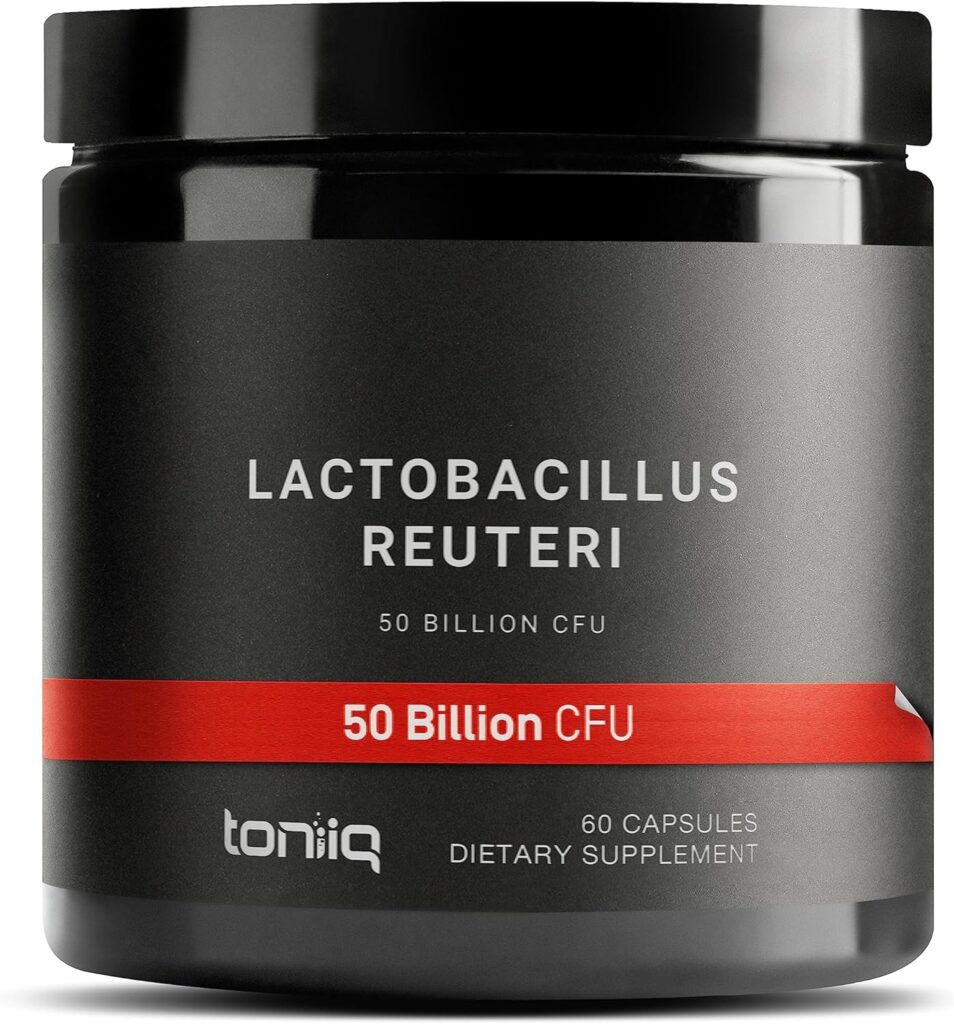
Toniiq is a brand that’s built a reputation for pushing out high-potency supplements, and their Lactobacillus reuteriprobiotic is no exception. Each capsule brings in 50 billion CFU of L. reuteri, putting it right up there with the strongest doses you’ll find on the market.
Instead of tossing in a generic blend, Toniiq keeps things focused: you’re getting L. reuteri paired with fructooligosaccharides (FOS), a light prebiotic powder. It’s a simple but effective combo—probiotic plus prebiotic—that helps the bacteria thrive once it lands in your gut.
I also like that Toniiq emphasizes purity and third-party testing. You’re not just trusting the label; the batch is verified for quality and potency, which matters a lot with probiotics since CFU counts can be tricky.
Pros
- 50B CFU per serving for serious potency
- Includes prebiotic support (FOS)
- Third-party tested for quality and purity
- Vegan-friendly
Cons
- High strength may be overkill if you’re new to probiotics
- Doesn’t list the exact strain (like DSM 17938), which would give it more credibility
3. Vitamatic Lactobacillus Reuteri Complex
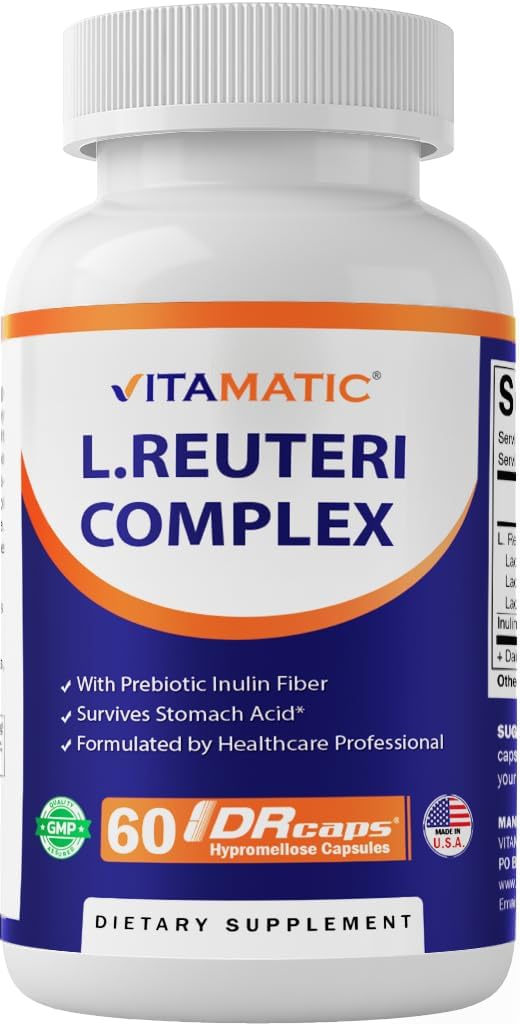
Vitamatic takes a slightly more balanced route with their L. reuteri complex. Instead of hitting you with 50 billion CFU like some of the mega-dosed options, this one gives you 22 billion CFU per capsule—still strong, but less likely to overwhelm if you’re just starting probiotics.
They also pair it with inulin fiber, a classic prebiotic that feeds the good bacteria already living in your gut. This combo helps with smoother digestion and may support regularity without the “too much, too fast” effect some high-dose probiotics can bring.
Pros
- 22B CFU—potent but not overwhelming
- Includes inulin fiber for prebiotic support
- Delayed-release capsules for better survival
- Solid choice for beginners or sensitive stomachs
Cons
- Doesn’t specify which L. reuteri strain is inside
- May be too mild for people who’ve already tried stronger probiotics
4. Supersmart Lactobacillus Reuteri
Supersmart has kept things simple: 5 billion CFU of L. reuteri per capsule, in a delayed-release format. On paper, that looks light compared to the 20B+ and 50B+ giants out there—but here’s the kicker: many clinical studies actually use doses in this range. So while the label isn’t flashy, the science says it may be more than enough for gut and oral health support.
It’s non-GMO, gluten-free, and vegan, which makes it an easy fit for most diets. If you’re after a probiotic that’s closer to clinical study levels and doesn’t overload your system, this one makes sense.
Pros
- 5B CFU aligns with clinical trial doses
- Delayed-release capsule protects bacteria
- Non-GMO, gluten-free, vegan
- Great for users who want a lighter daily probiotic
Cons
- Much lower CFU than competitors (some may prefer higher doses)
- No added prebiotic support
5. Swanson L. Reuteri Probiotic Plus
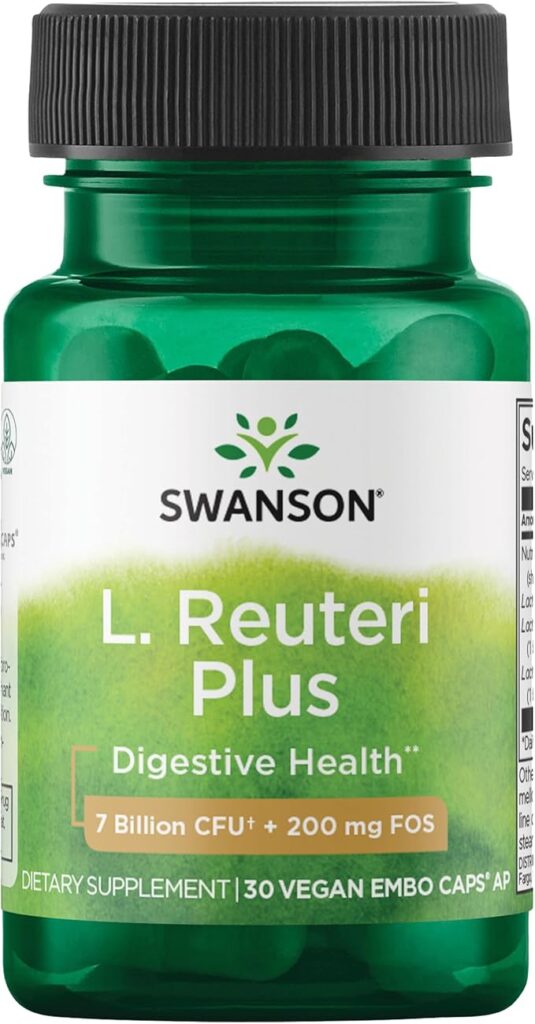
Swanson decided to go for a team effort here. Instead of just L. reuteri, each capsule brings together L. reuteri, L. rhamnosus, L. acidophilus, and FOS prebiotic fiber—adding up to 7 billion CFU per capsule.
That blend makes it more of a general digestive probiotic, with L. reuteri still playing a starring role. If you want something that covers more bases—gut balance, immune support, and regularity—this “combo approach” is appealing.
Pros
- 7B CFU from a trio of well-known probiotics
- Includes FOS prebiotic for better colonization
- Small veggie capsules—easy to take
- Good for all-around digestive support
Cons
- Lower CFU compared to 20B–50B formulas
- Not a pure L. reuteri supplement (some may prefer single strain)
6. Florida Herbal Pharmacy Lactobacillus Reuteri
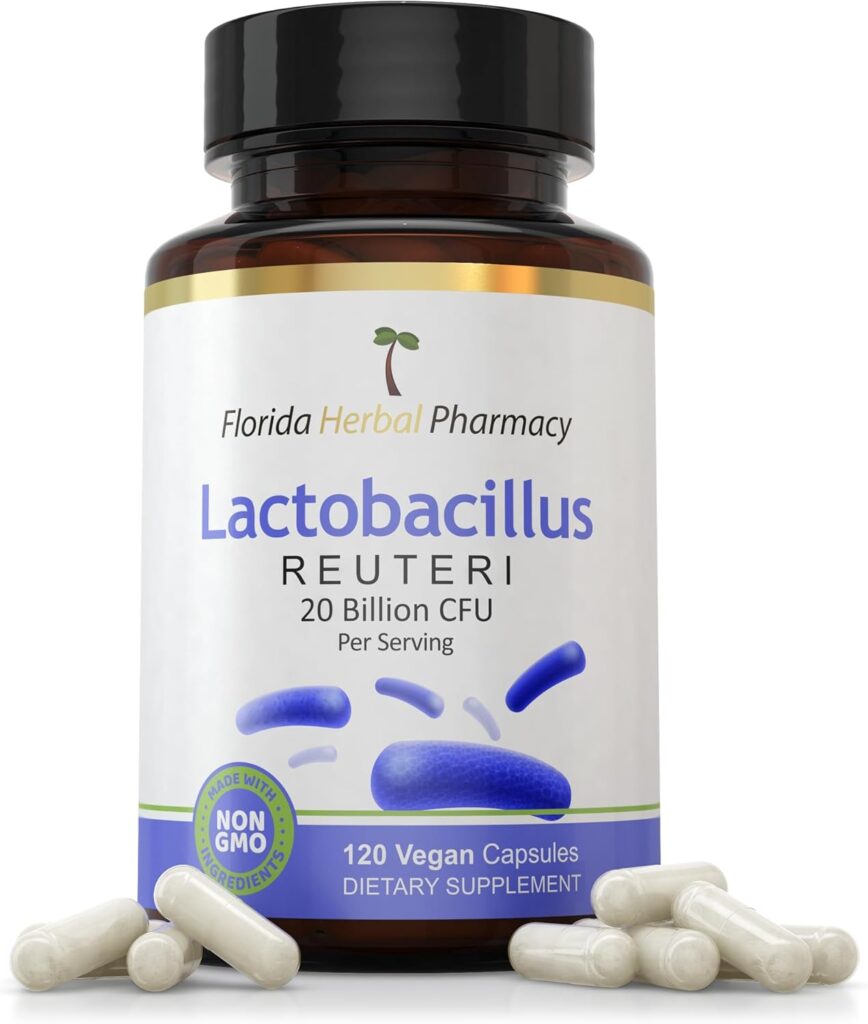
Florida Herbal Pharmacy didn’t hold back—they’ve packed 20 billion CFU of L. reuteri into a daily serving. Each capsule carries 500 mg, and the brand recommends 1–2 capsules per day, which gives you flexibility depending on how your gut handles probiotics.
It’s positioned as a high-potency probiotic without any extra bells and whistles. No prebiotics, no blend of strains—just straight L. reuteri. That makes it appealing if you want a clean, single-focus supplement with a solid CFU count.
Pros
- 20B CFU per serving, potent enough for noticeable results
- Pure L. reuteri focus without extras
- Flexible dosing (1–2 capsules)
- GMO-free, clean capsule
Cons
- No prebiotic support
- Doesn’t highlight a specific clinical strain
7. Foods For Gut Lactobacillus Reuteri SD-5865 Powder
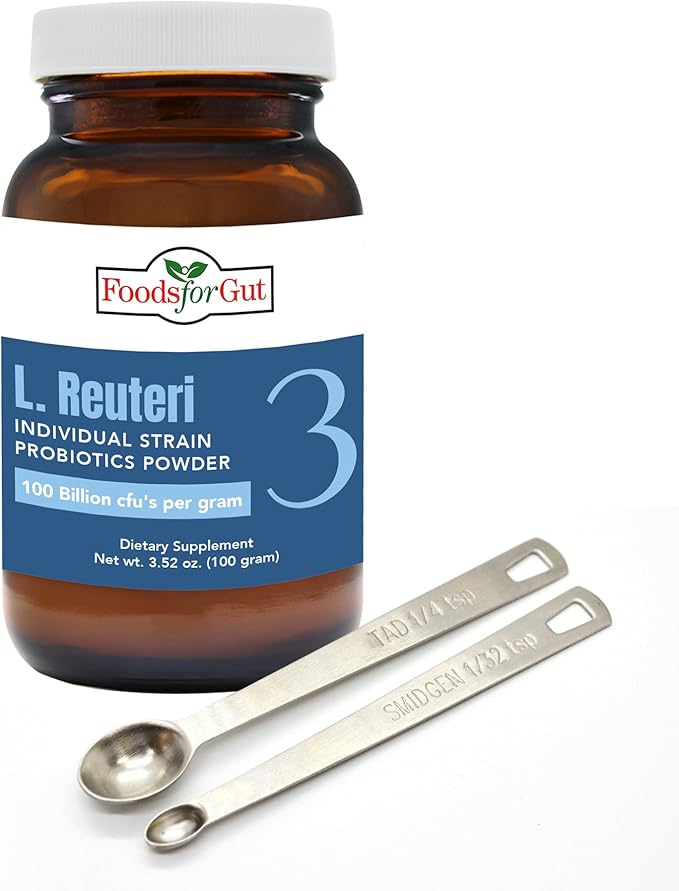
Now this one is for the serious probiotic enthusiasts. Foods For Gut offers a 100 billion CFU probiotic powder, specifically L. reuteri SD-5865. That’s a huge number, and the powder format lets you scoop and mix it into water, smoothies, or soft foods.
The advantage here? You’re not locked into capsule doses—you can adjust the serving depending on your tolerance and goals. It’s made in the USA, non-flavored, and geared toward those who want maximum potency for digestive and immune support.
Pros
- Massive 100B CFU per serving
- Pure L. reuteri SD-5865 strain
- Powder format allows flexible dosing
- Made in the USA
Cons
- Pricey compared to capsule options
- Powder form may not suit those who prefer easy capsules
8. BLIVA Nutrition Lactobacillus Reuteri
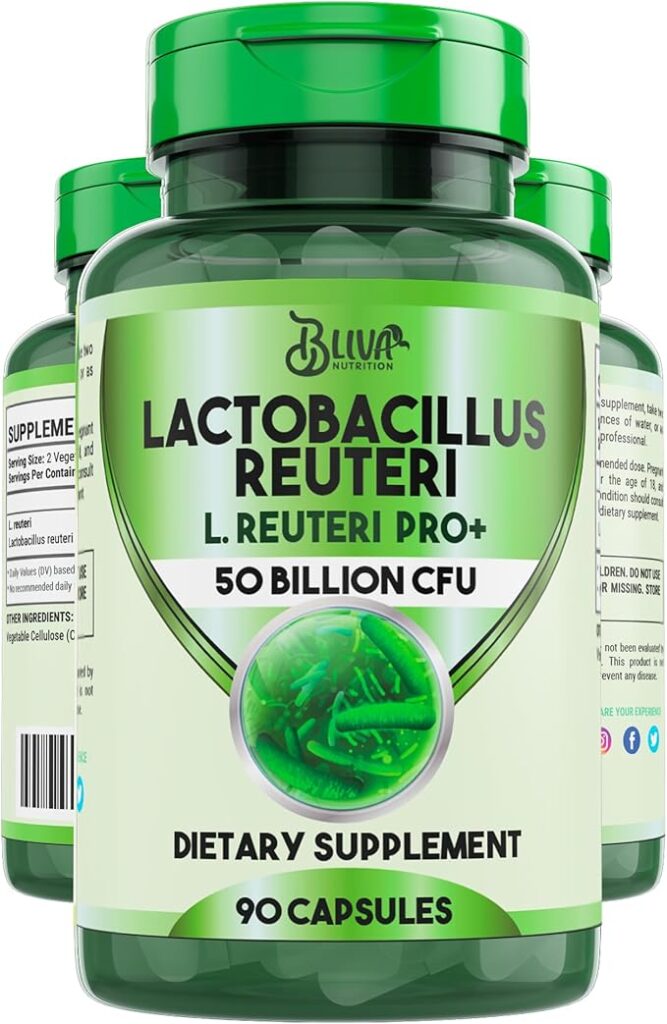
BLIVA Nutrition goes all-in on potency. Each serving of two capsules delivers a whopping 50 billion CFU of L. reuteri, making it one of the heaviest hitters on this list. With 90 capsules per bottle, you’re looking at a solid 45-day supply if you follow their recommended dosage.
This formula is aimed at both men and women who want serious support for gut balance, immune strength, and overall wellness. It’s straight to the point: high CFU, clean capsule, no gimmicks. For those who’ve tried lighter probiotics and didn’t notice much, BLIVA’s ultra-concentrated approach could be the step up.
Pros
- Massive 50B CFU per serving
- 45-day supply per bottle
- Focused formula built around L. reuteri
- Marketed for both men and women
Cons
- High-dose strength may be too much for probiotic newcomers
- Doesn’t specify exact strain IDs, which would add more scientific credibility
9. Natural Foundation Supplements Lactobacillus Reuteri Probiotic – 240 Tablets

This is the kind of bottle that says, “I’m here for the long haul.” With 240 tablets, you’ve basically got a multi-month supply ready to roll. Each tablet gives you 3 billion CFU of L. reuteri—a modest dose compared to the 20B+ or 50B+ giants, but don’t let the smaller number fool you. Many clinical trials actually hover around this range, which makes it a perfectly reasonable daily support option.
It’s a no-frills formula: just L. reuteri for gut and digestive health, no added prebiotics or multi-strain blends. That simplicity can be a good thing if you’re after a focused probiotic without extras.
Pros
- 240 tablets (lasts months without reordering)
- 3B CFU per serving—steady, research-friendly dosage
- Straightforward, single-strain support
- Budget-friendly for long-term use
Cons
- Lacks detailed strain information
- No prebiotic pairing or advanced delivery system
10. BioGaia Gastrus Probiotic
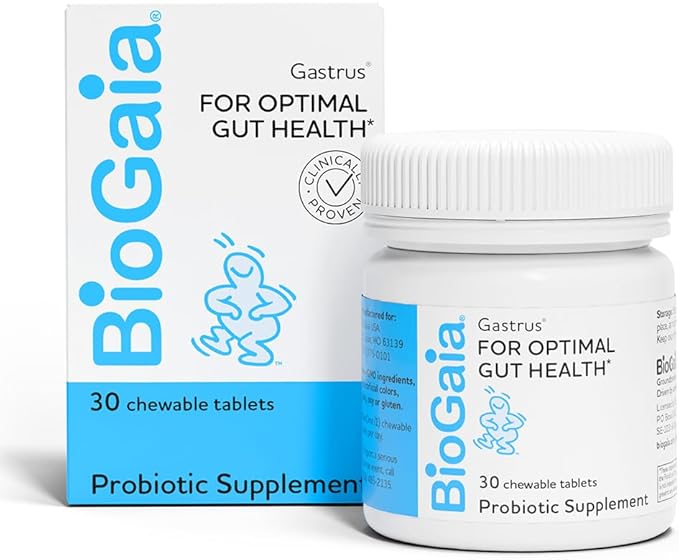
BioGaia isn’t just another probiotic brand—it’s the one that put Lactobacillus reuteri on the map. Their Gastrus chewable tablets combine the two most clinically studied strains: DSM 17938 and ATCC PTA 6475. Together, these have been linked to easing bloating, supporting regularity, and even playing a role in gut-brain balance.
Each mandarin-mint flavored chewable delivers a dose designed to survive stomach acid and reach the gut. Unlike high-CFU capsules that flood your system, BioGaia focuses on strains with clinical evidence, not just numbers.
Pros
- Contains DSM 17938 & ATCC PTA 6475—the most researched strains
- Convenient chewable format with pleasant flavor
- Backed by multiple human studies
- Keto-friendly, clean label
Cons
- Lower CFU count than high-dose capsules
- Pricier than generic options
Final Words on Choosing the Best Lactobacillus reuteri Supplement
Finding the right probiotic doesn’t have to feel like guesswork. Lactobacillus reuteri has something most probiotics lack—real clinical research and strains with proven benefits. Whether your goal is digestive comfort, immune support, or even oral health, choosing a supplement with the right strain and CFU count can make all the difference.
From the trusted BioGaia Gastrus to high-strength options like Toniiq and Peak Performance, the products we covered represent the best L. reuteri supplements available right now. If you’re new, start with a moderate formula like Vitamatic. If you’ve tried probiotics before and want stronger results, step up to a 50B CFU synbiotic blend. And if value matters most, the Natural Foundation 240-tablet supply is hard to beat.
Frequently Asked Questions About Lactobacillus reuteri
1. How long does it take for Lactobacillus reuteri to work?
Most people notice changes in digestion—like reduced bloating or more regular bowel movements—within 2 to 4 weeksof consistent use. Oral health benefits from lozenges may appear even sooner.
2. Can I take Lactobacillus reuteri with other probiotics?
Yes, L. reuteri can be taken alongside other strains. Just keep an eye on the total CFU count, since stacking multiple probiotics may cause temporary bloating or gas as your system adjusts.
3. Is L. reuteri safe to take every day?
For healthy adults, daily use is generally considered safe. Clinical studies—especially with the DSM 17938 strain—have tested continuous use for months without serious side effects.
4. Do L. reuteri supplements need refrigeration?
Some products do, especially high-CFU capsules. Always check the label. If it suggests storing in a cool place, keeping it in the fridge helps preserve potency.
5. Can L. reuteri help with women’s health issues?
Emerging research suggests certain strains may support vaginal microbiome balance and even bone health in postmenopausal women. Results are mixed, so it’s best to choose supplements with clinically studied strains.
6. What’s the difference between L. reuteri capsules, lozenges, and powders?
- Capsules → best for digestion and immune support.
- Lozenges → ideal for gum and oral health.
- Powders → flexible dosing, high CFU counts, but less convenient.