
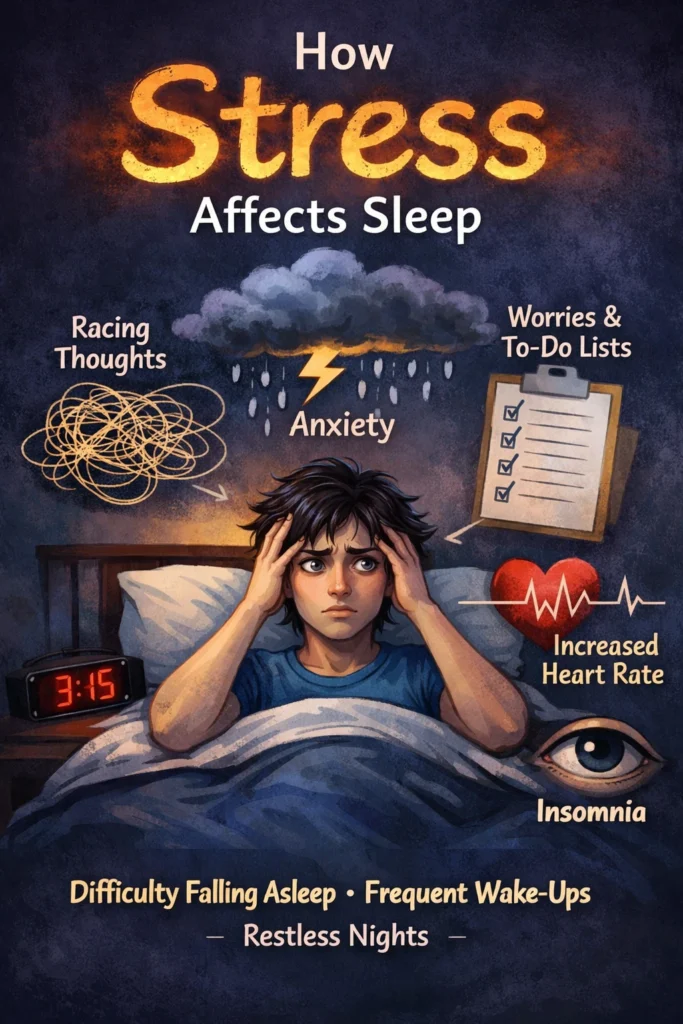
Many people struggle with sleep even when they feel physically tired. They lie awake at night, wake frequently, or feel unrefreshed in the morning. One of the most common — and often underestimated — reasons behind this pattern is stress. Stress doesn’t just affect mood or mental well-being; it has a direct and measurable impact on how the body initiates, maintains, and restores sleep.
Understanding how stress interferes with sleep requires looking beyond simple “overthinking” and examining how the nervous system, hormones, and brain chemistry interact. This article explains how stress affects sleep, why the problem can become chronic, and what happens inside the body when stress and sleep disruption feed into each other.
Best Sleep Support Supplements
What Is Stress, From a Biological Perspective?
Stress is not inherently harmful. In biological terms, stress is the body’s response to a perceived challenge or threat. This response is designed to help us react quickly and survive.
When the brain senses stress, it activates two major systems:
- The sympathetic nervous system (often called the “fight-or-flight” system)
- The hypothalamic–pituitary–adrenal (HPA) axis, which regulates stress hormones
These systems increase alertness, heart rate, blood pressure, and energy availability. While helpful in short bursts, prolonged activation creates problems — especially for sleep.
How Normal Sleep Works
To understand how stress disrupts sleep, it helps to know how sleep normally occurs.
Sleep is regulated by two primary processes:
1. The Sleep–Wake Drive (Homeostasis)
The longer you stay awake, the stronger your biological drive to sleep becomes.
2. The Circadian Rhythm
This is your internal clock, influenced by light, darkness, and routine. It controls when your body releases sleep-promoting hormones like melatonin.
For restful sleep, the body must shift from alert mode to rest mode, allowing the parasympathetic nervous system to dominate. Stress interferes with this transition.
The Stress Response vs. the Sleep Response
Stress and sleep require opposite physiological states.
| Stress State | Sleep State |
|---|---|
| High alertness | Low alertness |
| Increased cortisol | Reduced cortisol |
| Sympathetic dominance | Parasympathetic dominance |
| Rapid thoughts | Slowed brain activity |
When stress remains active into the evening or night, the body struggles to make this shift.
Cortisol: The Key Hormone Linking Stress and Sleep
Cortisol is often called the “stress hormone,” but it also follows a natural daily rhythm.
- Cortisol should be highest in the morning, helping you wake up
- It should gradually decline throughout the day
- Cortisol should be low at night, allowing sleep to begin
Chronic stress can disrupt this rhythm. Some people experience:
- Elevated nighttime cortisol
- A “second wind” late at night
- Difficulty falling asleep despite exhaustion
This pattern is sometimes described as being “tired but wired.”
How Stress Affects Sleep Onset (Falling Asleep)
One of the most common sleep complaints related to stress is difficulty falling asleep.
Stress affects sleep onset by:
- Increasing mental alertness and racing thoughts
- Raising heart rate and muscle tension
- Reducing melatonin release
- Keeping cortisol levels elevated
Even if a person feels physically exhausted, the brain may remain in a state of vigilance, delaying sleep initiation.
How Stress Affects Sleep Maintenance (Staying Asleep)
Stress doesn’t only affect falling asleep; it also disrupts sleep continuity.
People under chronic stress may experience:
- Frequent nighttime awakenings
- Light, fragmented sleep
- Early morning waking with difficulty returning to sleep
This occurs because stress increases micro-arousals, brief awakenings the person may not consciously remember but that prevent deep, restorative sleep.
Stress and Sleep Architecture
Sleep occurs in cycles, moving through different stages:
- Light sleep
- Deep sleep (slow-wave sleep)
- REM sleep (associated with memory and emotional processing)
Chronic stress is associated with:
- Reduced deep sleep
- Altered REM sleep patterns
- Increased time spent in lighter sleep stages
This helps explain why stressed individuals may sleep for many hours yet still feel unrefreshed.
The Role of the Nervous System
The nervous system plays a central role in stress-related sleep problems.
Sympathetic Dominance
Stress activates the sympathetic nervous system, which increases vigilance and readiness.
Parasympathetic Suppression
Sleep requires activation of the parasympathetic nervous system, which promotes relaxation, digestion, and repair.
When stress keeps the sympathetic system dominant, the body struggles to enter and maintain sleep.
Stress, Anxiety, and Sleep: A Feedback Loop
Stress and sleep problems often reinforce each other.
- Stress leads to poor sleep
- Poor sleep increases stress sensitivity
- Increased stress further disrupts sleep
Over time, this loop can lower the threshold for stress, meaning even minor challenges feel overwhelming and disrupt sleep.
Psychological Stress vs. Physiological Stress
Not all stress feels emotional.
Sleep can be disrupted by:
- Psychological stress (worry, pressure, uncertainty)
- Physiological stress (illness, inflammation, pain)
- Environmental stress (noise, light, irregular schedules)
Even when a person believes they are “mentally calm,” physiological stress can still impair sleep.
Why Stress Often Worsens at Night
Many people report that stress feels worse at night. Several factors contribute:
- Fewer distractions allow thoughts to surface
- Cortisol rhythm disruption becomes more noticeable
- Fatigue reduces emotional regulation
- Darkness removes time-based cues of safety and progress
This can make nighttime particularly challenging for those under chronic stress.
Stress and Early Morning Awakening
Waking too early and being unable to return to sleep is a common stress-related issue.
Possible contributors include:
- Elevated early-morning cortisol
- Anticipatory stress about the day ahead
- Increased light sensitivity
- Fragmented REM sleep
This pattern often leaves people feeling unrested despite adequate total sleep time.
Long-Term Effects of Stress-Related Sleep Disruption
Chronic sleep disruption caused by stress can have broader health implications, including effects on:
- Mood and emotional regulation
- Cognitive performance and memory
- Immune function
- Metabolic health
While this article focuses on sleep, it’s important to recognize that sleep is deeply interconnected with overall health.
When Stress-Related Sleep Problems Become Chronic
Occasional stress-related sleep disturbance is common. Concern arises when sleep problems persist for weeks or months.
Signs that stress may be chronically affecting sleep include:
- Ongoing difficulty falling or staying asleep
- Dependence on stimulants during the day
- Feeling “wired” at night despite exhaustion
- Increased irritability or emotional reactivity
At this stage, addressing only sleep hygiene may be insufficient without addressing stress regulation.
The Difference Between Acute and Chronic Stress Effects
- Acute stress may temporarily disrupt sleep but resolves when the stressor passes
- Chronic stress can recalibrate the nervous system, making sleep disruption persistent
This distinction is important because chronic stress often requires a more comprehensive approach.
Stress Sensitivity and Individual Differences
Not everyone responds to stress the same way.
Factors that influence stress-related sleep disruption include:
- Genetic predisposition
- Past trauma or prolonged stress exposure
- Lifestyle patterns
- Baseline nervous system sensitivity
Understanding these differences helps explain why similar stressors affect people differently.
When to Seek Professional Help
Stress-related sleep issues may warrant professional evaluation if:
- Sleep problems persist despite lifestyle changes
- Daytime functioning is significantly impaired
- Anxiety or mood symptoms worsen
- Sleep disruption is accompanied by physical symptoms
A healthcare professional can help rule out medical causes and guide appropriate management.
Key Takeaways
- Stress and sleep are biologically opposing states
- Chronic stress disrupts sleep through hormonal and nervous system pathways
- Cortisol plays a central role in stress-related sleep problems
- Stress can affect both falling asleep and staying asleep
- Poor sleep increases stress sensitivity, creating a cycle
- Understanding the physiology helps reduce self-blame and confusion
Conclusion
Stress-related sleep problems are not a personal failure or a lack of willpower. They are the result of complex interactions between the brain, hormones, and nervous system. By understanding how stress affects sleep at a biological level, individuals can approach sleep challenges with greater clarity and compassion.
Recognizing the stress–sleep connection is the first step toward breaking the cycle and restoring healthy, restorative rest.