
Sleep often feels simple: you feel tired, you go to bed, and you sleep. In reality, sleep is one of the most carefully regulated biological processes in the human body. When sleep breaks down—difficulty falling asleep, frequent awakenings, or waking up unrefreshed—the cause is rarely just “not being tired enough.”
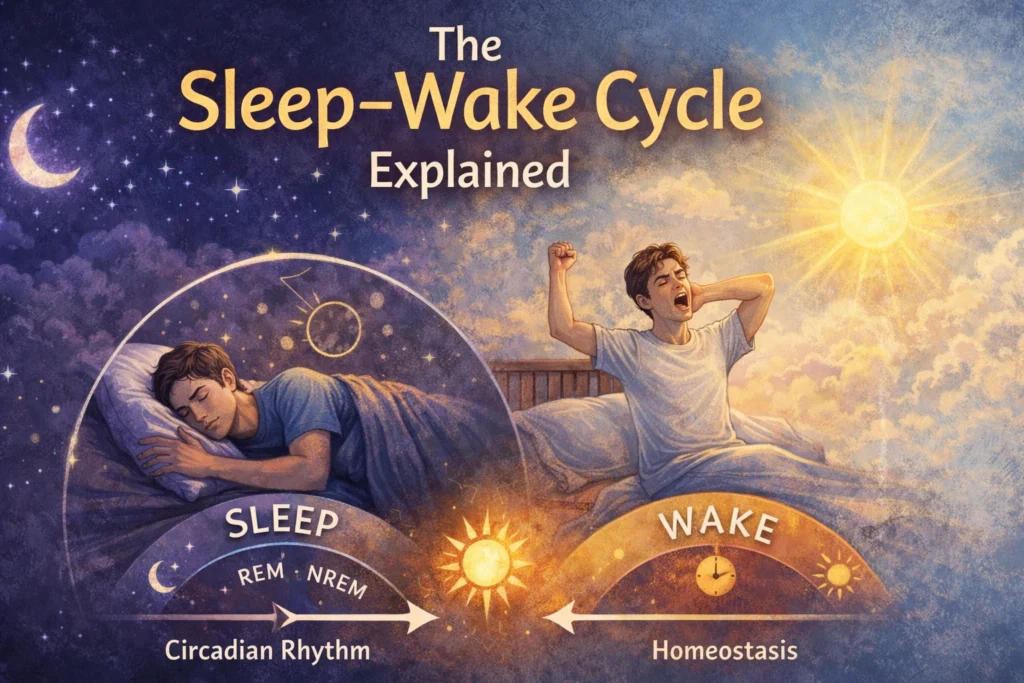
At the core of healthy sleep lies the sleep–wake cycle, controlled by two interacting biological systems: circadian rhythm and sleep pressure. These systems determine when we feel sleepy, how deeply we sleep, and how refreshed we feel upon waking.
Understanding how these two systems work—and how stress, lifestyle, and modern habits disrupt them—provides clarity for many common sleep problems. This article explains the sleep–wake cycle in simple terms, without oversimplifying the biology.
Best Supplements for Sleep Support
What Is the Sleep–Wake Cycle?
The sleep–wake cycle refers to the natural, repeating pattern of sleep and wakefulness that occurs over a 24-hour period. It is not driven by a single mechanism but by the interaction of two distinct processes:
- Circadian rhythm – your internal biological clock
- Sleep pressure – the buildup of the need for sleep during wakefulness
When these systems are aligned, sleep occurs easily and feels restorative. When they fall out of sync, sleep becomes difficult—even if you spend enough time in bed.
Circadian Rhythm: The Body’s Internal Clock
What Is Circadian Rhythm?
Circadian rhythm is an internal timing system that regulates daily patterns in the body, including:
- Sleep and wake timing
- Hormone release
- Body temperature
- Metabolism
- Alertness and performance
The word circadian comes from Latin words meaning “about a day.” This rhythm follows a cycle close to 24 hours and is present even in the absence of external cues.
Where the Circadian Clock Is Located
The body’s master clock is located in a small region of the brain called the suprachiasmatic nucleus (SCN), found in the hypothalamus. This clock coordinates timing signals throughout the body, synchronizing organs and systems to the same daily rhythm.
Although the SCN is the master regulator, many organs—including the liver, muscles, and digestive system—also have their own “peripheral clocks” that follow circadian timing.
Light: The Primary Circadian Signal
Light is the strongest external signal affecting circadian rhythm.
- Morning light signals the brain to promote wakefulness
- Darkness signals the release of sleep-promoting hormones
Specialized light-sensitive cells in the retina send information directly to the SCN, allowing light exposure to adjust the timing of the internal clock.
This is why light exposure at the wrong time—especially at night—can disrupt sleep.
Melatonin and Circadian Timing
Melatonin is a hormone often associated with sleep, but its primary role is timing, not sedation.
How Melatonin Works
- Released in response to darkness
- Signals the body that nighttime has begun
- Helps coordinate sleep timing
Melatonin does not “force” sleep but creates the biological conditions that allow sleep to occur more easily.
Circadian Disruption and Melatonin
Circadian disruption—due to stress, irregular schedules, or nighttime light exposure—can delay or suppress melatonin release, shifting sleep later or making it lighter.
Sleep Pressure: The Body’s Need for Sleep
What Is Sleep Pressure?
Sleep pressure refers to the increasing drive to sleep that builds the longer you stay awake. It is a homeostatic process, meaning it works to restore balance.
The longer you are awake:
- The stronger sleep pressure becomes
- The deeper sleep tends to be
This pressure decreases during sleep and resets after sufficient rest.
Adenosine and Sleep Pressure
A key chemical involved in sleep pressure is adenosine, a byproduct of cellular activity.
- Adenosine accumulates during wakefulness
- High adenosine levels increase sleepiness
- Sleep clears adenosine from the brain
This is one reason prolonged wakefulness leads to heavier, deeper sleep.
Why Caffeine Affects Sleep Pressure
Caffeine does not remove adenosine. Instead, it blocks adenosine receptors, temporarily masking sleep pressure.
As caffeine wears off, accumulated adenosine can suddenly exert its effects, leading to a “crash.”
How Circadian Rhythm and Sleep Pressure Work Together
Sleep occurs most easily when:
- Circadian rhythm promotes sleep
- Sleep pressure is sufficiently high
If one system is misaligned, sleep quality suffers.
Examples of Misalignment
- High sleep pressure + alert circadian signal → exhaustion but difficulty falling asleep
- Strong circadian sleep signal + low sleep pressure → early bedtime with frequent awakenings
This explains why naps, late wake times, or irregular schedules can interfere with nighttime sleep.
Body Temperature and the Sleep–Wake Cycle
Body temperature follows a circadian pattern:
- Higher during the day
- Gradually decreases in the evening
- Lowest in the early morning hours
The drop in core body temperature helps facilitate sleep onset. Circadian disruption can blunt this temperature decline, delaying sleep.
Stress and Circadian Rhythm Disruption
Stress interferes with circadian rhythm through several mechanisms:
- Elevated evening cortisol
- Delayed melatonin release
- Increased nighttime alertness
- Reduced sensitivity to light–dark cues
Chronic stress can shift circadian timing later or fragment the rhythm altogether, leading to irregular sleep–wake patterns.
Stress and Sleep Pressure Interference
Stress also affects sleep pressure:
- Heightened alertness counteracts adenosine signaling
- Mental hyperarousal delays sleep despite fatigue
- Physiological stress reduces sleep depth
This is why stress-related insomnia often feels paradoxical: the body is tired, but the brain remains awake.
Circadian Rhythm vs Sleep Pressure: Common Confusion
Many people assume that being tired automatically leads to sleep. However:
- Fatigue reflects energy depletion
- Sleepiness reflects sleep pressure and circadian timing
A person can feel fatigued but not sleepy if circadian signals promote alertness.
Jet Lag: A Clear Example of Circadian Misalignment
Jet lag occurs when the circadian clock is out of sync with the local time zone.
Symptoms include:
- Insomnia at night
- Sleepiness during the day
- Reduced cognitive performance
Sleep pressure may be high, but circadian signals promote wakefulness at inappropriate times.
Shift Work and Chronic Circadian Disruption
Shift work forces sleep at biologically unfavorable times, disrupting:
- Melatonin release
- Body temperature rhythm
- Hormonal cycles
Over time, this misalignment increases sleep disturbance and health risks.
Irregular Schedules and Social Jet Lag
Even without travel or shift work, inconsistent sleep schedules can disrupt circadian rhythm.
Examples include:
- Sleeping late on weekends
- Variable bedtime routines
- Irregular meal timing
This phenomenon is sometimes referred to as social jet lag.
Age-Related Changes in the Sleep–Wake Cycle
Circadian rhythm changes across the lifespan:
- Adolescents experience a natural delay in sleep timing
- Older adults often experience earlier sleep onset and awakening
Sleep pressure accumulation may also change, contributing to lighter sleep with age.
Sleep–Wake Cycle and Morning Grogginess
Difficulty waking in the morning can occur when:
- Circadian rhythm is delayed
- Sleep pressure has not fully dissipated
- Sleep is fragmented or insufficient
This is not always a sign of laziness but often reflects biological misalignment.
Why Waking at the Same Time Matters
Consistent wake time is one of the strongest stabilizers of the sleep–wake cycle.
- Reinforces circadian timing
- Regulates melatonin rhythm
- Supports predictable sleep pressure buildup
Irregular wake times weaken circadian signals, even if total sleep time is adequate.
The Role of Evening Habits
Evening behaviors influence both circadian rhythm and sleep pressure:
- Bright light delays circadian timing
- Mental stimulation increases alertness
- Late meals may affect metabolic rhythms
These factors can shift the sleep–wake cycle later.
When the Sleep–Wake Cycle Becomes Chronically Disrupted
Chronic disruption may lead to:
- Persistent insomnia
- Daytime fatigue
- Reduced sleep efficiency
- Increased stress sensitivity
At this stage, simply “trying to sleep earlier” is often ineffective.
When to Seek Professional Evaluation
Evaluation may be helpful if:
- Sleep timing remains inconsistent for weeks
- Daytime functioning is impaired
- Sleep problems persist despite routine stabilization
Circadian rhythm sleep disorders may require targeted assessment.
Key Takeaways
- Sleep is regulated by circadian rhythm and sleep pressure
- Both systems must align for healthy sleep
- Stress disrupts both timing and sleep drive
- Light exposure strongly influences circadian rhythm
- Irregular schedules weaken sleep regulation
- Understanding these systems reduces frustration and self-blame
Conclusion
The sleep–wake cycle is a finely tuned biological system shaped by internal rhythms and daily behavior. Circadian rhythm determines when sleep is biologically appropriate, while sleep pressure determines how strongly the body needs sleep.
When these systems are aligned, sleep occurs naturally. When disrupted—by stress, light exposure, irregular schedules, or chronic arousal—sleep becomes fragile and unpredictable.
Understanding the sleep–wake cycle provides a foundation for addressing sleep problems thoughtfully and realistically, grounded in biology rather than guesswork.