

Medically reviewed by Dr. A.S.M. Masum Billah, MBBS
We only recommend products we love and that we think you will, too. We may receive a portion of sales from products purchased from this article.

The Short Answer
For most people, VitaUp Magnesium Glycinate 200 mg is the one I’d reach for — an honest dose, a short ingredient list, and four months in a bottle. If you want the most provable chelate on the market, Doctor’s Best uses Albion® TRAACS® and costs less per milligram than anything else here.
You bought magnesium glycinate because someone told you it helps you sleep. They weren’t wrong — the mechanism is real, and I’ll walk you through it.
But there’s something you deserve to know first.
A lot of what’s sold as “magnesium glycinate” isn’t really magnesium glycinate. It’s cheap magnesium oxide with loose glycine stirred in, wearing a chelate’s label and charging a chelate’s price.
I’m not guessing. A manufacturer sent sixteen of these to a lab, and the results are ugly.
So I checked the arithmetic on every bottle here. Eight add up. Two famous names don’t.
If you are comparing sleep support more broadly, you may also want to read our main magnesium glycinate supplement guide, magnesium vs glycine for sleep comparison, glycine supplement roundup, and better sleep supplement guide.
What changed in this 2026 update
- Checked each pick against elemental magnesium, not just the big number on the front label.
- Added product images and direct CTA links so the comparison feels easier to scan.
- Looked for chelate quality, including Albion TRAACS, bisglycinate, and labels that make the math easier to verify.
- Kept the sleep angle practical: gentleness, bedtime fit, dose comfort, and who should be careful.
Best Magnesium Glycinate for Sleep: Quick Comparison
| # | Product | Form | Elemental Mg | Chelate | Label Math | Best For |
|---|---|---|---|---|---|---|
| 1 | VitaUp | Capsule | 200 mg / 2 caps | Bisglycinate | ✅ Plausible | Overall |
| 2 | Doctor’s Best | Tablet | 200 mg / 2 tabs | Albion TRAACS | ✅ Verified | Value |
| 3 | Pure TheraPro Rx | DR capsule | 250 mg / 2 caps | TRAACS + malate | ✅ Verified | Zero fillers |
| 4 | Pure Encapsulations | Capsule | 120 mg / 1 cap | Bisglycinate | ✅ Verified | Sensitive stomachs |
| 5 | Thorne | Powder | 200 mg / scoop | Bisglycinate | ✅ Verified | Athletes |
| 6 | NOW Foods | Powder | 250 mg / tsp | Albion TRAACS | ✅ Lab-proven | Proven purity |
| 7 | Metagenics | Tablet | 100 mg / 1 tab | Bis-glycinate | ✅ Verified | Low stomach acid |
| 8 | Solaray | VegCap | 350 mg / 4 caps | In-house chelate | ✅ Verified | Higher doses |
How I Judged These
First, the arithmetic. Fully-reacted magnesium bisglycinate is about 14% elemental magnesium by weight. That’s chemistry, not opinion. Albion’s TRAACS chelate runs nearer 10%. So 200 mg of usable magnesium needs somewhere between 1,430 mg and 2,000 mg of real chelate powder in the bottle.
When a label claims much more than 14–18% elemental, it’s telling on itself: the magnesium is padded with cheap oxide, or it never properly bonded to the glycine.
Second, the lab data. NOW Foods bought 16 of these products off Amazon and tested them by ICP-OES in their own lab, then again at Eurofins. Twelve hit their total magnesium claim. Only NOW’s hit the claim for soluble magnesium — the part that’s actually chelated. Glycine was in every sample. It just wasn’t attached to anything.
Third, the dose. The upper limit for supplemental magnesium is 350 mg a day. Several bestsellers blow past that in one serving, and I’ve flagged every one.
Why Magnesium Glycinate Helps You Sleep — and Where the Hype Runs Ahead of the Evidence
It’s a two-part molecule, and both halves are doing something at bedtime.
The magnesium. Abbasi and colleagues (Journal of Research in Medical Sciences, 2012) gave magnesium to 46 older adults with insomnia for eight weeks, double-blind. Sleep efficiency improved, sleep time went up, insomnia scores came down. Melatonin rose, cortisol fell. Held’s team (Pharmacopsychiatry, 2002) found it deepened slow-wave sleep — the restorative stage you want more of.
The glycine. Glycine quiets nerve signalling, and Kawai’s group (Neuropsychopharmacology, 2015) showed it nudges core body temperature down through receptors in the brain’s master clock — one of the signals your body reads as time to sleep.
So far, so good. Now the part the marketing leaves out.
Reality Check
Those glycine sleep studies used 3 grams of glycine. A 200 mg dose of real bisglycinate gives you roughly 1.2 grams — about 40% of what was tested. The glycine story is pointing the right way, but it’s being sold harder than the numbers support. Take magnesium glycinate to top up your magnesium gently. Don’t buy it expecting a glycine sleep aid.
One caveat I’d rather you hear from me: Mah and Pitre reviewed the literature in 2021 (BMC Complementary Medicine and Therapies) and graded the evidence low quality. The trials are small and short. Magnesium is still worth trying — cheap, safe for most people, minimal downside. But it isn’t a sedative, and it won’t fix sleep apnoea or a phone habit at 2 a.m.
The 8 Best Magnesium Glycinate Supplements for Sleep
1. VitaUp Magnesium Glycinate 200 mg
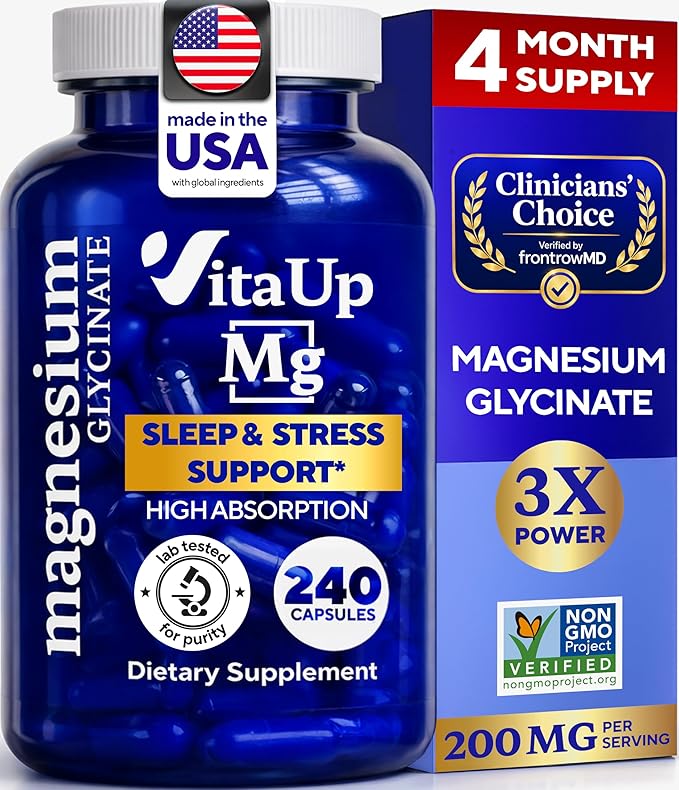
Most people don’t need the fanciest magnesium. They need a sensible dose they’ll actually keep taking, at a price that doesn’t make them think twice each month. That’s what this is.
The Label Math
200 mg over two capsules is 100 mg each — roughly 715 mg of bisglycinate per capsule, plus rice flour and silicon dioxide. Tight, but it fits. More importantly, the label leads with elemental magnesium — the honest way to do it, and exactly what the rejected brands stop doing.
Why It Works for Sleep
200 mg is the sweet spot: enough to matter, under the 350 mg ceiling, and you get there in two capsules rather than four. Readers who stick with it describe the same two things — falling asleep more easily, and fewer tight, twitchy legs after a hard day. The capsules go down without a fight, which sounds trivial until you’ve tried the alternatives.
Who Should Skip It
VitaUp is young, without decades behind it. And while the label gives the elemental figure, it doesn’t publish the compound weight — so you can’t check the chelation percentage yourself. You’re trusting their certificate. If you’d rather trust an independent lab, jump to NOW at number six.
Pros & Cons
✔ Four-month supply in one bottle
✔ Certificate of analysis published
✔ Coupons regularly cut the price hard
✘ Young brand, short track record
✘ Compound weight not disclosed
✘ No independent assay published
2. Doctor’s Best High Absorption Magnesium
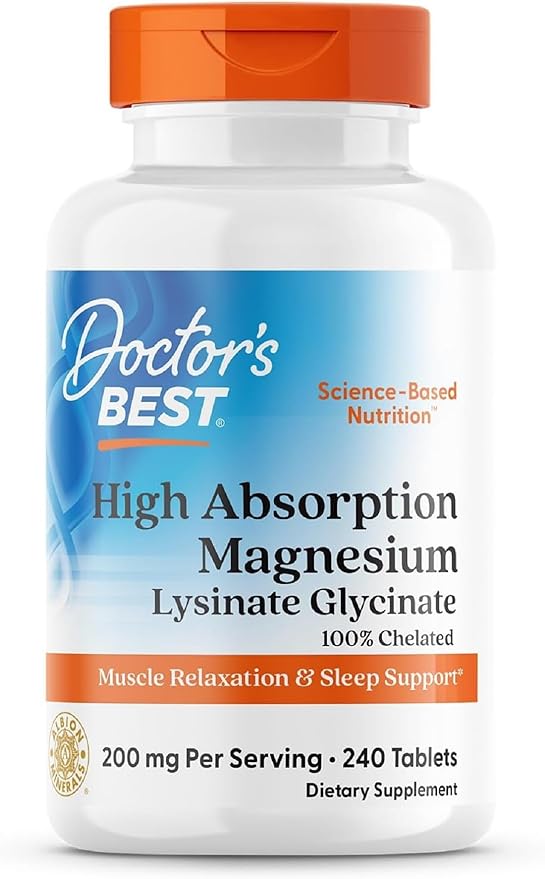
If VitaUp is the sensible everyday choice, this is the one for readers who want to see the receipts before they buy.
The Label Math
Two tablets give 200 mg elemental from magnesium lysinate glycinate chelate. Albion’s material is about 10% elemental, so that needs roughly 2,000 mg of chelate — about a gram per tablet. Yes, the tablets are big. That weight is the point: it’s real chelate, and there’s nowhere for oxide to hide.
Why It Works for Sleep
Lysinate glycinate hangs magnesium on two amino acids instead of one, so it rides in through amino-acid pathways rather than the usual mineral route. Less magnesium loiters in your gut pulling water — the whole reason magnesium got its laxative reputation. Readers who gave up on citrate for that exact reason tend to get along with this one.
Who Should Skip It
The tablets really are large — if pills are a struggle, take Pure Encapsulations or a powder. And read the directions critically: the label says two tablets twice daily, which is 400 mg. Over the limit. Take half.
Pros & Cons
✔ Albion® TRAACS®, fully disclosed
✔ Cheapest verified magnesium here
✔ Not buffered with oxide
✘ Tablets are large
✘ Label dosing overshoots the limit
✘ “6x better absorbed” is marketing, not a trial
3. Pure TheraPro Rx Optimum Magnesium
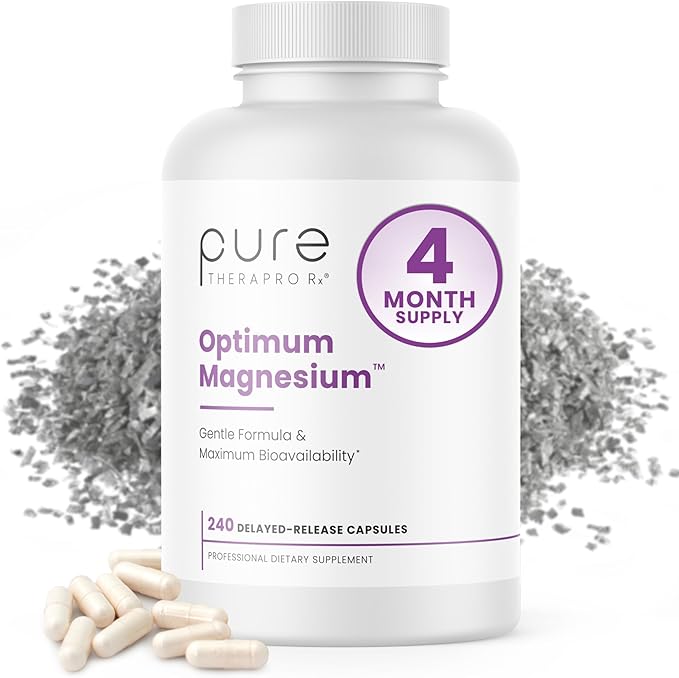
If you’re the kind of reader who turns the bottle around and reads the small print first, this one was made for you.
The Label Math
250 mg per two capsules, from two Albion chelates — TRAACS® lysinate glycinate plus DiMagnesium Malate. That blend is how they hit the number without fillers: malate carries magnesium more densely. It adds up — but it isn’t pure glycinate, and that matters here.
Why It Works for Sleep
The delayed-release capsules open in the small intestine rather than the stomach — where most magnesium is absorbed anyway — sidestepping the queasiness concentrated magnesium can cause. Made in an NSF, cGMP-certified, FDA-inspected facility, with a batch certificate published. Give it 90 minutes before bed; the shell needs the lead time.
Who Should Skip It
Here’s the caveat. There’s 830 mg of malic acid in here, and malate is the energising magnesium — it feeds aerobic energy production. Some people find it revs them up at night. For sleep alone, it isn’t the cleanest match. For night-time recovery and sleep together, it’s superb — one reader takes it before bed specifically to settle their calves.
Pros & Cons
✔ Zero fillers — capsule shell only
✔ Two patented Albion® chelates
✔ Batch certificate published
✘ Malate may be stimulating at night
✘ Not a pure glycinate formula
✘ Harder to find than the big brands
4. Pure Encapsulations Magnesium (Glycinate)
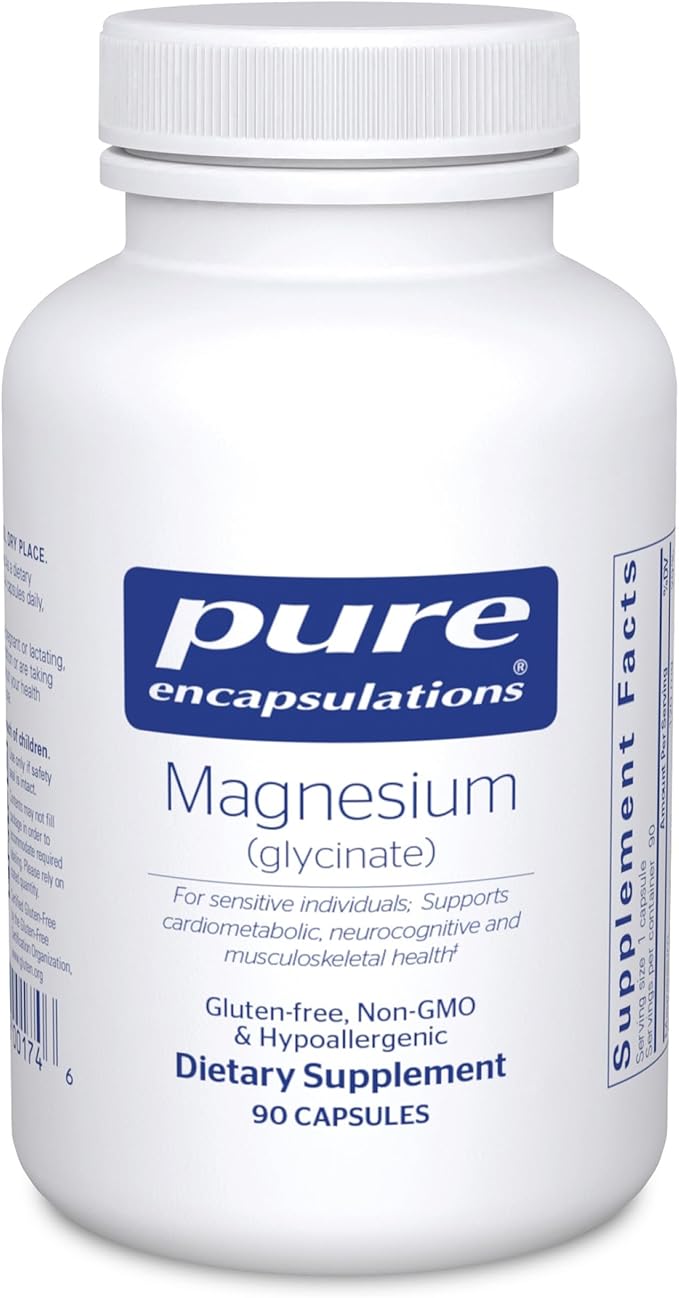
If magnesium has upset your stomach before, start here. This is the bottle I’d hand someone who’s been burned twice already.
The Label Math
120 mg divided by 14% is about 851 mg of bisglycinate. A capsule that size holds roughly 850–900 mg. It fits — but only just, and only because the rest of the label is a cellulose capsule and a trace of ascorbyl palmitate. This is what a fully-reacted chelate looks like when nobody cuts a corner.
Why It Works for Sleep
Dose control is the thing nobody talks about. Magnesium’s window is personal — the amount that relaxes you might send your neighbour to the bathroom. Here you get a clean 120 mg ladder. One capsule at dinner, add another every three or four days, and when your stools soften, step back one. That’s your dose. It’s how I’d titrate it in clinic.
Who Should Skip It
You’ll pay more per milligram than Doctor’s Best, and if 400 mg is your target that’s four capsules a night. Watching your budget? VitaUp gives you the same idea for a fraction of the money.
Pros & Cons
✔ Cleanest ingredient list here
✔ 120 mg per capsule — precise dosing
✔ Hypoallergenic, vegan, non-GMO
✘ Premium pricing
✘ Four capsules for higher doses
✘ Capsules aren’t small
5. Thorne Magnesium Bisglycinate Powder
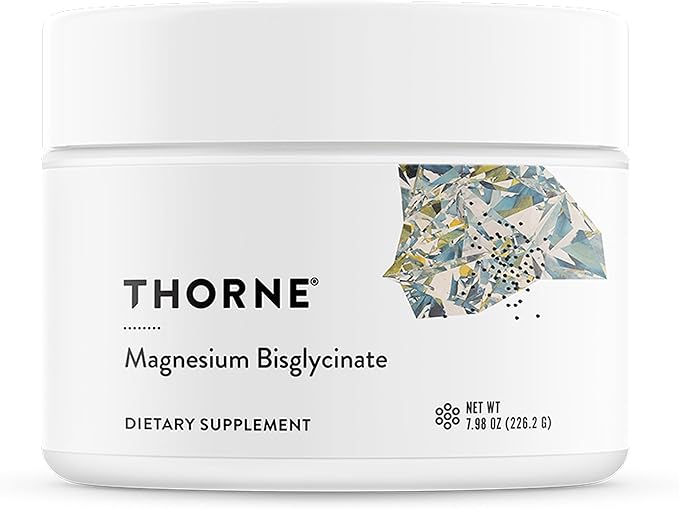
A failed drug test can end a season. If that’s your world, the certification isn’t a luxury — it’s the whole reason to buy.
The Label Math
Powder skips the problem entirely. A scoop holds 1,400 mg of chelate without anyone having to swallow it — which is exactly why powders tend to be honest. No capsule, no reason to cheat. No gymnastics needed.
Why It Works for Sleep
Dissolved magnesium isn’t waiting on a capsule to break down, so it gets going faster than a tablet — handy if you’re dosing 30 minutes before bed rather than 90. More than 100 professional teams use Thorne, and the recovery-and-sleep overlap is why athletes take it at night rather than the morning.
Who Should Skip It
If nobody’s testing you, you’re paying for a badge you’ll never use — NOW’s powder gives more magnesium for less. The flavour splits people too: monk fruit and citric acid land between sweet and tart, and plenty find it a strange thing to drink at bedtime.
Pros & Cons
✔ NSF Certified for Sport — batch-tested
✔ Faster onset than tablets
✔ Clean 200 mg serving, easy to halve
✘ You’re paying for the certification
✘ Flavour divides opinion
✘ Mixing beats swallowing, until it doesn’t
6. NOW Foods Magnesium Bisglycinate Powder
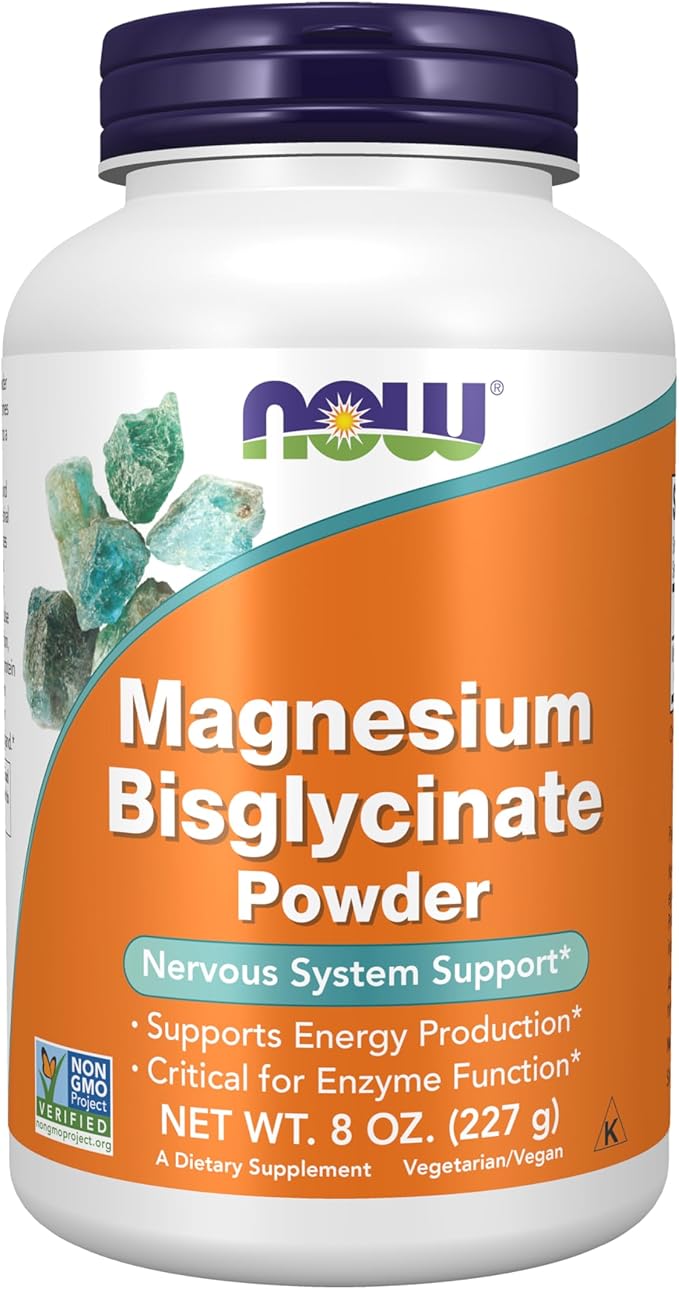
Every other brand here asks you to take their word for it. This one showed its working.
The Label Math
A 2.5 gram teaspoon yields 250 mg elemental — exactly 10%, exactly what Albion TRAACS delivers. Then they had it assayed. Their lab found 271 mg of soluble magnesium; Eurofins found 260 mg. Both above the label claim. Nothing else here has published proof the chelate is real.
Why It Works for Sleep
Soluble magnesium is the magnesium you actually absorb. In that testing, rivals posted respectable total magnesium next to collapsed soluble numbers — the mineral was in the capsule, locked in a form your gut can’t use. Verified solubility means you get the dose you paid for. That’s the whole foundation of the effect you’re after.
Who Should Skip It
Let’s name the obvious: NOW published a study in which NOW came out on top. The Eurofins arm is independent, which is why I give it weight — but if that sits badly, take Doctor’s Best on the Albion chelate alone. It’s also unflavoured, and it tastes it. Dilute it properly.
Pros & Cons
✔ Published soluble-magnesium data
✔ Citric acid is the only other ingredient
✔ ~91 servings — outstanding value
✘ Unflavoured, and you’ll know it
✘ The study is the brand’s own
✘ Must be diluted before drinking
7. Metagenics Magnesium Glycinate
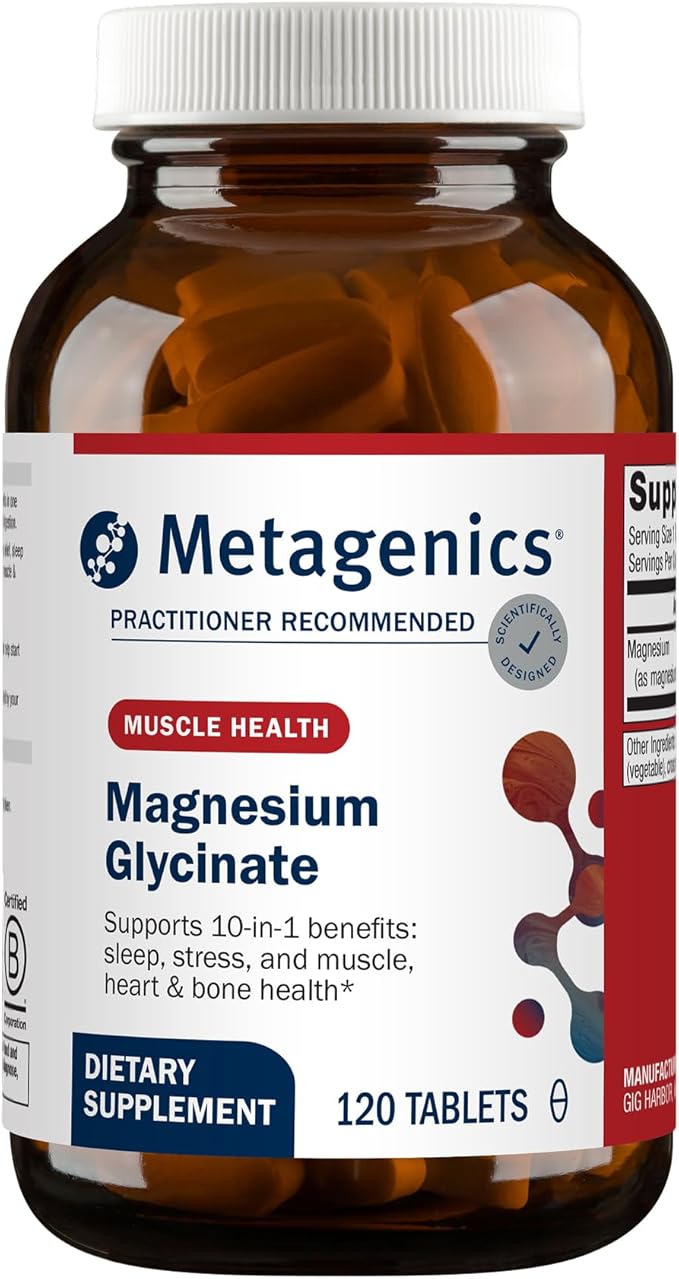
If you’ve been on omeprazole for years and your sleep has quietly got worse, read this one carefully. It may be about you.
The Label Math
One tablet, 100 mg elemental, declared as magnesium bis-glycinate. At 14% that’s ~715 mg of chelate per tablet, plus cellulose and stearic acid — comfortably inside a normal tablet. Conservative, and correct.
Why It Works for Sleep
Metagenics says its bis-glycinate travels through amino-acid transport rather than mineral pathways, so it doesn’t lean on gastric acid. That matters, because long-term proton pump inhibitors deplete magnesium — and the same drugs blunt the acid mineral absorption needs. Low magnesium, poor absorption, bad sleep. A trap, and this is a sensible way out.
Who Should Skip It
100 mg a tablet is the smallest dose here, and the label wants three a day for 300 mg — a lot of swallowing at practitioner prices. If acid isn’t your problem, Doctor’s Best gives twice the magnesium per tablet for less. One tweak if you do buy: one at breakfast, two an hour before bed.
Pros & Cons
✔ Acid-independent absorption — rare and useful
✔ #1 doctor-recommended professional brand
✔ Third-party tested, Certified B Corporation
✘ Only 100 mg per tablet
✘ Three tablets a day for a full dose
✘ “4x better absorbed” is unsupported marketing
8. Solaray Magnesium Glycinate 350 mg
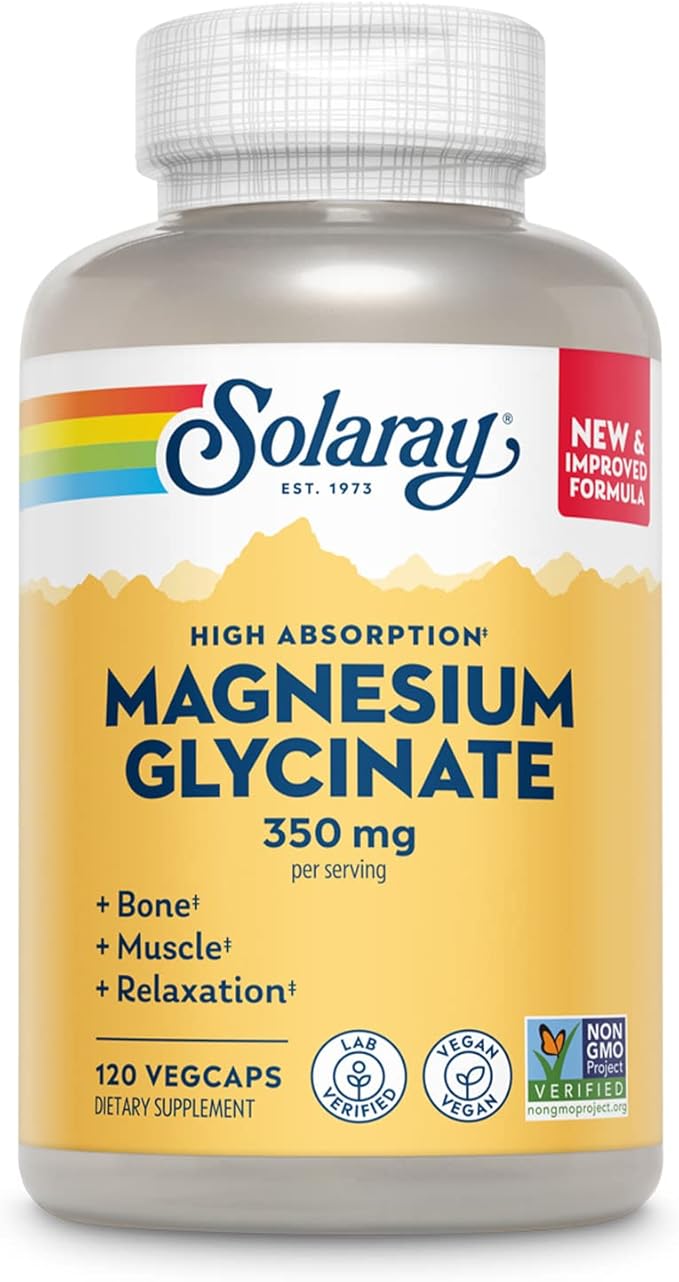
Sometimes 200 mg isn’t enough and you’d rather not juggle two bottles. This is that product — with a warning attached.
The Label Math
350 mg across four capsules is 87.5 mg each — roughly 625 mg of bisglycinate per capsule. Easy fit. Splitting a dose four ways is the mark of a company that respects the chemistry rather than jamming an impossible number into one pill and hoping nobody checks.
Why It Works for Sleep
Solaray chelates in its own NSF-certified facility in Ogden, Utah, using nothing but magnesium, glycine, heat and water — and claims to be the only US finished-product maker doing this in-house. That’s control the brands buying chelate from a supplier don’t have.
Who Should Skip It
Please read this bit. That 350 mg serving is the exact upper limit for supplemental magnesium. Not dangerous for a healthy adult, but it leaves no room — take a multivitamin with magnesium and you’re over. If your kidneys aren’t in good shape, don’t take this dose at all. The BioPerine matters too: piperine slows the enzymes clearing certain medications and can push their levels up. Split the capsules — two at lunch, two before bed.
Pros & Cons
✔ Verified in-house chelation
✔ Non-GMO Project Verified magnesium
✔ Serving designed to be split
✘ Sits exactly at the upper limit
✘ BioPerine may interact with medications
✘ Four capsules per serving
Which Magnesium Glycinate Should You Choose for Sleep?
If you want the cleanest all-around starting point, VitaUp is still the easiest first choice. The dose is not extreme, the bottle lasts a long time, and the label is simple enough to understand without doing mental gymnastics at midnight.
If you care most about chelate proof and value, Doctor’s Best is the one to compare against everything else because the Albion TRAACS angle is clear. If your stomach is sensitive or low stomach acid is part of your situation, Metagenics deserves a closer look.
If swallowing capsules at night is the reason you keep quitting supplements, Thorne or NOW Foods may fit better because both are powders. And if you want a higher-dose option, Solaray can make sense, but only if the 350 mg serving fits your total magnesium intake and your clinician has not told you to keep magnesium lower.
The simple rule: choose the product you can take consistently, understand clearly, and tolerate comfortably. For sleep, the best supplement is not the loudest label. It is the one that helps your evening feel easier without making the next morning harder.
The 350 mg Problem: How Much Should You Actually Take?
You’ve probably seen that adults need 400–420 mg of magnesium a day if they’re men, 310–320 mg if they’re women. So you reach for a 400 mg bottle. Makes sense — and it’s the wrong move.
That figure covers magnesium from everything, food included. There’s a separate limit for magnesium from supplements alone, and it’s 350 mg a day. Your spinach doesn’t count against it. Your capsules do.
So a 400 mg or 600 mg “high potency” serving isn’t better value. It’s over the line before breakfast.
Where to start
Take 100–200 mg about an hour before bed and hold for a week. If sleep improves and digestion is fine, stay there. If nothing shifts, add 100 mg and give it another week. Loose stools mean you’ve gone past your limit — step back one notch. That’s your dose, and it’s yours, not the label’s.
When to talk to your doctor first
Kidney disease is the hard stop. Your kidneys clear excess magnesium, and once eGFR drops below about 30 that clearance fails and the mineral builds up. Hypermagnesaemia is a real clinical problem. Any degree of kidney impairment means ask first.
Medications worth knowing about
Magnesium grabs certain drugs in your gut and stops them being absorbed. Leave at least two hours between it and bisphosphonates, tetracyclines, fluoroquinolones like ciprofloxacin, or levothyroxine.
It runs the other way too. Loop and thiazide diuretics flush magnesium out, so you may need more. Potassium-sparing diuretics hold it in. And long-term proton pump inhibitors quietly deplete it — raise that with your prescriber if you’ve taken them for years. Pregnant or breastfeeding? Check before you start.
Frequently Asked Questions
How long does magnesium glycinate take to work for sleep?
Some people feel something within a few nights. Most of the research ran six to eight weeks before measuring anything — Abbasi’s insomnia trial ran eight. Give it a month before you decide it’s not working.
Is magnesium glycinate better than magnesium citrate for sleep?
For sleep, yes — mostly because of what it doesn’t do. Citrate pulls water into your bowel, which is why it’s sold for constipation. Glycinate is a true chelate and largely skips that. Waking at 3 a.m. for the bathroom rather defeats the point.
Can I take magnesium glycinate with melatonin?
No known interaction, and Rondanelli’s 2011 trial (Journal of the American Geriatrics Society) combined magnesium, melatonin and zinc with better sleep scores in care-home residents. They work differently, so try magnesium alone first — otherwise you’ll never know which helped.
Why does one bottle say 1,000 mg and another says 100 mg?
Because they’re measuring different things, and one of them is hoping you won’t notice. The big number is usually the compound weight — magnesium plus glycine plus whatever else. The small number is the elemental magnesium your body can use. Only the small number matters.
Does magnesium glycinate cause vivid dreams?
Readers mention it constantly, though no trial confirms it. The likely explanation is sound: magnesium deepened slow-wave sleep in Held’s 2002 study, and better sleep architecture means more REM — so you remember more dreams.
What Didn’t Make the List
Two brands I fully expected to recommend got cut once I ran the numbers. You should know why.
Toniiq Magnesium Glycinate 3,000 mg. The label claims 600 mg elemental from 3,000 mg of glycinate — 20% elemental, where fully-reacted bisglycinate tops out near 14%. NOW’s lab tested this exact product: total magnesium was fine, but soluble magnesium came back at 68 mg in one lab and 49 mg at Eurofins, against a claim of 150 mg a capsule. Their report names Toniiq directly. And 600 mg is 1.7 times the limit.
KAL Magnesium Glycinate 400. Two tablets claim 400 mg elemental — 200 mg per tablet. At 14% that needs ~1,430 mg of chelate in one tablet, before the cellulose, stearic acid and silica they also list. It doesn’t fit. The likeliest explanation is oxide buffering they haven’t declared. Their VegCap version (350 mg across four capsules) works, if you like the brand.
Also cut on NOW’s soluble-magnesium data: Double Wood, Naturebell, Horbaach, NaturaLife Labs, Nature’s Branch, Purely Holistic and Terranics. All of them failed the chelation test.
Medical disclaimer: This article is general information and doesn’t replace advice about your own situation. Magnesium supplements can interact with prescription medications and aren’t right for everyone, particularly people with kidney disease. Speak to your doctor or pharmacist before starting any supplement. Statements about dietary supplements have not been evaluated by the FDA and are not intended to diagnose, treat, cure, or prevent any disease.