
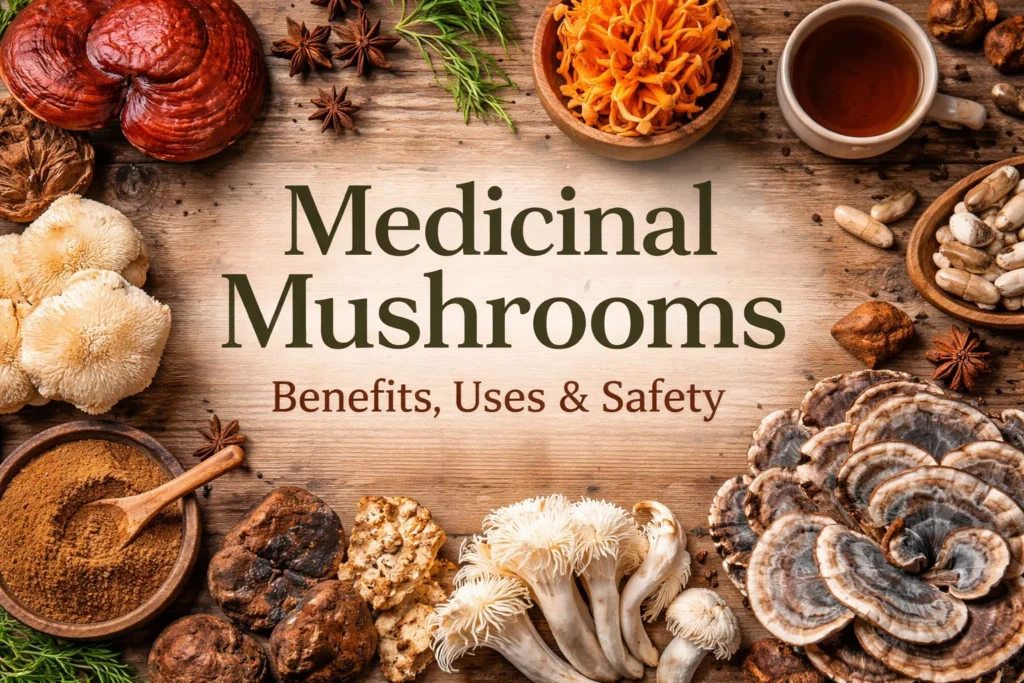
If you’ve been seeing medicinal mushrooms everywhere lately—capsules, powders, coffees, gummies—you’re not imagining things. Interest in these mushrooms has grown rapidly, not because they’re trendy, but because many people are searching for gentler, food-based ways to support long-term health.
Still, curiosity often comes with confusion.
What exactly are medicinal mushrooms?
Do they actually do anything?
Are they safe?
And how do you separate real science from marketing noise?
This guide is written to answer those questions clearly and honestly. No miracle promises. No borrowed jargon. Just careful explanations, grounded in what we do know—and transparent about what we don’t.
What Are Medicinal Mushrooms?
Medicinal mushrooms are functional fungi that have been traditionally used for health support rather than culinary flavor alone. Unlike button mushrooms or portobello mushrooms—eaten mainly for nutrition and taste—medicinal mushrooms are valued for their bioactive compounds, especially polysaccharides, beta-glucans, and other secondary metabolites.
They’ve been used for centuries in systems such as Traditional Chinese Medicine (TCM) and various folk traditions across Asia, Eastern Europe, and Indigenous cultures. Modern interest focuses less on tradition itself and more on how specific mushroom compounds interact with the human body.
It’s important to clarify one thing early:
Medicinal mushrooms are not drugs, and they are not treatments for disease. They are best understood as biologically active foods or supplements that may support certain physiological processes when used appropriately.
Best Mushroom Coffees for Weight Loss
Why Mushrooms Are Biologically Unique
Mushrooms occupy a fascinating space in biology. They are neither plant nor animal, and their cellular structure reflects that uniqueness.
Some key differences that matter for health:
- Mushroom cell walls contain beta-glucans, a type of polysaccharide structurally different from those found in oats or barley.
- Mushrooms naturally produce ergothioneine, an antioxidant amino acid that humans cannot synthesize on their own.
- Certain mushrooms produce triterpenes, hericenones, erinacines, and other compounds that interact with immune, nervous, and metabolic pathways.
This doesn’t mean “stronger” or “better”—it simply means different, which is why mushrooms are studied separately from herbs or vitamins.
The Core Compounds That Matter
Understanding medicinal mushrooms starts with understanding their key constituents.
Beta-Glucans
These are the most studied compounds in medicinal mushrooms. Mushroom beta-glucans differ structurally from cereal beta-glucans and are primarily researched for their role in immune modulation, not immune stimulation.
This distinction matters. Modulation refers to helping the immune system respond appropriately, rather than pushing it in one direction.
Polysaccharides
A broader category that includes beta-glucans and other complex carbohydrates. Research explores how these compounds interact with gut-associated immune tissue.
Triterpenes
Found most prominently in reishi mushroom, triterpenes are studied for their role in stress response, inflammation signaling, and liver-related pathways. Research is ongoing, and claims should remain conservative.
Ergothioneine
Often called a “longevity antioxidant,” though that term should be used carefully. Ergothioneine accumulates in tissues prone to oxidative stress, such as the brain and liver. Mushrooms are the richest dietary source.
Common Medicinal Mushrooms and What They’re Known For
Rather than overwhelm you with a long list, it’s more helpful to understand the roles these mushrooms are traditionally and scientifically associated with.
Reishi (Ganoderma lucidum)
Often described as an adaptogenic mushroom. Research focuses on stress physiology, immune balance, and sleep-adjacent pathways. Traditionally used for long-term vitality rather than quick effects.
Lion’s Mane (Hericium erinaceus)
Studied primarily for its relationship with nerve growth factors. Interest centers on cognitive health and neuroplasticity. Human research exists but is still limited in scale.
Chaga (Inonotus obliquus)
Rich in antioxidants and phenolic compounds. Research often examines oxidative stress markers and immune signaling rather than direct clinical outcomes.
Cordyceps (Cordyceps militaris)
Associated with energy metabolism and oxygen utilization in research settings. Often discussed in relation to physical performance, though results vary by population.
Turkey Tail (Trametes versicolor)
One of the most researched mushrooms in immune-related studies, particularly its polysaccharide fractions. Often used as an adjunct in research settings, not as a stand-alone solution.
How Medicinal Mushrooms May Support the Body
This is where language needs care. Medicinal mushrooms do not cure, do not replace medical care, and do not work the same for everyone.
What research suggests—when interpreted responsibly—is support in areas such as:
- Immune system communication and regulation
- Stress adaptation rather than stimulation
- Antioxidant defense systems
- Gut-immune axis support
- Cognitive and nervous system nourishment (specific mushrooms only)
Think of medicinal mushrooms as contributors, not controllers.
Mushrooms and the Immune System: Clearing a Common Misunderstanding
Many people worry that mushrooms “boost” immunity too much. In reality, most research uses the word modulate, not boost.
Immune modulation means:
- Supporting low immune responsiveness when needed
- Avoiding excessive immune activation where inappropriate
This is especially relevant for people who are cautious due to autoimmune concerns. That said, anyone with immune-related conditions should consult a healthcare professional before use.
The Gut Connection
A growing area of interest is how mushroom polysaccharides interact with the gut microbiome.
These compounds may act as prebiotic substrates, meaning they feed beneficial gut bacteria. Since a large portion of immune tissue resides in the gut, this interaction may partially explain the immune-related observations in research.
Again, this is supportive—not corrective.
Fruiting Body vs Mycelium: Why This Matters
You’ll see this debate everywhere, and for good reason.
- Fruiting body refers to the visible mushroom.
- Mycelium is the root-like fungal network.
Most clinical research focuses on fruiting body extracts, because that’s where beta-glucans and other compounds are more consistently quantified.
Mycelium grown on grain may contain additional starch, which dilutes active compounds unless carefully processed. This doesn’t automatically make it bad—but transparency matters.
For readers:
Ask what part of the mushroom is used and how it’s extracted.
Extraction Methods Explained Simply
Mushroom compounds are not all water-soluble.
- Hot water extraction pulls out polysaccharides like beta-glucans.
- Alcohol extraction is used for compounds like triterpenes.
- Dual extraction combines both.
This isn’t marketing jargon—it directly affects what ends up in the final product.
Safety, Side Effects, and Who Should Be Careful
Medicinal mushrooms are generally well tolerated, but “natural” does not mean risk-free.
Possible considerations:
- Digestive discomfort in sensitive individuals
- Allergic reactions (rare but possible)
- Interactions with immunosuppressive medications
- Caution during pregnancy or breastfeeding due to limited data
If someone is undergoing medical treatment, mushrooms should be discussed—not assumed safe by default.
How Long Do Medicinal Mushrooms Take to Work?
This is one of the most honest answers you’ll read:
They are slow.
Medicinal mushrooms are typically used for weeks to months, not days. People looking for immediate effects often feel disappointed—not because mushrooms don’t work, but because expectations were unrealistic.
Consistency matters more than intensity.
Powder, Capsules, Tea: Does Form Matter?
Form affects convenience more than effectiveness, assuming quality is equal.
- Capsules offer dosage consistency
- Powders allow flexible use but require trust in sourcing
- Teas extract some compounds but not all
Choose what you’ll actually stick with.
How to Choose a Quality Medicinal Mushroom Supplement
This matters more than brand popularity.
Look for:
- Clear identification of mushroom species (Latin names)
- Disclosure of fruiting body vs mycelium
- Extraction method transparency
- Beta-glucan testing (not just “polysaccharides”)
- Third-party testing when available
If a label feels vague, that’s usually intentional.
Are Medicinal Mushrooms Worth Considering?
For the right person, yes.
For someone seeking:
- Gentle, long-term support
- Food-based bioactives
- A complementary approach to wellness
Medicinal mushrooms may fit thoughtfully into a routine.
They are not shortcuts. They are not cures.
They are tools, and tools work best when used with understanding.
Final Thoughts
Medicinal mushrooms deserve neither blind praise nor automatic skepticism. They sit in a middle space—where tradition, emerging science, and personal experience overlap.
If you approach them with patience, curiosity, and realistic expectations, they can be explored responsibly. And that—more than hype or fear—is what truly serves long-term health.