
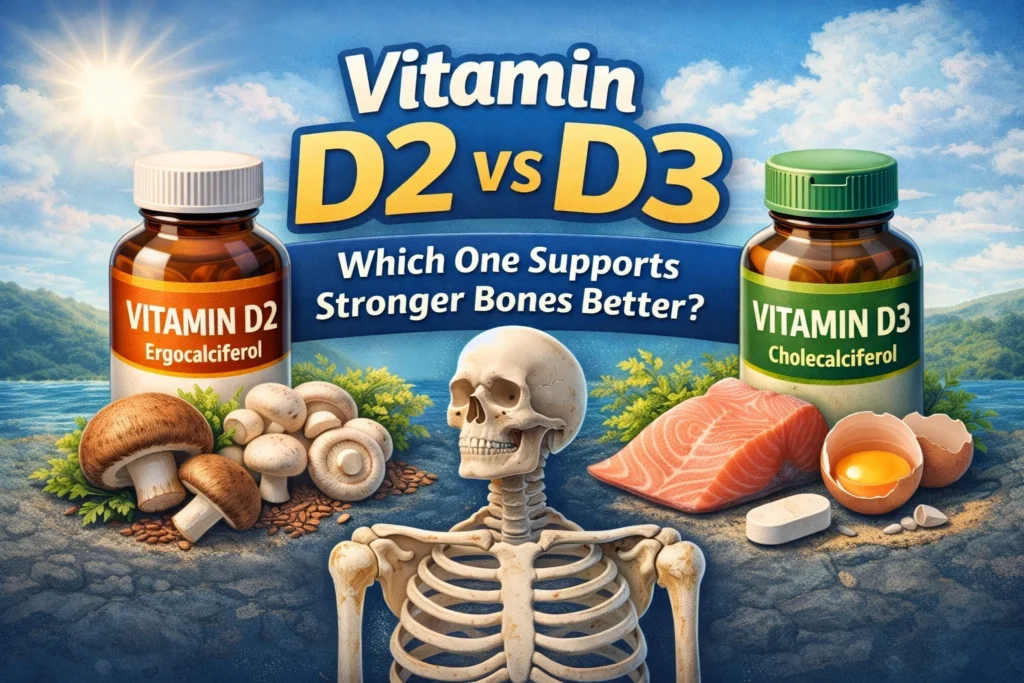
Bones aren’t just “hard sticks.” They’re living tissue that constantly breaks down and rebuilds. And vitamin D is one of the key players that helps that rebuild happen properly—mainly because it helps your gut absorb calcium (and helps regulate calcium and phosphorus balance). (Office of Dietary Supplements)
Now the confusing part: “vitamin D” usually means two different forms in supplements and fortified foods:
- Vitamin D2 (ergocalciferol)
- Vitamin D3 (cholecalciferol)
Both can raise vitamin D levels in your blood, but for bone health—especially if you’re supplementing—the D2 vs D3 choice can matter. (Office of Dietary Supplements)
Let’s make it simple, clinical, and practical.
Best Vitamin D3 & K2 Supplements
Why Vitamin D Matters for Bones (the part people skip)
Your body uses vitamin D to create 25-hydroxyvitamin D [25(OH)D], the main marker doctors test. That’s the “storage” form in blood. Then the body converts it into an active hormone form that helps manage calcium absorption and bone mineral balance. (Office of Dietary Supplements)
When vitamin D is too low, your body can’t use calcium efficiently. Over time, that can contribute to weaker bones. The NIH consumer fact sheet even frames vitamin D + calcium together as protective for bone structure and osteoporosis risk. (Office of Dietary Supplements)
D2 vs D3: The quick difference
Vitamin D2 (ergocalciferol)
- Often made from yeast/fungi exposed to UV light
- Shows up in some fortified foods and some supplements (Office of Dietary Supplements)
Vitamin D3 (cholecalciferol)
- The form your skin makes from sunlight (UVB)
- Found in animal foods and many supplements (and there are vegan D3 options from lichen, depending on the brand) (Office of Dietary Supplements)
Absorption: Both are absorbed in the intestine, and taking vitamin D with a meal that includes some fat improves absorption. (Office of Dietary Supplements)
So the real difference is not absorption. It’s what happens after absorption.
For bone health, what matters most is: which raises 25(OH)D better?
Your bones don’t “care” whether the label says D2 or D3. They care about whether your body reaches and maintains adequate vitamin D status in blood.
What the evidence says
Multiple analyses show vitamin D3 tends to raise total 25(OH)D more than vitamin D2, especially in head-to-head comparisons:
- A well-known meta-analysis (Tripkovic et al., 2012) concluded D3 is more effective than D2 at raising serum 25(OH)D. (PubMed)
- A more recent systematic review of comparative studies (2024) also found D3 produced a greater increase in total 25(OH)D than D2 in daily-dose comparisons. (ScienceDirect)
- NIH ODS notes both forms work, but D3 may raise levels higher and maintain them longer. (Office of Dietary Supplements)
Practical bone-health takeaway
If you’re choosing a supplement mainly to support bone health, D3 is usually the safer “default pick” because it more reliably increases the blood marker tied to bone adequacy in many studies. (Office of Dietary Supplements)
That said: D2 is not useless. It still raises 25(OH)D—just often not as strongly, dose-for-dose. (Office of Dietary Supplements)
But… do vitamin D supplements actually prevent fractures?
This is where bone health gets spicy.
In generally healthy, community-dwelling adults
Several large evidence reviews and trials suggest routine supplementation does not consistently reduce fractures in generally healthy populations not selected for deficiency.
- A large NEJM trial (VITAL fracture analysis) found vitamin D3 supplementation did not lower fracture riskcompared with placebo in generally healthy midlife and older adults not selected for low vitamin D or osteoporosis. (New England Journal of Medicine)
- A JAMA meta-analysis (2017) reported that calcium, vitamin D, or both were not associated with a lower fracture risk in community-dwelling older adults in the included trials. (JAMA Network)
- USPSTF draft guidance (Dec 2024) recommends against vitamin D (with or without calcium) for primary prevention of fractures in community-dwelling postmenopausal women and men ≥60. (uspreventiveservicestaskforce.org)
So is vitamin D pointless for bones?
No. It means one important thing:
Vitamin D is necessary for bone biology, but supplementing everyone “just in case” doesn’t magically translate into fewer fractures. Fracture risk is also driven by muscle strength, balance, falls, medications, overall nutrition (protein!), and bone density conditions.
Where vitamin D tends to be most relevant is when someone has:
- low vitamin D status,
- low calcium intake,
- limited sun exposure,
- malabsorption issues,
- or bone disease risk factors (clinician-guided).
NIH also gives reference ranges for blood levels, noting that levels around 50 nmol/L (20 ng/mL) or above are adequate for most people for bone and overall health and very low levels can weaken bones. (Office of Dietary Supplements)
Bone health isn’t “Vitamin D alone” — it’s a combo
If you want bones that age like a well-built brick house, vitamin D is only one brick.
1) Calcium intake still matters
Vitamin D helps absorb calcium—but you still need calcium in the diet. That’s why many bone-health resources discuss them together. (Office of Dietary Supplements)
2) Weight-bearing + resistance training matters a lot
Bones respond to load. Walking helps, but strength training is the real “bone signal,” because it loads bones through muscle pull and impact patterns.
3) Protein is underrated
Bone matrix isn’t made of calcium alone. Protein supports bone structure and muscle mass, which also reduces falls.
(I’m keeping this section practical because the best bone strategy is never “one nutrient vs another.”)
If you’re picking D2 or D3 specifically for bone health, here’s the clean decision
Choose Vitamin D3 if:
- You want the form that typically raises 25(OH)D more effectively
- You want the “most evidence-backed default” for supplementation (PubMed)
Choose Vitamin D2 if:
- You specifically need D2 (availability or personal preference)
- You’re following a clinician’s plan that uses D2
Again: D2 can work—D3 just tends to be stronger at moving the needle on blood levels. (ScienceDirect)
How much vitamin D is “enough” for bone support?
For general healthy populations, the Dietary Reference Intakes for vitamin D and calcium were built using bone health as the primary indicator. (National Academies)
NIH’s professional fact sheet summarizes recommended intakes and also lists Tolerable Upper Intake Levels (ULs) (the UL is not a target; it’s the ceiling above which risk increases). (Office of Dietary Supplements)
If your audience includes teens: it’s smart to avoid “DIY high-dose” habits. A clinician should guide dosing when you’re treating a confirmed deficiency, especially for minors.
Bone-focused FAQ
Is D3 always better than D2 for bones?
Based on comparative research, D3 is usually better at raising total 25(OH)D, which is tied to bone adequacy. (PubMed)
But bone outcomes (fractures) depend on many variables, and routine supplementation doesn’t guarantee fewer fractures in healthy populations. (New England Journal of Medicine)
Can I just take vitamin D and ignore everything else?
Not if your goal is real bone strength. Vitamin D supports calcium absorption, but bone strength also depends on resistance training, overall diet, and fall risk reduction. (Office of Dietary Supplements)
What vitamin D blood level is considered adequate for bones?
NIH’s consumer sheet notes 50 nmol/L (20 ng/mL) or above is adequate for most people for bone and overall health, while much lower levels may weaken bones. (Office of Dietary Supplements)
Do healthy adults need vitamin D supplements to prevent fractures?
Large trials and USPSTF guidance suggest routine supplementation for primary prevention doesn’t reduce fractures in community-dwelling older adults who aren’t selected for deficiency. (New England Journal of Medicine)
The bottom line for your “bone health” angle
If your post is about bone health and you’re comparing forms:
- Vitamin D3 is generally the better pick for supplementation because it more reliably raises blood 25(OH)D. (PubMed)
- Vitamin D2 still works, especially when it’s the available option or clinician-prescribed—but it often has a smaller effect on total 25(OH)D per equal dose. (ScienceDirect)
- And for fracture prevention, the bigger story is: vitamin D is important, but it’s not a solo act—exercise, calcium intake, and fall-risk reduction often drive the real-world outcomes. (New England Journal of Medicine)