
If you’re weighing sunflower lecithin vs. soy lecithin, you’ve already done the smart thing — you noticed the label says “soy” or “sunflower” and paused to ask whether it matters.
Short answer: it does, but probably not in the way the marketing suggests.
Both are excellent sources of the same active compound. The real differences come down to sourcing, allergens, and what kind of person you are. Let’s sort it out so you can buy with confidence.
Best Lecithin Supplements for Every Needs
Best Sunflower Lecithin Supplements for Breastfeeding Mom
First, What They Share
Strip away the source, and soy and sunflower lecithin are remarkably similar. Both are phospholipid blends led by phosphatidylcholine, with phosphatidylinositol, phosphatidylethanolamine, and essential fatty acids along for the ride.
That means both may help support the same things: healthy cholesterol in the normal range, liver and fat metabolism, brain and choline supply, and smoother milk flow for nursing moms.
So if someone tells you one source is dramatically “more powerful,” be skeptical. The phospholipids are the point, and both deliver them.
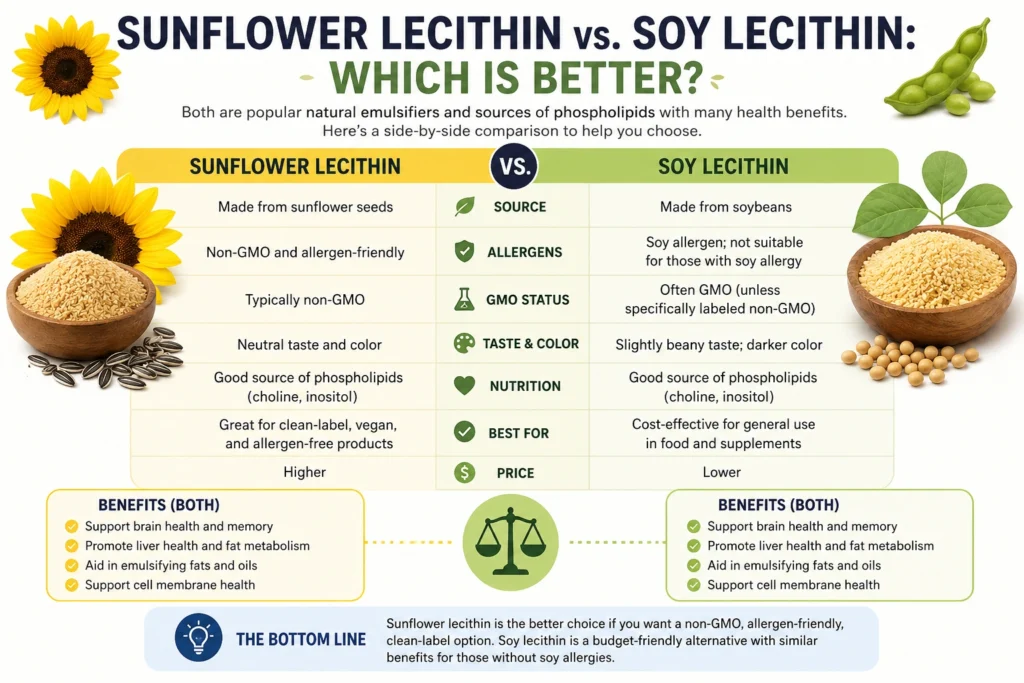
Sunflower vs. Soy Lecithin: Quick Comparison
| Factor | Sunflower Lecithin | Soy Lecithin |
|---|---|---|
| Source | Sunflower seeds | Soybeans |
| GMO status | Naturally non-GMO | Often GMO (look for “identity-preserved”) |
| Allergen | Soy-free | Contains soy |
| Extraction | Usually cold-pressed | Often solvent-extracted |
| Phosphatidylcholine | Rich | Rich |
| Cost | Higher | Lower |
| Research depth | Growing | More studied |
| Best for | Allergies, clean-label, breastfeeding | Budget, broad availability |
Where Soy Lecithin Wins
Soy isn’t the villain the internet makes it out to be. It has real advantages:
- Price. It’s the cheaper option, often by a wide margin.
- Research. Soy lecithin has the longer track record in studies.
- Availability. It’s everywhere, in every form, at every price point.
The catch is GMO sourcing and the soy allergen. Both are easily handled — choose a product that says identity-preserved, non-GMO soy, and skip it entirely if you’re soy-allergic.
Where Sunflower Lecithin Wins
Sunflower has quietly become the favorite for a few good reasons:
- Naturally non-GMO. Sunflower seeds aren’t genetically modified, so you sidestep that worry by default.
- Soy-free. A genuine relief for anyone with a soy allergy or sensitivity.
- Cleaner extraction. It’s usually cold-pressed, which protects the delicate phospholipids better than solvent methods.
The trade-off is cost — you’ll generally pay more. For many readers, the cleaner profile is worth it.
Which Should You Choose?
Here’s how I’d guide a patient in two sentences:
- Pick sunflower if you’re soy-allergic, avoiding GMOs, breastfeeding, or you simply want the cleanest label.
- Pick soy if budget is your priority and soy doesn’t bother you — just choose non-GMO, identity-preserved soy.
There’s no wrong answer. There’s only the right answer for you.
A Quick Note for Breastfeeding Moms
If you’re here because of clogged ducts, go sunflower. It’s soy-free, naturally non-GMO, and it’s what most lactation consultants reach for. It may help support milk flow by thinning sticky milk — though remember, it won’t increase your supply, and you should loop in your provider, especially during pregnancy.
The Bottom Line
In the sunflower lecithin vs. soy lecithin debate, sunflower edges ahead on cleanliness and allergen-friendliness, while soy wins on price and research depth. The phospholipids that do the real work are nearly identical, so choose based on your body and your budget — not the biggest number on the bottle.
Ready to pick a specific product? See our full guides to the [best sunflower lecithin supplements] and the [best lecithin supplements overall] for doctor-vetted picks in every category.