
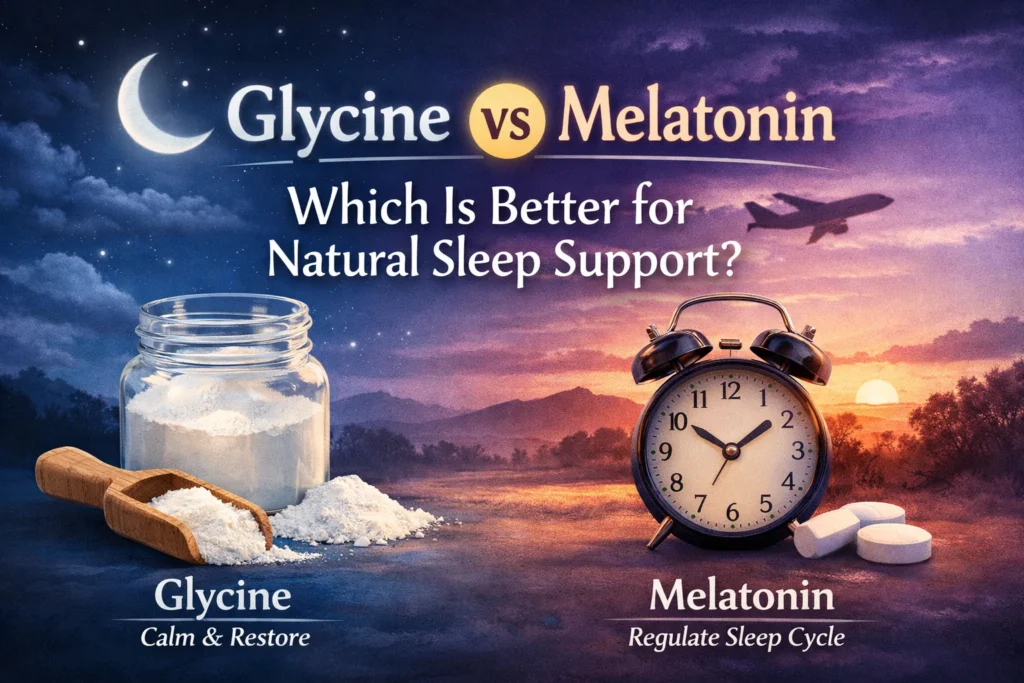
If you’ve ever stared at the ceiling at 2:37 a.m., exhausted but wide awake, you already know this: sleep problems are personal. What works beautifully for one person can leave another feeling worse — groggy, anxious, or frustrated.
That’s why the question “glycine vs melatonin — which is better for sleep?” doesn’t have a one-line answer.
Both are popular. Both are widely used. And both work in very different ways.
This article isn’t about picking a winner. It’s about helping you understand which one makes sense for your body, your sleep pattern, and the reason you’re not sleeping well in the first place.
First, let’s talk about why sleep feels hard
Before comparing supplements, it helps to pause for a moment.
Most people don’t struggle with sleep because they lack willpower. They struggle because something in the sleep systemis off:
- The nervous system doesn’t slow down
- The brain doesn’t cool properly
- Stress signals stay active too late
- The sleep–wake rhythm is misaligned
Melatonin and glycine target different parts of this system. That difference matters more than most people realize.
What Melatonin Actually Does (and what it doesn’t)
Melatonin is a hormone, not a sedative.
Your brain releases melatonin in response to darkness. It’s a signal — a biological “night mode” message — telling your body that it’s time to prepare for sleep.
Think of melatonin as a timekeeper, not a sleep enforcer.
What melatonin helps with
Melatonin is most useful when sleep problems are related to timing, such as:
- Jet lag
- Shift work
- Delayed sleep phase (feeling sleepy very late)
- Inconsistent sleep schedules
In these cases, melatonin helps reset the internal clock.
What melatonin does not do
Melatonin does not:
- Calm an overactive nervous system
- Reduce nighttime anxiety
- Relax tense muscles
- Improve deep sleep quality directly
This is where many people feel disappointed. They take melatonin, feel sleepy at first, but still wake up restless — or wake up feeling heavy and foggy.
That’s not failure. It’s a mismatch.
Common issues people experience with melatonin
Melatonin works well for some people. But it also comes with real drawbacks that often go unspoken.
Some users report:
- Morning grogginess
- Headaches
- Vivid or unsettling dreams
- A “hungover” feeling
- Reduced natural melatonin production over time
Another issue is dose confusion. Many supplements contain 3–10 mg, while research suggests much lower doses (0.3–1 mg) are often more appropriate.
More is not better with melatonin.
What Glycine Is — and why it’s different
Glycine is an amino acid, not a hormone.
Your body uses glycine every day for:
- Nervous system regulation
- Collagen formation
- Glutathione (antioxidant) production
- Neurotransmitter balance
In the brain, glycine acts as an inhibitory neurotransmitter. That means it helps quiet excessive neural activity.
Instead of telling your body when to sleep (like melatonin), glycine helps your body feel safe enough to sleep.
That distinction matters.
How Glycine Supports Sleep (without forcing it)
Glycine doesn’t knock you out. And that’s exactly why many people prefer it.
1. It calms the nervous system
If your mind races at night — thoughts looping, body tired but alert — glycine helps reduce that background noise.
It works gently, more like turning down a dimmer switch than flipping a breaker.
2. It helps lower core body temperature
Your body needs to cool slightly to fall asleep. Glycine supports this natural drop, which can make falling asleep feel smoother and more natural.
3. It supports sleep quality, not just onset
Many people notice:
- Fewer nighttime awakenings
- Deeper, more refreshing sleep
- Less morning grogginess
Glycine doesn’t override your biology. It supports it.
Glycine feels subtle — and that’s not a weakness
One reason glycine gets overlooked is because it doesn’t feel dramatic.
There’s no “hit.” No rush. No forced drowsiness.
Instead, people often say things like:
- “I just slept better.”
- “I didn’t wake up as much.”
- “I felt calmer at night.”
That quiet effectiveness is often what long-term users value most.
Glycine vs Melatonin: Side-by-side comparison
Here’s the clearest way to understand the difference.
Melatonin
- A hormone
- Signals sleep timing
- Best for circadian rhythm issues
- Can cause grogginess or vivid dreams
- Works fast, sometimes too fast
Glycine
- An amino acid
- Calms the nervous system
- Supports natural sleep processes
- Usually no next-day heaviness
- Builds benefit with consistency
Neither is “better” in all cases. They simply serve different needs.
Which one should you choose?
Let’s get practical.
Glycine may be a better fit if:
- You feel tired but wired at night
- Stress or anxiety keeps your mind active
- You fall asleep but wake often
- You want non-hormonal sleep support
- You’re sensitive to supplements
Melatonin may be a better fit if:
- Your sleep schedule is shifted late
- You travel across time zones
- You work rotating shifts
- You struggle to feel sleepy at all
And for some people, low-dose melatonin + glycine together works well — timing and dose matter a lot here.
Can you take glycine and melatonin together?
Yes — cautiously and intentionally.
Some people use:
- Glycine nightly for nervous system calm
- Low-dose melatonin (0.3–1 mg) occasionally for timing support
The key is avoiding high melatonin doses that overpower your system.
If you try both together, start low. Listen to how your body responds.
Why many people move away from melatonin over time
This is something you hear quietly, not in ads.
Many long-term users say:
- Melatonin worked at first
- Then it stopped feeling right
- Or they needed more to feel the same effect
Because melatonin is a hormone, your body can adapt to external intake.
Glycine doesn’t work that way. It supports pathways your body already uses.
That’s why many people eventually switch — not because melatonin is “bad,” but because glycine feels more sustainable.
Is glycine safe for long-term use?
For most healthy adults, glycine is considered well tolerated, even with long-term daily use.
Typical sleep doses are around 3 grams before bedtime.
Possible side effects are usually mild:
- Digestive discomfort at high doses
- Daytime relaxation if taken too early
If you have kidney disease, are pregnant, or take multiple amino acid supplements, professional guidance is wise.
A gentle reminder about sleep supplements
No supplement replaces:
- Consistent sleep timing
- Light exposure during the day
- Reducing stimulation at night
But the right support can make those habits actually work.
Sleep shouldn’t feel like a battle.
So… glycine or melatonin?
If sleep issues feel like a timing problem, melatonin may help.
If sleep issues feel like a nervous system problem, glycine is often the gentler, more satisfying choice.
Many people who felt disappointed by melatonin discover that glycine meets them where they are — quietly, patiently, without pressure.
And sometimes, that’s exactly what sleep needs.