
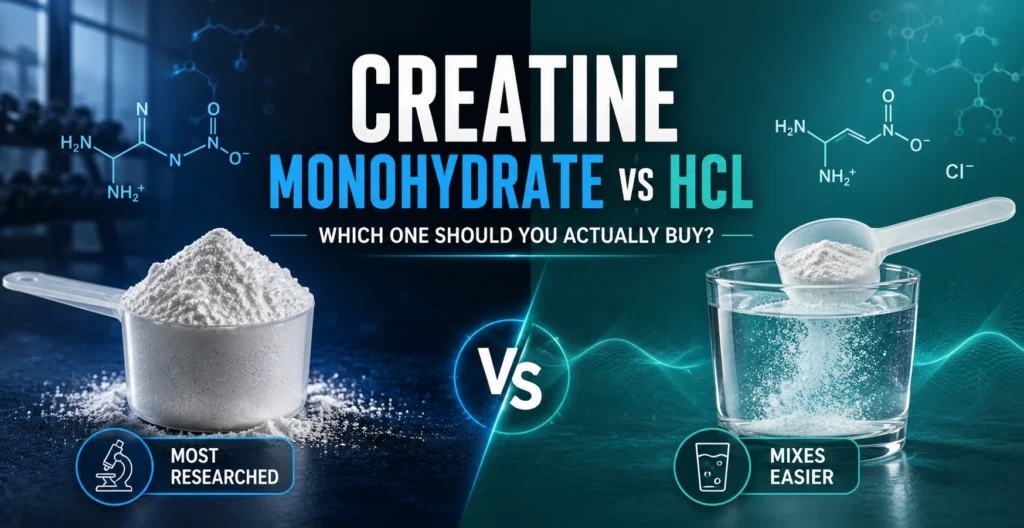
Creatine used to be simple.
You bought creatine monohydrate, mixed it with water, trained hard, and got on with your life.
Now? The supplement aisle looks like a chemistry exam. Creatine HCL. Buffered creatine. Creatine nitrate. Gummies. Chews. Capsules. “Ultra-absorbable” this. “No bloating” that.
And somewhere in the middle of all that marketing noise, a simple question gets buried:
Is creatine HCL actually better than creatine monohydrate — or is monohydrate still the smarter buy?
Here’s the honest answer: for most people, creatine monohydrate is still the better first choice. It is more studied, usually cheaper, easier to dose, and strongly supported for strength, high-intensity exercise performance, and lean mass when paired with resistance training. The International Society of Sports Nutrition position stand describes creatine monohydrate as one of the most effective nutritional ergogenic aids available for athletes and active people. (PMC)
Creatine HCL is not useless. It may mix better. Some people find it easier on the stomach. Capsules can also be convenient. But “more soluble” does not automatically mean “better results.”
That distinction matters.
Because in supplements, the most expensive option is not always the most effective one.
Best Creatine for Women over 50
Quick Verdict: Creatine Monohydrate Wins for Most People
If you want the simplest answer, here it is:
Choose creatine monohydrate if you want the most proven, affordable, and reliable form of creatine.
Choose creatine HCL only if you have a specific reason — like poor tolerance, dislike of gritty powders, or a strong preference for capsules.
That’s the practical difference.
Creatine monohydrate has decades of research behind it. It has been studied in athletes, resistance-trained people, older adults, and clinical contexts. The evidence base is much larger than what we have for creatine HCL. (PMC)
Creatine HCL, on the other hand, is mostly sold around the idea that it dissolves better and may require a smaller serving. That may sound impressive on a label, but the evidence that HCL clearly outperforms monohydrate in muscle gain, strength, or performance is still limited. A 2024 paper notes that marketing claims often suggest creatine HCL is more bioavailable than creatine monohydrate, but those claims are not the same as strong proof of superior real-world outcomes. (PMC)
So, if you are buying your first creatine supplement, don’t overthink it.
Start with monohydrate.
What Is Creatine Monohydrate?
Creatine monohydrate is the classic form of creatine. Chemically, it is creatine attached to one water molecule. That sounds boring, but boring is often good in the supplement world.
It means the form is stable, widely studied, affordable, and predictable.
Creatine helps your body regenerate ATP, the fast-energy currency your muscles use during short bursts of effort. Think heavy sets, sprints, repeated reps, hill climbs, or any activity where your muscles need quick power.
That is why creatine is popular for:
- Strength training
- Muscle growth
- High-intensity exercise
- Power output
- Workout recovery support
- Healthy aging and muscle preservation
Creatine monohydrate is the form used in most major creatine studies. The ISSN position stand specifically identifies creatine monohydrate as highly effective for increasing muscle creatine stores and improving high-intensity exercise capacity. (PMC)
And this is where monohydrate has a huge advantage.
It does not need a fancy story.
It already has the evidence.
What Is Creatine HCL?
Creatine HCL, or creatine hydrochloride, is creatine bound to hydrochloric acid.
The main selling point is solubility. In plain English, it usually dissolves more easily in water than standard creatine monohydrate. That can make it feel smoother to drink and less gritty.
Some creatine HCL products also come in smaller serving sizes or capsule form, which can be convenient for people who hate scooping powder.
That part is fair.
But then the marketing often takes a bigger leap.
You may see claims suggesting creatine HCL is better absorbed, more powerful, does not require loading, causes less bloating, or works at a much lower dose. The problem is that these claims are not as strongly supported as the marketing makes them sound. A 2020 review notes that creatine HCL is claimed to have higher absorption and no loading requirement, but those are manufacturer-driven claims that need stronger comparative evidence. (ScienceDirect)
So, creatine HCL may be more convenient.
But convenience is not the same as superiority.
That is the part many supplement labels quietly skip.
Creatine Monohydrate vs HCL: Main Differences
| Feature | Creatine Monohydrate | Creatine HCL |
|---|---|---|
| Research support | Very strong | Much more limited |
| Cost | Usually cheaper | Usually more expensive |
| Solubility | Can be slightly gritty | Usually dissolves better |
| Typical dose | Commonly 3–5 g daily | Varies by product |
| Best for | Most beginners and regular users | People who dislike powder or have tolerance issues |
| Evidence for performance | Stronger | Less established |
| Value for money | Excellent | Depends on price and dose |
The simple takeaway:
Monohydrate wins on evidence and value. HCL wins mainly on mixability and convenience.
That does not make HCL bad. It just means it has not earned the “better than monohydrate” crown.
Which One Works Better for Muscle Growth?
For muscle growth, creatine monohydrate is the safer recommendation.
Not because HCL cannot work. It likely can help supply creatine too. But when we talk about evidence-backed muscle support, most of the research is built on monohydrate.
Creatine does not build muscle like protein does. It does not directly become muscle tissue. Instead, it helps your muscles perform better during repeated high-intensity efforts. Over time, better training volume and strength progression can support lean mass gains when paired with resistance training and enough protein.
That is the real mechanism.
No magic. No superhero serum. Just better energy support for hard training.
The ISSN position stand supports creatine supplementation for improving high-intensity exercise capacity and lean mass when combined with training. (PMC)
So if your goal is muscle growth, the boring choice is still the smart one:
Creatine monohydrate. 3–5 grams daily. Taken consistently.
That will beat most “advanced creatine matrix” labels that look impressive but hide weak dosing.
Which One Is Better for Strength and Performance?
Again, monohydrate has the stronger case.
Most strength and performance studies use creatine monohydrate. That matters because supplement recommendations should follow the evidence, not the advertising.
Creatine monohydrate can increase muscle creatine stores, which helps support rapid ATP regeneration during intense exercise. That is why it is commonly used for lifting, sprinting, repeated explosive efforts, and other high-output activities. (PMC)
Creatine HCL may still help some people indirectly if they simply prefer it and take it more consistently. And honestly, consistency matters more than people admit.
A supplement sitting untouched in your kitchen cabinet has a success rate of exactly zero.
So if HCL is the only form you will actually take every day, that matters.
But biologically, we cannot say HCL is clearly better for strength than monohydrate based on the current evidence.
Better-tasting? Maybe.
Better-dissolving? Often.
Better proven? No.
Absorption and Bioavailability: Is Creatine HCL Really Better?
This is the section where marketing gets slippery.
Creatine HCL is often advertised as having better absorption because it dissolves more easily in water. That sounds logical at first.
But here is the catch:
Solubility in a glass is not the same as superior muscle uptake or better performance.
Your body is not a shaker bottle.
A supplement can dissolve beautifully and still fail to outperform the older, cheaper option in meaningful outcomes.
A 2024 study discussing creatine HCL notes that marketing claims often suggest higher bioavailability than creatine monohydrate, but the paper also highlights how those claims rely on limited evidence and simulated conditions rather than clear proof that HCL produces superior training results. (PMC)
That is the point buyers need to understand.
Creatine HCL may be more soluble. That is useful.
But creatine monohydrate already works very well when taken consistently at the right dose.
So the better question is not:
“Which one dissolves faster?”
The better question is:
Which one has the best proof, best price, and best chance of giving me the result I want?
For most people, that answer is still monohydrate.
Dosage: How Much Should You Take?
Creatine Monohydrate Dosage
A common maintenance dose for creatine monohydrate is 3–5 grams per day.
Some people use a loading phase, often around 20 grams per day split into multiple doses for 5–7 days, followed by a maintenance dose. But loading is optional. The ISSN position stand describes loading strategies such as 5 g of creatine monohydrate four times daily for several days to rapidly increase muscle creatine stores. (PMC)
But you do not have to load.
If you take 3–5 grams daily, your muscle creatine stores will still rise over time. It just takes longer.
For most regular users, I prefer the simple route:
Take 3–5 grams daily. Don’t make it dramatic.
No cycling. No complicated timing. No spreadsheet.
Just take it consistently.
Creatine HCL Dosage
Creatine HCL dosage varies more by product.
Some brands recommend much smaller servings than monohydrate. But because serving sizes differ so much, it is better to follow the label of the specific product.
Do not assume every HCL product gives you an equivalent amount of usable creatine. Check the label carefully.
This is especially important with capsules and gummies, where the serving size may look convenient but the actual creatine amount can be lower than expected.
Side Effects: Which One Is Easier on the Stomach?
Creatine monohydrate is generally well tolerated by healthy adults when used at recommended doses. A 2021 review addressing common questions and misconceptions about creatine reports that creatine supplementation is generally safe and well tolerated, especially at recommended intakes. (PMC)
Still, some people report:
Mild bloating
Water weight gain
Stomach discomfort
Loose stool if taking too much at once
Grittiness when mixed in water
Most of these issues are practical, not dangerous.
For example, taking 5 grams in one large scoop on an empty stomach may bother some people. Splitting the dose, taking it with food, or choosing a micronized monohydrate can help.
Creatine HCL may feel easier for some users because it dissolves better and often uses smaller serving sizes. But again, that is individual tolerance — not proof that HCL is automatically safer or more effective.
A good rule:
If monohydrate agrees with your stomach, there is no strong reason to switch.
But if monohydrate consistently bothers you, HCL is a reasonable alternative to try.
Does Creatine Cause Water Weight?
Creatine can increase body weight in some users, especially early on. But that weight is often related to increased water stored inside muscle cells, not fat gain.
This is one reason some beginners panic after seeing the scale move.
But the scale does not tell the whole story.
If you gain one or two pounds after starting creatine, that does not mean you suddenly gained fat. It may simply reflect increased water retention within muscle tissue.
That is not necessarily a bad thing. It is part of how creatine works.
For readers worried about this, you can also read: 11 Best Creatine Supplements for Women Over 50
That article is especially useful because women are often unfairly warned away from creatine because of the “weight gain” fear.
Price and Value: Which One Saves More Money?
Creatine monohydrate usually wins here, and it is not close.
A plain monohydrate powder often gives you more servings for less money. HCL products are commonly more expensive because they are marketed as premium, more soluble, or more advanced.
Sometimes paying more makes sense.
For example, if someone hates powder and will only take capsules, then a pricier HCL capsule may be worth it because it improves compliance.
But if you are comparing evidence, cost per serving, and expected results, monohydrate is hard to beat.
This is why I like monohydrate for most buyers.
It does not ask you to pay extra for a promise that has not been clearly proven.
Taste, Mixing, and Convenience
This is where creatine HCL has a real argument.
Creatine monohydrate can be gritty. Some powders settle at the bottom of the glass. Micronized versions mix better, but even then, the texture may bother some people.
Creatine HCL usually dissolves more easily. That can make it more pleasant to drink.
Capsules are also cleaner and easier for travel.
So the decision becomes practical:
If you care most about research and value, choose monohydrate.
If you care most about easy mixing or capsule convenience, HCL may be worth considering.
That is a fair tradeoff.
Just do not buy HCL because a label tells you it is automatically superior.
Buy it because it fits your routine better.
Creatine Monohydrate vs HCL for Beginners
Beginners should usually start with creatine monohydrate.
Here’s why:
It is simple.
It is affordable.
It has the strongest evidence.
The dose is easy: 3–5 grams daily.
You do not need a loading phase.
You do not need a “proprietary creatine matrix.”
Most beginners do not fail because they chose the wrong advanced form.
They fail because they make supplementation too complicated.
Start with creatine monohydrate. Take it daily. Train consistently. Eat enough protein. Sleep properly.
That boring plan works better than most shiny-label formulas.
You may also like: 10 Best Ashwagandha Supplements for Men in 2026 if your bigger issue is stress, poor sleep, or workout recovery rather than creatine choice alone.
Who Should Choose Creatine Monohydrate?
Creatine monohydrate is the better choice for most people, especially if you are:
New to creatine
Trying to build muscle
Training for strength
Budget-conscious
Using creatine long-term
Looking for the most studied form
Fine with powder
Trying to avoid overhyped supplement claims
It is also the better default choice if you are older and using creatine as part of a healthy aging or muscle-preservation routine.
For that angle, read: 11 Best Creatine for Men Over 50 in 2026
Who Should Choose Creatine HCL?
Creatine HCL may make sense if you:
Dislike gritty powders
Prefer capsules
Travel often
Get stomach discomfort from monohydrate
Want a form that mixes more smoothly
Are willing to pay more for convenience
But I would not make HCL the default first choice.
It is better viewed as a backup option or comfort upgrade.
Not a magic upgrade.
Not a “monohydrate is outdated” replacement.
Just an alternative.
And that is perfectly fine.
Common Myths About Creatine Monohydrate and HCL
Myth 1: Creatine HCL Builds More Muscle Than Monohydrate
There is not strong evidence showing HCL builds more muscle than monohydrate.
Creatine HCL may dissolve better, but that does not prove superior muscle growth.
Myth 2: Creatine Monohydrate Is Outdated
Older does not mean weaker.
In this case, older means better studied. Creatine monohydrate is still the reference form because it has the strongest evidence base.
Myth 3: You Must Load Creatine
You do not have to load creatine.
Loading can saturate muscles faster, but daily maintenance dosing can still work over time. The ISSN position stand describes loading as an effective strategy, but it is not the only way to use creatine. (PMC)
Myth 4: Creatine Is Only for Bodybuilders
Creatine is popular in bodybuilding, but it is not only for bodybuilders.
It is used by strength athletes, recreational lifters, older adults, and people interested in exercise performance and muscle function. The ISSN position stand covers creatine use across exercise, sport, and medicine. (PMC)
Myth 5: More Expensive Creatine Must Be Better
Not necessarily.
Sometimes you are paying for third-party testing, better packaging, better flavor, or convenience. Those can be worthwhile.
But if you are paying extra only because the label says “advanced absorption,” be careful.
That claim needs evidence.
Safety Note: Who Should Be Careful With Creatine?
Creatine is generally considered safe for healthy adults when used appropriately, but that does not mean everyone should take it casually. Reviews addressing creatine safety generally report good tolerability at recommended intakes, but individual health context still matters. (PMC)
Speak with a healthcare professional before taking creatine if you:
Have kidney disease
Have significant liver or kidney-related lab abnormalities
Are pregnant or breastfeeding
Take multiple prescription medications
Have a complex chronic medical condition
Are under medical supervision for hypertension, diabetes, or kidney risk
This is not fearmongering.
It is basic supplement responsibility.
Creatine is not a replacement for training, nutrition, sleep, or medical care. It is a tool. A useful one — but still a tool.
Final Verdict: Creatine Monohydrate vs HCL
If you want the most proven creatine, choose creatine monohydrate.
It has the best research support, the best value, and the most predictable dosing. For muscle, strength, performance, and long-term use, it remains the first choice for most people.
Creatine HCL is not a bad supplement. It may be useful if you dislike gritty powders, want better mixability, prefer capsules, or have stomach discomfort with monohydrate.
But it is not clearly better.
That is the key point.
Creatine HCL may be more convenient. Creatine monohydrate is more proven.
And if you are spending your own money, that difference matters.
FAQs About Creatine Monohydrate vs HCL
Is creatine HCL better than monohydrate?
Not for most people. Creatine HCL may dissolve better, but creatine monohydrate has stronger research support and usually offers better value.
Does creatine HCL cause less bloating?
Some people report less bloating with HCL, possibly because it dissolves better or uses smaller serving sizes. But this varies from person to person.
Which creatine is best for muscle growth?
Creatine monohydrate is the better-supported option for muscle growth because most research on creatine and lean mass uses monohydrate.
Which creatine is best for beginners?
Creatine monohydrate is usually best for beginners. It is affordable, simple, and well studied.
Do I need to load creatine monohydrate?
No. Loading is optional. You can take 3–5 grams daily and still increase muscle creatine stores over time.
Can I take creatine HCL every day?
Most creatine HCL products are designed for daily use, but serving sizes vary. Follow the specific product label.
Is creatine monohydrate safe?
For healthy adults, creatine monohydrate is generally considered safe when used at recommended doses. People with kidney disease or significant medical conditions should consult a healthcare professional first. (PMC)
Is creatine HCL worth the extra money?
It may be worth it if you strongly prefer better mixability or capsules. But if you want the best evidence-to-price ratio, monohydrate is usually the smarter buy.