
You don’t suddenly wake up one day with poor memory.
It builds quietly.
You forget where you placed your phone. You read a paragraph twice. Names don’t come as fast.
Most people blame age. Some blame stress.
But here’s what I see in practice—diet is one of the most overlooked drivers of memory performance.
Your brain is not just thinking. It’s biochemistry in motion. And what you eat directly shapes how efficiently it works.
Certain foods may help support memory, focus, and long-term cognitive health. Others slowly push your brain in the opposite direction.
Let’s get this straight—no fluff, no exaggerated claims.
Just what actually matters.
🧬 Why Your Diet Directly Affects Memory
Your brain is metabolically expensive. It consumes a significant portion of your daily energy.
But energy alone doesn’t cut it.
It needs:
- Structural fats
- Micronutrients
- Antioxidants
- Stable glucose supply
Without these, processes like
neuroplasticity start to decline.
That’s when you begin to notice:
- Slower recall
- Reduced attention span
- Mental fatigue
At the cellular level, two major mechanisms drive this decline:
1. oxidative stress
Free radicals damage neurons over time.
2. neuroinflammation
This disrupts communication between brain cells.
Now here’s the interesting part.
Certain foods actively help counter these processes. That’s where brain-supportive nutrition comes in.
⚙️ How Brain Foods Actually Work (No Confusion)
Forget vague claims like “boosts brain power.”
Let’s talk mechanisms.
These foods support memory through four key pathways:
🧠 Improved cerebral blood flow
More oxygen and nutrients reach your brain.
🧠 Structural support for neurons
Healthy fats maintain cell integrity.
🧠 Reduced inflammation
Keeps signaling pathways efficient.
🧠 Neurotransmitter support
These chemicals control learning and recall.
This is why diet is not optional—it’s foundational.
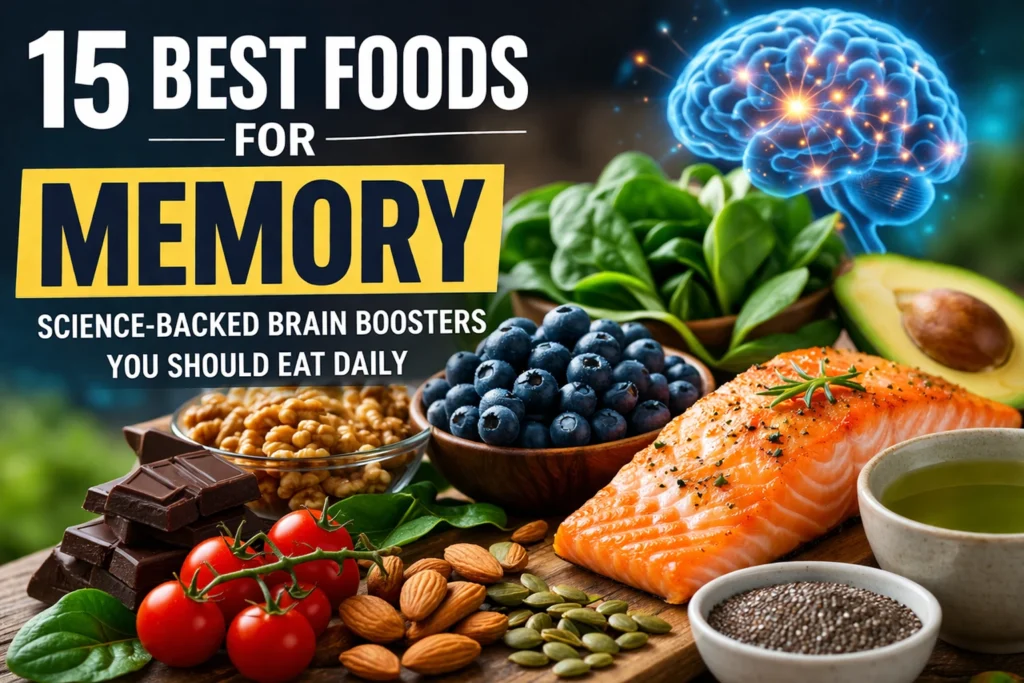
🏆 15 Best Foods for Memory and Brain Function
Now we get practical.
These are not trendy picks. These are foods consistently discussed in research and clinical nutrition contexts.
🫐 1. Blueberries – Small Fruit, Big Brain Impact
If I had to pick one food to start with, it would be blueberries.
They are packed with anthocyanins—powerful compounds linked with brain health.
Why they matter
- Help reduce oxidative stress
- Support communication between brain cells
- May slow cognitive decline (observational data suggests this trend, though exact effects vary)
What real users say
Many people report better mental clarity when they include berries regularly. It’s subtle, but noticeable over time.
How to use
Add a handful to breakfast. Daily use works better than occasional intake.
🐟 2. Fatty Fish – The Brain’s Structural Fuel
This is non-negotiable.
Fatty fish like salmon and sardines provide omega-3 fatty acids, especially DHA.
Why it stands out
- DHA is a core component of brain cell membranes
- Supports learning and memory processes
- Low intake is associated with cognitive decline patterns
What makes it different
Unlike most foods, omega-3s directly become part of brain structure.
How to use
2–3 servings per week is a realistic target.
🥜 3. Walnuts – Practical Brain Support You Can Snack On
Easy. Affordable. Effective.
Walnuts contain:
- Omega-3 fatty acids
- Polyphenols
- Vitamin E
Why they help
- May protect brain cells from oxidative damage
- Support long-term cognitive health
Real-life advantage
No prep needed. Just grab a handful.
🥬 4. Leafy Greens – Quiet but Powerful
Spinach. Kale. Broccoli.
These don’t get hype—but they should.
Key nutrients
- Vitamin K
- Folate
- Lutein
A study in Neurology (2018) associated higher intake with slower cognitive decline. I cannot confirm exact causation, but the association is consistent.
Why they work
They support overall brain maintenance rather than quick boosts.
How to use
At least one serving daily.
🥚 5. Eggs – Underrated Memory Nutrient Source
Eggs are one of the best sources of choline.
This nutrient is essential for producing acetylcholine—a neurotransmitter involved in memory.
Why it matters
Without adequate choline, memory processes can become less efficient.
What makes eggs practical
Affordable. Accessible. Easy to include daily.
☕ 6. Coffee – More Than Just Wakefulness
Most people drink coffee for energy.
But it also supports:
- Alertness
- Reaction time
- Short-term memory
What research suggests
Some observational studies link regular intake with lower risk of cognitive decline. This is not definitive cause-and-effect, but the trend appears repeatedly.
Key tip
Moderation matters. Too much backfires.
🍫 7. Dark Chocolate – Cognitive Boost with a Catch
Yes, chocolate made the list.
But not the sugary kind.
What it contains
- Flavonoids
- Antioxidants
- Mild caffeine
Why it helps
- May improve blood flow to the brain
- Supports short-term cognitive performance
The catch
Go for 70% cocoa or higher. Otherwise, sugar cancels the benefit.
🥑 8. Avocados – Fat That Supports Brain Circulation
Your brain loves healthy fats.
Avocados provide monounsaturated fats that support blood flow.
Why it matters
Better circulation = better nutrient delivery to brain cells.
Practical benefit
Also supports heart health—which indirectly supports brain function.
🌰 9. Pumpkin Seeds – Small but Nutrient-Dense
Don’t underestimate these.
They’re rich in:
- Magnesium
- Zinc
- Iron
Why this matters
These minerals play roles in nerve signaling and brain function.
Real advantage
Portable. Cheap. Easy snack.
🍊 10. Oranges – Simple but Effective
Sometimes the simplest foods work best.
Oranges are rich in vitamin C.
Why it helps
Vitamin C acts as an antioxidant, protecting brain cells.
Low levels are associated with impaired thinking in some studies.
🍅 11. Tomatoes – Lycopene for Brain Protection
Tomatoes contain lycopene, an antioxidant.
Why it matters
May help protect against cellular damage in the brain.
🧅 12. Turmeric – Anti-Inflammatory Support
Curcumin, the active compound, has been studied for its anti-inflammatory effects.
What we know
Some studies suggest cognitive benefits, but results are mixed. I cannot confirm strong clinical outcomes yet.
Still, it supports overall brain-friendly nutrition.
🌾 13. Whole Grains – Stable Energy Source
Your brain runs on glucose.
But it needs it steady—not spikes.
Why whole grains help
They provide slow, stable energy.
This supports:
- Focus
- Sustained attention
🫘 14. Beans – Consistent Brain Fuel
Beans provide:
- Fiber
- B vitamins
Why it matters
They stabilize blood sugar—critical for mental clarity.
🍵 15. Green Tea – Calm, Focused Energy
Green tea offers a rare combination:
- Caffeine (alertness)
- L-theanine (calm focus)
Why it stands out
You get focus without jitter.
🔑 What Most People Get Wrong
They look for a “magic food.”
It doesn’t exist.
Memory improvement comes from patterns, not single items.
You don’t need all 15 daily.
You need consistency.
🥗 A Practical Memory-Boosting Diet Plan (That You’ll Actually Follow)
Most readers fail here.
Not because they don’t know the foods—but because they don’t know how to combine them daily.
So let’s make this realistic.
🧠 Morning (Kickstart Focus)
- 2 eggs (choline support)
- Whole grain toast (stable glucose)
- Blueberries (antioxidants)
- Coffee or green tea
👉 This combo supports alertness + memory encoding early in the day.
🧠 Midday (Sustain Cognitive Performance)
- Fatty fish (omega-3s)
- Leafy greens (micronutrients)
- Avocado (healthy fats)
👉 This helps maintain steady brain energy without afternoon crashes.
🧠 Snack (Prevent Mental Fatigue)
- Walnuts or pumpkin seeds
- Orange
👉 Keeps blood sugar stable. Prevents brain fog.
🧠 Evening (Recovery Mode)
- Beans or lentils
- Vegetables with turmeric
👉 Supports repair + anti-inflammatory pathways overnight.
⚠️ Reality Check
You don’t need perfection.
Even adding 3–4 of these foods daily may help support noticeable improvement over time.
⚠️ Foods That May Harm Memory (Most People Ignore This)
You can eat all the right foods…
…but if you keep eating these, progress slows.
❌ Excess sugar
Spikes blood glucose → crashes → brain fog
❌ Highly processed foods
Low nutrient density + promotes inflammation
❌ Trans fats
Associated with impaired cognitive performance in multiple observational studies
❌ Ultra-refined carbs
Cause energy instability → poor focus
👉 This matters because these foods worsen
neuroinflammation,
which interferes with brain signaling.
👥 Who Needs Memory-Boosting Foods the Most
This isn’t just for older adults.
You’ll benefit significantly if you fall into any of these:
🧠 Students
Need better focus, retention, and recall
🧠 Professionals
Mental fatigue and long working hours
🧠 Adults over 40
Natural cognitive decline begins gradually
🧠 High-stress individuals
Stress affects memory formation
💊 Foods vs Supplements for Memory (The Honest Take)
Let’s be clear.
Food is your foundation.
But here’s what I see repeatedly:
People don’t eat consistently enough.
That’s where supplements come in.
🧠 Where Food Wins
- Broad nutrient coverage
- Long-term health support
- Sustainable habit
🧠 Where Supplements Help
- Fill nutritional gaps
- Provide concentrated nutrients
- Convenient for busy routines
Practical Example
If you:
- Don’t eat fish → omega-3 supplement may help
- Don’t eat enough greens → micronutrient gaps appear
- Have high stress → certain nootropics may support focus
⏳ How Long Does It Take to Notice Results
This is where most people quit too early.
Let’s set expectations properly.
⏱️ Short-term (days to 1 week)
- Better alertness
- Improved focus
⏱️ Medium-term (2–6 weeks)
- More stable concentration
- Less brain fog
⏱️ Long-term (8–12+ weeks)
- Noticeable memory support
- Better mental clarity
👉 Based on available research patterns, consistent intake matters more than any single food.
🧠 Subtle Signs Your Diet Is Helping Your Brain
You won’t suddenly feel like a genius.
Instead, you’ll notice:
- You recall names faster
- You reread less
- You feel mentally “lighter”
- Your focus lasts longer
These are real-world indicators.
🏁 Final Verdict (This Is What Actually Works)
There’s no miracle food.
But there is a pattern that works.
If you consistently include:
- Fatty fish
- Leafy greens
- Berries
- Nuts
- Eggs
You’re giving your brain what it needs to perform better over time.
🎯 If you want a simple starting point:
Start with just this:
- Add blueberries daily
- Eat eggs in the morning
- Include fish 2–3 times weekly
That alone puts you ahead of most people.
FAQs
What is the best food for memory?
There is no single best food. A combination of fatty fish, berries, leafy greens, and nuts works best for supporting memory.
Do brain foods actually improve memory?
They may help support brain function and cognitive health over time. However, they do not replace medical treatment for neurological conditions.
Can diet reverse memory loss?
Diet may support brain health but cannot reverse serious conditions like dementia based on current scientific evidence.
Which foods improve memory and concentration quickly?
Coffee, green tea, and dark chocolate may support short-term focus due to caffeine and flavonoids.
How long does it take for brain foods to work?
Some effects like alertness may appear quickly, while memory-related benefits typically take weeks to months of consistent intake.
What foods should I avoid for better memory?
Highly processed foods, excess sugar, and trans fats may negatively impact brain health.