
Glutathione is already confusing enough.
Then you start shopping for a supplement and suddenly you see different forms everywhere: reduced glutathione, liposomal glutathione, S-acetyl glutathione, Setria glutathione, sublingual glutathione, topical glutathione, and even injectable glutathione.
For most supplement buyers, two premium forms usually stand out:
Liposomal glutathione and S-acetyl glutathione.
Both are marketed as better than ordinary glutathione. Both are usually more expensive. Both are often promoted for antioxidant support, skin glow, liver health, immune function, and healthy aging.
But are they actually different? And if you are spending more money, which one makes more sense?
Here’s the simple answer:
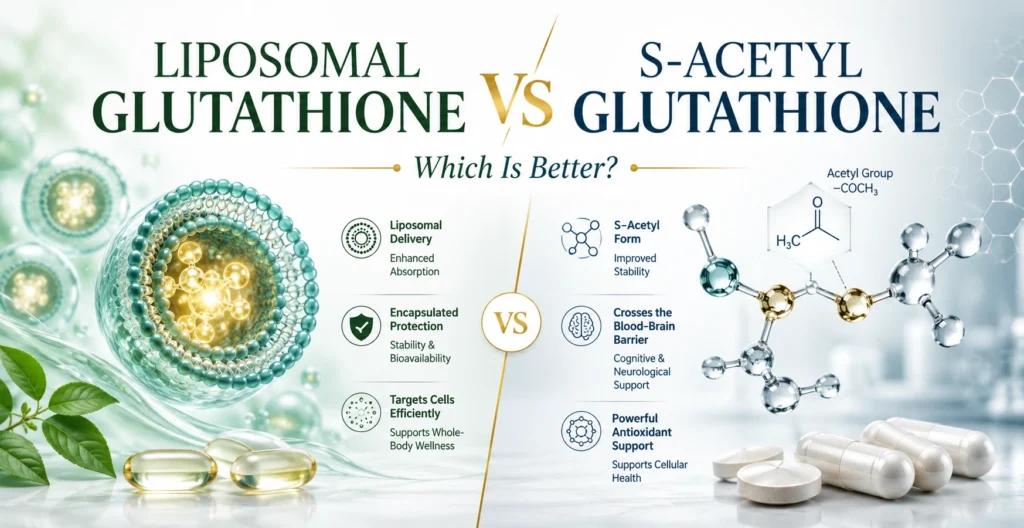
Liposomal glutathione is usually the better-studied premium form for oral delivery, while S-acetyl glutathione is a stability-focused form that may be a strong option but has less direct human evidence.
That does not mean one is perfect and the other is useless. It means they solve slightly different problems.
In this guide, we’ll compare liposomal glutathione vs S-acetyl glutathione in terms of absorption, stability, benefits, dosage, side effects, price, and who should choose which.
For broader context, read our glutathione benefits guide, compare the best liposomal glutathione supplements, and see our best S-acetyl L-glutathione supplements.
Quick Verdict: Liposomal Glutathione vs S-Acetyl Glutathione
If you want the fastest practical answer:
Choose liposomal glutathione if you want a premium form with human evidence showing it can raise glutathione stores and support antioxidant-related markers.
Choose S-acetyl glutathione if you want a capsule-friendly, stability-focused form that is designed to resist oxidation and support glutathione delivery.
Choose regular reduced glutathione if you want a more affordable option and do not want to pay premium prices.
Here’s the quick comparison:
| Feature | Liposomal Glutathione | S-Acetyl Glutathione |
|---|---|---|
| Main purpose | Better oral delivery | Better stability |
| Typical form | Liquid, softgel, capsule | Capsule or tablet |
| Evidence level | Better human evidence among premium forms | Promising, but more limited human evidence |
| Best for | People who want absorption-focused glutathione | People who want a stable capsule form |
| Price | Usually expensive | Usually expensive |
| Taste issues | Common with liquids | Usually less of an issue |
| Convenience | Liquid forms can be less convenient | Very convenient |
| Best overall choice | Best for evidence-focused buyers | Best for capsule/stability-focused buyers |
If I had to choose one for most readers, I would usually start with liposomal glutathione because it has stronger direct human evidence as a premium delivery form.
But for people who dislike liquids, want capsules, or care most about stability, S-acetyl glutathione is still worth considering.
What Is Glutathione?
Glutathione is a small antioxidant molecule naturally made by your body. It is made from three amino acids:
- Glutamate
- Cysteine
- Glycine
It is often called the body’s “master antioxidant,” although that phrase can be overused in supplement marketing.
Glutathione helps support:
- Antioxidant defense
- Cellular protection
- Liver detoxification pathways
- Immune cell function
- Redox balance
- Mitochondrial health
You will often see glutathione written as GSH. This usually refers to reduced glutathione, the active antioxidant form.
The challenge is that plain oral glutathione may have variable absorption. That is why supplement companies have developed upgraded forms like liposomal glutathione and S-acetyl glutathione.
Why Glutathione Form Matters
The main issue with glutathione supplements is not whether glutathione is important. It clearly is.
The issue is delivery.
A supplement has to survive digestion, reach the bloodstream, and ideally help raise glutathione where the body can use it.
That is where different forms come in.
Standard reduced glutathione is the basic form. It can still be useful, and human studies suggest oral glutathione can increase body stores in some cases.
But premium forms try to improve one of two things:
- Absorption — helping more glutathione get through digestion
- Stability — protecting glutathione from breaking down too quickly
Liposomal glutathione mainly focuses on delivery.
S-acetyl glutathione mainly focuses on stability.
That difference is the core of this comparison.
What Is Liposomal Glutathione?
Liposomal glutathione is glutathione wrapped in tiny lipid-like particles called liposomes.
Think of a liposome like a microscopic bubble made from fat-like compounds. The idea is that this bubble may help protect glutathione during digestion and improve how it is delivered.
This is why liposomal glutathione is often marketed as a premium absorption-focused form.
You may find liposomal glutathione as:
- Liquid
- Softgels
- Capsules
- Sachets
Liquid liposomal glutathione is common, but not everyone loves the taste. Some products have a sulfur-like taste because glutathione contains sulfur.
Potential Benefits of Liposomal Glutathione
Liposomal glutathione may help support:
- Antioxidant defense
- Glutathione status
- Oxidative stress balance
- Immune health
- Liver antioxidant pathways
- Cellular health
The best thing about liposomal glutathione is that it has direct human research behind it.
That does not mean every liposomal product is equally effective. Liposomal quality depends heavily on the actual formula. A product can claim to be “liposomal,” but that does not automatically prove it is well-made.
Still, compared with many other premium glutathione forms, liposomal glutathione has a stronger evidence base.
Pros of Liposomal Glutathione
Better delivery focus
Liposomal glutathione is designed to improve oral delivery. For people specifically worried about absorption, this is its biggest selling point.
Human evidence exists
There are human studies showing oral liposomal glutathione can raise glutathione stores. This gives it an advantage over forms that rely mostly on theory or manufacturer claims.
Good premium option
If you are already buying a higher-end supplement, liposomal glutathione is one of the most reasonable premium forms to consider.
Useful for people who did not respond to basic glutathione
Some people try standard reduced glutathione and feel nothing. Liposomal glutathione may be worth trying if they still want direct glutathione support.
Cons of Liposomal Glutathione
It can be expensive
Liposomal glutathione usually costs more than regular reduced glutathione.
Taste can be unpleasant
Liquid liposomal glutathione can have a strong taste. Some people tolerate it well. Others hate it.
Quality varies
Not all liposomal supplements are equal. The term “liposomal” itself does not guarantee a high-quality delivery system.
It may require refrigeration
Some liquid formulas may need refrigeration after opening. That can make travel or daily use less convenient.
What Is S-Acetyl Glutathione?
S-acetyl glutathione is a modified form of glutathione.
In simple terms, an acetyl group is attached to glutathione to help improve stability. This modification is intended to protect glutathione from breaking down too quickly before it can be used.
S-acetyl glutathione is often marketed as:
- More stable
- Better absorbed
- More cell-friendly
- Easier to use in capsules
- A premium form of glutathione
The key idea is stability.
Glutathione can be sensitive to oxidation and breakdown. S-acetyl glutathione is designed to be more stable and then convert back into glutathione after absorption.
Potential Benefits of S-Acetyl Glutathione
S-acetyl glutathione may support:
- Antioxidant defense
- Glutathione status
- Cellular protection
- Redox balance
- Liver antioxidant pathways
- Healthy aging support
The theory is strong. The supplement form makes sense.
But the important point is this:
S-acetyl glutathione has promising evidence, but there is less direct human research compared with liposomal glutathione.
That does not make it a bad supplement. It means the claims should be written carefully.
Pros of S-Acetyl Glutathione
Stability-focused
S-acetyl glutathione is designed to protect glutathione from oxidation and breakdown.
Usually capsule-friendly
Many S-acetyl glutathione products come in capsules or tablets, which are easier for many people than liquids.
No major taste issue
Unlike some liquid liposomal products, S-acetyl capsules usually avoid the strong taste problem.
Good premium option for convenience
If someone wants a high-end glutathione form but hates liquids, S-acetyl glutathione is attractive.
Cons of S-Acetyl Glutathione
Less direct human evidence
There is human evidence for S-acetyl glutathione, but it is not as extensive as many supplement brands imply.
Often expensive
S-acetyl glutathione is usually priced as a premium supplement.
Marketing can be exaggerated
Some brands present S-acetyl glutathione as clearly superior to every other form. That is stronger than the evidence allows.
Not always easy to compare
There are not many high-quality head-to-head trials comparing S-acetyl glutathione with liposomal glutathione in real-world supplement users.
Liposomal Glutathione vs S-Acetyl Glutathione: Key Differences
Now let’s compare them directly.
1. Absorption
Liposomal glutathione is mainly designed to improve absorption and delivery.
Its liposomal structure may help protect glutathione as it passes through the digestive system. Human studies suggest it can increase glutathione stores.
S-acetyl glutathione is also designed to improve delivery, but through a different mechanism. Instead of wrapping glutathione in a liposome, it modifies the molecule to make it more stable.
Winner for absorption evidence: Liposomal glutathione
Liposomal glutathione has stronger direct human evidence as a delivery-focused form.
2. Stability
S-acetyl glutathione is specifically designed for stability.
The acetyl modification helps protect the glutathione molecule before it is converted back into glutathione.
Liposomal glutathione may also protect glutathione, but its quality depends heavily on the liposomal technology used.
Winner for stability-focused design: S-acetyl glutathione
If stability is your main concern, S-acetyl glutathione has the clearer positioning.
3. Convenience
S-acetyl glutathione usually wins here.
Most S-acetyl products come as capsules or tablets. They are easy to store, easy to travel with, and usually easy to take.
Liposomal glutathione may come as liquid, softgel, or capsule. Liquid formulas can be effective but less convenient. They may taste unpleasant or require refrigeration.
Winner for convenience: S-acetyl glutathione
Capsules are simply easier for most people.
4. Taste
This is not a small issue.
Some people stop taking liposomal glutathione because they dislike the taste. Liquid glutathione formulas can taste sulfur-like or medicinal.
S-acetyl glutathione capsules usually avoid this problem.
Winner for taste: S-acetyl glutathione
If you are sensitive to taste, S-acetyl glutathione may be easier to stick with.
5. Price
Both forms are usually expensive.
Liposomal glutathione can be costly because liposomal manufacturing is more complex.
S-acetyl glutathione can also be expensive because it is positioned as a premium modified form.
Winner for price: Tie
Neither is usually cheap. If price matters most, regular reduced glutathione may be the better starting point.
6. Evidence
This is where liposomal glutathione has an advantage.
Liposomal glutathione has human data showing it can raise glutathione stores and influence oxidative stress and immune-related markers.
S-acetyl glutathione has some human pharmacokinetic evidence and a strong stability rationale, but the overall evidence base is smaller.
Winner for evidence: Liposomal glutathione
For an evidence-first buyer, liposomal glutathione is easier to justify.
7. Supplement Quality
This depends more on the brand than the form.
A high-quality S-acetyl glutathione product may be better than a poorly made liposomal product. A high-quality liposomal product may be better than a cheap S-acetyl product with weak quality control.
Look for:
- Clear dose per serving
- Third-party testing
- GMP manufacturing
- No proprietary blend hiding the dose
- No extreme medical claims
- Transparent ingredient list
- Reasonable serving size
Winner for quality: Depends on the brand
Do not choose by form alone. Choose by form plus brand quality.
Which Form Is Better for Skin?
Many people take glutathione for skin brightness, uneven tone, dark spots, or hyperpigmentation.
Between liposomal glutathione and S-acetyl glutathione, liposomal glutathione may be the better choice if you want a form with more direct human evidence for raising glutathione stores.
But that does not mean it will dramatically lighten your skin.
Skin-related glutathione results are usually modest and variable. Some people may notice a brighter or more even-looking complexion. Others may not notice much.
For skin goals, it is better to think in terms of:
- Antioxidant support
- Skin brightness
- Uneven tone support
- Hyperpigmentation support
Avoid expecting “permanent whitening” or dramatic changes.
Also, oral glutathione is very different from injectable glutathione. Injectable glutathione for cosmetic skin lightening has more safety concerns and should not be casually recommended.
Which Form Is Better for Liver Support?
The liver uses glutathione heavily for antioxidant defense and detoxification pathways.
For liver antioxidant support, either liposomal or S-acetyl glutathione may make sense.
But there is an important warning:
Glutathione supplements should not be presented as a treatment for liver disease.
If someone has fatty liver, hepatitis, cirrhosis, abnormal liver enzymes, or alcohol-related liver injury, they should speak with a clinician.
For general liver antioxidant support, liposomal glutathione may be easier to justify because of its human evidence. But S-acetyl glutathione may also be a reasonable premium choice, especially for someone who prefers capsules.
Which Form Is Better for Antioxidant Support?
For general antioxidant support, liposomal glutathione has the edge because of stronger human evidence.
That said, S-acetyl glutathione may still be a good option if the person wants a stable, convenient capsule.
A practical approach:
- Choose liposomal glutathione if you want the evidence-focused premium option.
- Choose S-acetyl glutathione if you want the convenience-focused premium option.
- Choose reduced glutathione if you want a simpler, more affordable option.
Which Form Is Better for Immune Support?
Glutathione plays a role in immune cell function because immune cells are sensitive to oxidative stress.
Liposomal glutathione has human evidence showing changes in immune-related markers, which gives it an advantage for this specific angle.
However, do not frame this as “boosts immunity” or “prevents infections.” That would be too strong.
A better phrase is:
Liposomal glutathione may support normal immune function by helping maintain glutathione status and antioxidant balance.
Dosage: How Much Liposomal or S-Acetyl Glutathione Should You Take?
There is no single perfect dose for everyone.
Common glutathione supplement doses often range from:
- 250 mg daily
- 500 mg daily
- 1,000 mg daily
For liposomal glutathione, studies have used 500 mg and 1,000 mg per day.
For S-acetyl glutathione, many supplements use doses around 100 mg to 500 mg per serving, depending on the product. However, there is no universally accepted ideal dose.
A sensible approach is to start with the label dose and avoid stacking multiple glutathione products at the same time.
More is not always better.
Best Time to Take Liposomal or S-Acetyl Glutathione
There is no universally proven best time to take glutathione.
Many brands suggest taking glutathione:
- In the morning
- On an empty stomach
- Away from heavy meals
But in real life, consistency and tolerance matter more.
If glutathione upsets your stomach, taking it with a small meal may be easier. If you tolerate it well on an empty stomach, that may be fine too.
For liquid liposomal glutathione, follow storage instructions carefully. Some products may need refrigeration after opening.
Side Effects: Is Liposomal or S-Acetyl Glutathione Safer?
Both oral liposomal glutathione and S-acetyl glutathione are generally marketed as well-tolerated supplement forms.
Possible side effects may include:
- Bloating
- Gas
- Loose stool
- Nausea
- Stomach discomfort
- Headache
- Unpleasant taste, especially with liquid liposomal formulas
Some people tolerate one form better than another.
For example, someone may dislike liquid liposomal glutathione because of the taste, but tolerate S-acetyl capsules well. Another person may feel better with liposomal glutathione and not notice much from S-acetyl.
Individual response matters.
Who Should Be Careful With Glutathione Supplements?
Ask a healthcare professional before using glutathione if you are:
- Pregnant
- Breastfeeding
- Under 18
- Diagnosed with asthma
- Living with liver disease
- Living with kidney disease
- Taking multiple medications
- Undergoing cancer treatment
- Managing a chronic disease
This does not mean glutathione is unsafe for everyone in these groups. It means self-supplementing without guidance may not be wise.
Also, avoid using oral supplement information to justify injectable glutathione. Injections are a different safety category.
Liposomal Glutathione vs S-Acetyl Glutathione vs Reduced Glutathione
Here’s how all three compare:
| Form | Best For | Main Advantage | Main Limitation |
|---|---|---|---|
| Reduced glutathione | Budget-conscious users | Simple and widely available | Absorption may vary |
| Liposomal glutathione | Evidence-focused premium users | Better delivery focus with human evidence | Expensive; liquid taste issues |
| S-acetyl glutathione | Capsule-focused premium users | Stability-focused and convenient | Less direct human evidence |
| NAC | Precursor strategy | Helps body make glutathione | Not direct glutathione |
Do not ignore reduced glutathione. It is not automatically useless. In fact, oral glutathione studies suggest standard glutathione can still raise body stores in some situations.
But if the reader wants a premium form, liposomal and S-acetyl are the two most common choices.
Should You Take NAC Instead?
NAC, or N-acetylcysteine, is not glutathione. It is a precursor.
Your body uses cysteine, glycine, and glutamate to make glutathione. NAC provides cysteine, which is often considered an important building block.
NAC may be better if:
- You want to support your body’s own glutathione production
- You are budget-conscious
- You already tolerate NAC well
- You want a precursor-based approach
Glutathione may be better if:
- You want direct glutathione support
- You do not tolerate NAC
- You are focused on premium antioxidant supplementation
- You are comparing skin or liver antioxidant formulas
Some people use both NAC and glutathione, but that is not necessary for everyone.
Related guide: Best NAC Supplements.
How to Choose the Best Liposomal Glutathione Supplement
If you choose liposomal glutathione, look for:
- A clear glutathione dose
- A reputable brand
- Good manufacturing standards
- Third-party testing when possible
- Minimal unnecessary additives
- Clear storage instructions
- No extreme skin-whitening or disease-cure claims
Liquid liposomal glutathione may be potent, but check taste reviews. If you hate the taste, you will not use it consistently.
Related guide: Best Liposomal Glutathione Supplements.
How to Choose the Best S-Acetyl Glutathione Supplement
If you choose S-acetyl glutathione, look for:
- Clear “S-acetyl L-glutathione” labeling
- Dose per capsule
- No proprietary blend hiding the amount
- Third-party testing when possible
- A clean capsule formula
- No exaggerated claims
- Good brand reputation
S-acetyl glutathione is usually a premium product, so do not buy only based on price. Quality matters.
Related guide: Best S-Acetyl L-Glutathione Supplements.
Red Flags to Avoid
Avoid glutathione products that claim:
- Permanent skin whitening
- Instant detox
- Cure for liver disease
- Guaranteed anti-aging
- No side effects for anyone
- Better than prescription medicine
- Works overnight
- Medical results without medical supervision
These are not responsible claims.
A good glutathione supplement should sound credible, not magical.
Final Verdict: Which One Should You Choose?
Liposomal glutathione and S-acetyl glutathione are both premium forms, but they are not the same.
Liposomal glutathione is the better choice for most people who want a premium, evidence-focused glutathione supplement. It is designed for delivery and has human evidence showing it can raise glutathione stores.
S-acetyl glutathione is the better choice for people who want a stable, convenient capsule form and do not want to deal with liquid taste or refrigeration. It is promising, but the evidence base is more limited.
Here is the simplest recommendation:
- Best overall premium option: Liposomal glutathione
- Best capsule convenience option: S-acetyl glutathione
- Best budget option: Reduced glutathione
- Best precursor option: NAC
If you want the most evidence-supported premium form, start with liposomal glutathione.
If you want a stable capsule and are willing to accept less direct evidence, S-acetyl glutathione is a reasonable alternative.
Either way, choose a reputable brand, use a sensible dose, avoid exaggerated claims, and remember that glutathione works best when paired with good sleep, enough protein, a nutrient-rich diet, and a healthy lifestyle.
FAQs About Liposomal Glutathione vs S-Acetyl Glutathione
Is liposomal glutathione better than S-acetyl glutathione?
Liposomal glutathione has stronger direct human evidence as a premium delivery form. S-acetyl glutathione is promising and stability-focused, but there is less direct human evidence comparing it with liposomal glutathione.
Is S-acetyl glutathione better absorbed?
S-acetyl glutathione is designed to be more stable and support glutathione delivery, but supplement brands often make stronger claims than the evidence can fully prove. It may be a good option, especially for people who prefer capsules.
What is the best form of glutathione to take?
For most premium supplement buyers, liposomal glutathione is the best starting point. For capsule convenience, S-acetyl glutathione is a strong alternative. For budget users, reduced glutathione may be enough.
Does liposomal glutathione really work?
Human evidence suggests liposomal glutathione can increase body glutathione stores. Results may vary depending on the product, dose, duration, and individual factors.
Is S-acetyl glutathione worth it?
S-acetyl glutathione may be worth it if you want a stable capsule form and are willing to pay premium prices. However, it should not be presented as clearly superior to all other forms.
Which is better for skin, liposomal or S-acetyl glutathione?
Liposomal glutathione may be the better evidence-focused option, but skin results are usually modest and vary between individuals. Do not expect guaranteed or permanent skin whitening.
Which is better for liver support?
Both may support liver antioxidant pathways, but neither should be used as a treatment for liver disease. People with liver problems should speak with a healthcare professional.
Can I take liposomal glutathione and S-acetyl glutathione together?
Most people do not need to take both. Combining them may increase cost and side effects without clearly proven extra benefit.
Can I take glutathione with NAC?
Some people combine glutathione with NAC, but it is not necessary for everyone. If you take medications or have chronic disease, ask a healthcare professional first.
What is the best time to take glutathione?
There is no universally proven best time. Many people take it in the morning, with or without food depending on tolerance.
How long does glutathione take to work?
Some studies show changes in glutathione markers within weeks, but visible or subjective benefits may take longer and may not occur for everyone.
Are glutathione injections better?
Injectable glutathione is different from oral supplements and carries more safety concerns. It should not be used casually for cosmetic skin lightening.
References
- Richie JP Jr. et al. Randomized controlled trial of oral glutathione supplementation on body stores of glutathione. European Journal of Nutrition.
- Watanabe F. et al. Skin-whitening and skin-condition-improving effects of topical oxidized glutathione: a double-blind placebo-controlled clinical trial. Clinical, Cosmetic and Investigational Dermatology.
- Sinha R. et al. Oral supplementation with liposomal glutathione elevates body stores of glutathione and immune markers. European Journal of Clinical Nutrition.
- Fanelli S. et al. Oral administration of S-acetyl-glutathione and glutathione levels in healthy volunteers. International Journal of Clinical Nutrition & Dietetics.