
Medically reviewed by Dr. A.S.M. Masum Billah, MBBS
A cluster of new bumps appears after you add an acid, retinoid or cleanser. Is your skin breaking out—or have you irritated its protective barrier?
The distinction matters. Treating every bump as acne can lead to more exfoliation, scrubbing and drying products. If irritation is driving the problem, that response can make the burning, roughness and redness worse. On the other hand, abandoning an effective acne treatment at the first whitehead may prevent it from ever having time to work.
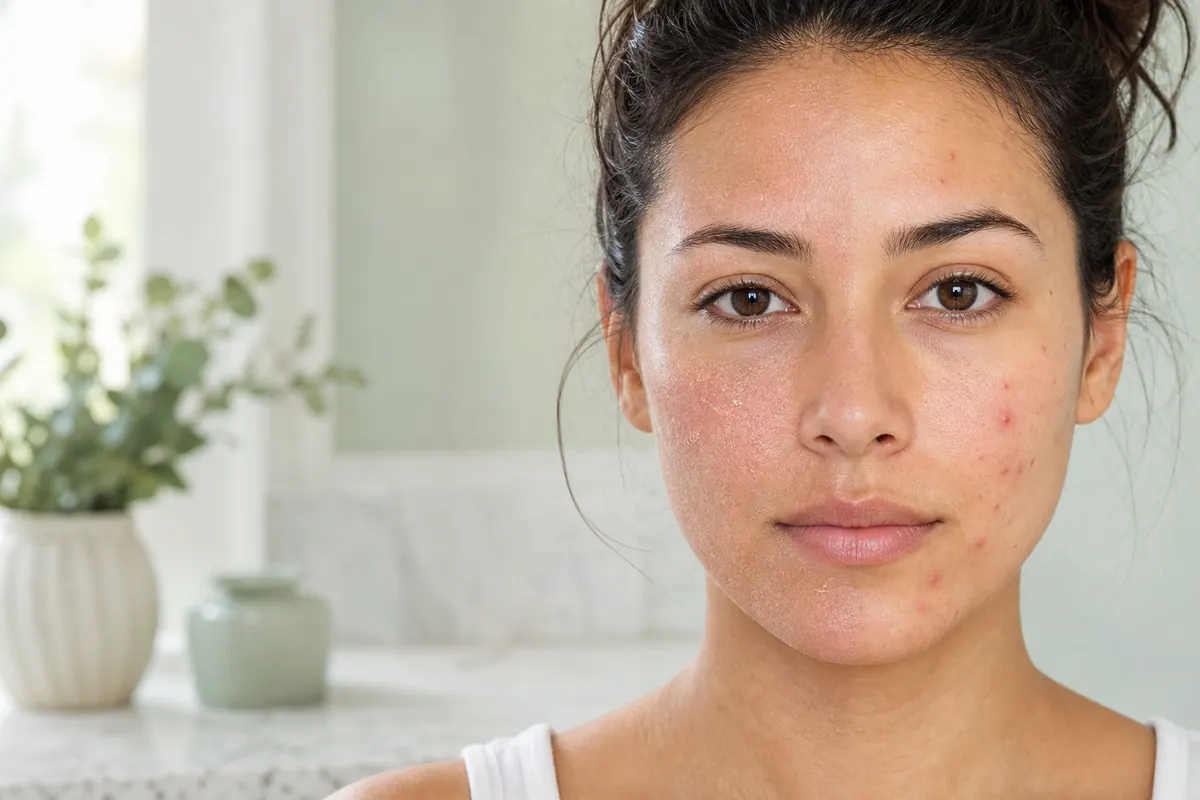
Short answer: a damaged skin barrier usually causes widespread sensitivity, stinging, tightness, flaking or redness. Acne produces recognizable lesions such as blackheads, whiteheads, inflamed papules or pustules. Both can occur together, so appearance alone cannot always establish the diagnosis.
Doctor’s note: “Damaged skin barrier” is a useful description, but it is not a specific diagnosis. Allergic contact dermatitis, irritant dermatitis, rosacea, eczema, acne and folliculitis can overlap. Persistent, painful or rapidly worsening symptoms deserve a professional assessment.
A 60-Second Skin Check
- Barrier damage is more likely when water or bland moisturizer stings, redness is widespread, and the skin feels tight, flaky or unusually sensitive.
- An acne breakout is more likely when you see blackheads, whiteheads or inflamed pimples in your usual acne-prone areas while the surrounding skin feels comfortable.
- Both can happen together. If the pattern is mixed, pause new irritants and treat comfort first rather than escalating several acne actives at once.
Important: This check can guide a safer next step, but it cannot diagnose acne, dermatitis, rosacea or folliculitis.
What Does the Skin Barrier Actually Do?
The outermost part of the epidermis is called the stratum corneum. It contains flattened skin cells surrounded by lipids, including ceramides, cholesterol and fatty acids. Together, these structures slow water loss and reduce the entry of irritants, allergens and microorganisms.
The broader barrier also has chemical, microbiological and immune functions. That is why barrier disruption can feel like more than simple dryness. Products that were previously comfortable may begin to sting, and skin may become reactive to heat, cleansing or friction.
The American Academy of Dermatology (AAD) specifically warns that overusing exfoliating products can damage the skin barrier, leaving skin raw and irritated and potentially causing reactions to products that were previously tolerated.1
Damaged Skin Barrier vs Acne Breakout: Quick Comparison
| Clue | Barrier irritation is more likely | Acne breakout is more likely |
|---|---|---|
| Main sensation | Burning, stinging, tightness or tenderness | Often little surface discomfort, although inflamed lesions may be sore |
| Texture | Roughness, scaling, peeling or small irritated bumps | Blackheads, whiteheads, papules, pustules or deeper lesions |
| Distribution | May involve broad areas exposed to a product | Usually follows an acne-prone pattern such as the forehead, cheeks, chin, chest or back |
| After applying products | Water, cleanser or moisturizer may sting | Most bland products do not sting unless irritation is also present |
| Common trigger | Over-exfoliation, harsh cleansing, friction or too many active ingredients | Follicular plugging, increased sebum and inflammation; some products can contribute |
| What makes it worse | Scrubbing, astringents and continuing irritating actives | Comedogenic products, picking and inconsistent treatment |
This table is a guide, not a diagnostic test. Acne-prone skin can also become dry and irritated from treatment. The AAD notes that drying the skin, scrubbing and repeatedly changing acne treatments can irritate skin and worsen breakouts.2
Signs That Point Toward a Damaged or Irritated Barrier
1. Products suddenly sting
A cleanser or moisturizer that was previously comfortable now burns. This change is more suggestive of irritation than a straightforward acne flare.
2. Tightness appears with flaking
Skin may feel stretched after cleansing and then become rough or scaly. Oiliness does not exclude dehydration or irritation; oily and acne-prone skin can still be over-cleansed.
3. Redness is broad rather than limited to individual pimples
Acne can cause redness around lesions. Barrier irritation more often produces a diffuse red or inflamed background, particularly where an active product was applied.
4. Several strong products were introduced together
A retinoid, exfoliating acid and benzoyl peroxide can each be useful in the right context. Starting multiple actives simultaneously makes irritation more likely and makes the responsible product harder to identify.
5. Even gentle cleansing feels uncomfortable
Burning with lukewarm water or a bland cleanser should not be interpreted as proof that the product is “working.” Pain and persistent irritation are reasons to simplify the routine.
Signs That Point Toward an Acne Breakout
Blackheads and whiteheads are present
Comedones are plugged follicles. Open comedones are blackheads; closed comedones are whiteheads or small skin-colored bumps. DermNet describes acne as a condition that can include both noninflamed comedones and inflamed papules or pustules.3
Lesions appear in familiar acne-prone areas
A recurrence on the forehead, chin, cheeks, chest or back is more compatible with acne than a new itchy or burning rash in an unusual distribution.
The surrounding skin feels normal
Individual pimples can be tender, but unaffected skin usually does not burn when it contacts water or moisturizer.
New products are oily or occlusive
Some cosmetics and hair products can contribute to clogged pores. The AAD advises choosing products labeled “non-comedogenic” or “won’t clog pores,” while acknowledging that individual responses can still vary.2
Can a Damaged Skin Barrier Cause Breakouts?
Barrier disruption and acne can reinforce each other, but it is too simplistic to say that every impaired barrier directly “causes” acne. Irritation can increase inflammation, and aggressive attempts to remove oil can make acne care harder to tolerate. People may then stop and restart treatments, add more products or scrub—behaviors that can worsen the overall picture.
Acne treatments can also produce dryness or irritant dermatitis. This creates a mixed presentation: genuine comedones or inflammatory acne alongside burning, peeling and sensitivity.
What to Do When You Are Not Sure
Step 1: Stop adding new products
Do not conduct several experiments at once. Pause newly introduced exfoliants, scrubs and nonessential active serums, particularly if the skin burns or peels. Prescription medication should be discussed with the prescribing clinician before major changes.
Step 2: Use a short, gentle routine
- A mild, fragrance-free cleanser, usually no more than twice daily
- A simple moisturizer suited to your skin type
- A broad-spectrum sunscreen during the day
If you also have acne, choose products labeled non-comedogenic. Moisturizers can support barrier function and may improve tolerance of acne therapy.4
Step 3: Do not scrub, pick or “dry out” the bumps
Scrubbing can intensify irritation, while squeezing acne increases inflammation and the risk of more visible marks or scarring.2
Step 4: Watch the pattern, not just one day
Photograph the area in consistent lighting and record new products. Improvement in stinging and scaling after simplifying the routine supports irritation, but it does not rule out acne.
Step 5: Reintroduce products one at a time
Once the skin is comfortable again, introduce only one nonessential product at a time. The AAD recommends testing a new skincare product on a small area twice daily for seven to ten days before broader use.5
When to See a Dermatologist
Arrange an evaluation if you have severe swelling, blistering, crusting, eye involvement, rapidly spreading redness, signs of infection, deep painful acne, scarring, or symptoms that continue despite simplifying the routine. Seek urgent medical care for facial swelling associated with breathing or swallowing difficulty.
Frequently Asked Questions
Does a damaged skin barrier look like tiny bumps?
It can. Irritant or allergic reactions may create small bumps, but tiny bumps can also represent closed comedones, folliculitis, eczema or other conditions. Sensations such as burning and itching, the distribution and the timing after a product change provide additional clues.
Should I exfoliate bumps caused by a damaged barrier?
Usually not while the skin is actively burning, peeling or raw. Over-exfoliation is itself a recognized cause of barrier damage.1
Can acne-prone skin use moisturizer?
Yes. The AAD recommends an acne-friendly moisturizer when acne treatments leave skin dry. Look for a non-comedogenic formula and select a texture appropriate for your skin.2
Why does my moisturizer sting?
Stinging can occur when skin is irritated, but it can also signal sensitivity or contact dermatitis from an ingredient. Stop a product that causes persistent burning and seek advice if the reaction is significant.
Can I have acne and a damaged barrier simultaneously?
Yes. Acne itself and its treatments can coexist with dryness and irritation. The practical goal is to control acne while maintaining a tolerable, gentle routine.
The Bottom Line
Think beyond the bumps. Widespread burning, tightness, flaking and sudden product sensitivity point toward barrier irritation. Comedones and recognizable inflammatory lesions in acne-prone areas point toward a breakout. When the pattern is mixed, simplify the routine, avoid aggressive treatment and obtain a dermatologist’s assessment if symptoms persist.
Sources
- American Academy of Dermatology. Dermatologist-recommended skin care for your 20s.
- American Academy of Dermatology. 10 skin care habits that can worsen acne.
- DermNet. Acne.
- Purnamawati S, et al. The Role of Moisturizers in Addressing Various Kinds of Dermatitis: A Review. Clin Med Res. 2017.
- American Academy of Dermatology. How to test skin care products.
Medical disclaimer: This article provides general education and does not diagnose or treat an individual skin condition. Consult a qualified healthcare professional for personalized advice.