
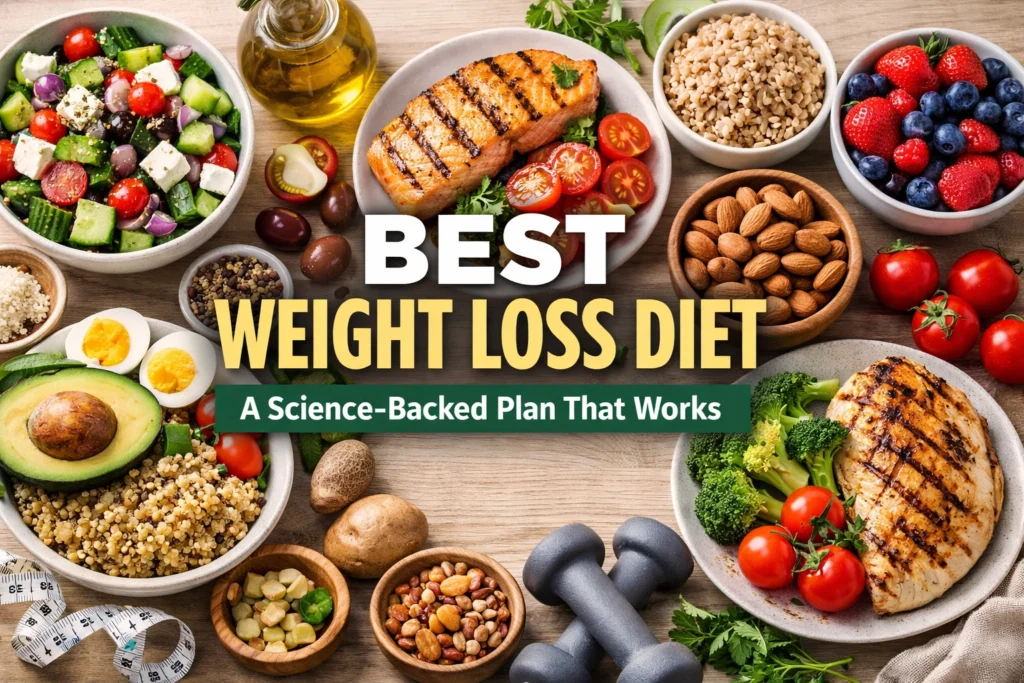
If you’ve Googled best weight loss diet before, you’ve probably noticed a pattern: everyone claims their approach is “the one.” Keto vs. Mediterranean. Intermittent fasting vs. “eat six meals.” Low-fat vs. low-carb. It can feel like dieting is a loud debate show… and you’re the confused audience member holding a grocery list.
Here’s the truth that stays true even when trends change: the best diet for weight loss is the one that helps you maintain a consistent calorie deficit without making you miserable, while still giving you enough protein, fiber, and micronutrients to function like a human—not a cranky gremlin. Public health guidance and long-term research consistently support eating patterns built around minimally processed foods, plenty of plants, and sustainable habits. (CDC)
What Makes a Diet “Best” for Weight Loss?
1) It creates a calorie deficit—without constant hunger
Weight loss happens when your body uses more energy than it takes in. That’s not a “diet ideology,” it’s physiology. The CDC puts it plainly: reducing calories + increasing physical activity supports weight loss, and activity is especially important for maintaining it. (CDC)
But the best diets do something smarter than “eat less”:
- Increase satiety (so you stop thinking about food every 14 minutes)
- Stabilize blood sugar swings (less snack-panic)
- Protect muscle while losing fat (especially with protein + strength training)
2) It’s nutritionally complete and realistic
The “perfect plan” that you can’t follow on normal days isn’t perfect. Dietary guidelines from major health organizations emphasize dietary patterns rich in whole foods—vegetables, fruits, whole grains, legumes, nuts, and healthy fats—while limiting highly processed foods, added sugars, and excess saturated fats. (fns.usda.gov)
3) It supports long-term adherence (the unsexy superpower)
A lot of diets work for two weeks. The best weight loss diet works for two years—or longer.
The Shortlist: The 5 “Best” Diet Styles for Weight Loss (Ranked by Sustainability + Evidence)
There isn’t one universal winner, but there are patterns with strong evidence and high stick-to-it potential.
1) Mediterranean-Style Diet (Best overall for most people)
If I had to pick one approach that’s consistently “boring but brilliant,” it’s this.
Why it’s top-tier:
- Strong long-term data for cardiometabolic health
- Weight loss results comparable to other diets, and sometimes better than low-fat over time (PubMed)
- Doesn’t demand extreme rules
Core structure:
- High intake of vegetables, fruits, legumes, whole grains
- Olive oil as a primary fat
- Fish/seafood regularly, moderate dairy, limited ultra-processed foods
Who it fits best:
- People who want a healthy weight loss diet without cutting carbs entirely
- Anyone with family history of heart disease, fatty liver, insulin resistance, or high cholesterol
How to make it “weight-loss effective” (simple tweaks):
- Keep olive oil (great), but measure it—liquid calories are sneaky
- Make protein non-negotiable at every meal (fish, eggs, yogurt, beans, chicken)
- Build meals around vegetables first, starch second
2) High-Protein, High-Fiber “Balanced Plate” (Best for hunger control)
This isn’t a brand-name diet. It’s a strategy. And it works because it attacks the #1 reason diets fail: hunger.
Research suggests higher-protein approaches can improve satiety and support weight loss outcomes (though long-term adherence varies). (PMC)
What it looks like:
- Protein at each meal (e.g., eggs, chicken, fish, Greek yogurt, lentils, tofu)
- Fiber anchor (vegetables + fruit + legumes/whole grains)
- Moderate fats (nuts, olive oil, seeds)
Why it helps:
- Protein supports fullness and helps preserve lean mass
- Fiber slows digestion and improves satiety signals (and may support weight loss) (PMC)
Your easiest “plate formula”:
- ½ plate vegetables
- ¼ plate protein
- ¼ plate smart carbs (whole grains/beans/potatoes)
- 1 thumb of healthy fat
No drama. No spreadsheet.
3) Lower-Carb (Not “Zero Carb”) (Best for blood sugar swings + cravings)
A moderate low carb diet for weight loss can help some people feel more in control—especially those who experience intense cravings or reactive snacking.
It’s also supported as a viable option in longer trials: a major 2-year dietary intervention found both Mediterranean and low-carbohydrate diets were effective alternatives to low-fat dieting for weight loss. (New England Journal of Medicine)
Important distinction:
Lower-carb ≠ no-carb. Most people do better with a sustainable reduction in refined carbs and added sugars, not a permanent ban on fruit and oats.
What to prioritize:
- Protein + vegetables first
- Carbs mostly from beans, fruit, yogurt, whole grains (if tolerated)
- Reduce sugar drinks, desserts, refined snacks
Want a snack-friendly angle for internal linking? Point readers to your own: 15 low-carb snacks that don’t taste like punishment.
4) Time-Restricted Eating (TRE) (Best for people who like simple boundaries)
This approach changes when you eat rather than obsessing over what you eat.
Recent systematic reviews/meta-analyses suggest time-restricted eating can reduce body fat, though it may also reduce lean mass depending on how it’s implemented—so protein + resistance training matter a lot. (MDPI)
Who it can work well for:
- Late-night snackers
- People who do better with clear structure than “portion intuition”
Teen note: fasting windows can be risky during growth and can trigger disordered eating patterns. For teens, I’d generally avoid TRE unless guided by a clinician/guardian.
A safer “TRE-lite” version:
- Keep a consistent breakfast
- Stop eating 2–3 hours before bed
- Make dinner protein-forward and fiber-rich
5) Plant-Forward (Flexitarian) (Best for volume eating + health)
You don’t need to go full vegan to win here. Plant-forward eating means:
- More legumes, vegetables, fruits, whole grains
- Less ultra-processed foods and frequent takeout
- Meat is optional, not the center of the universe
This style naturally increases fiber and nutrient density—two traits linked with better weight control and overall health. (World Health Organization)
So… Which Diet Is Actually the Best Weight Loss Diet?
Here’s my practical decision rule:
Choose Mediterranean-style if:
- You want the most “all-around healthy” option with strong evidence (PubMed)
Choose High-Protein + High-Fiber if:
- Hunger is your biggest enemy
- You want a diet plan for weight loss that doesn’t feel like a diet (PMC)
Choose Lower-Carb if:
- Sugar cravings or blood sugar swings drive overeating (New England Journal of Medicine)
Choose TRE if:
- You snack late and want simple rules (adults only) (MDPI)
Choose Plant-Forward if:
- You like big portions, want better digestion, and prefer food variety (World Health Organization)
The “Best Weight Loss Diet” Meal Framework (Simple, Repeatable)
Breakfast (choose one)
- Greek yogurt + fruit + chia
- Eggs + veggies + toast (whole grain)
- Oats + protein (milk/yogurt) + berries
Lunch
- Rice/roti + protein + huge veggie portion
- Big salad + chicken/beans + olive oil + fruit
- Lentils + vegetables + yogurt
Dinner
- Fish/chicken/tofu + roasted vegetables + potatoes/beans
- Stir-fry: protein + mixed veg + small rice portion
- Soup + protein add-on + side salad
Snacks (optional, but planned)
- Fruit + yogurt
- Nuts + fruit
- Protein + crunchy veg
Or link readers to your snack guide: 15 low-carb snacks for alternatives.
The 7 Habits That Make Any Weight Loss Diet Work Better
These are not “motivation quotes.” They’re mechanics.
- Protein first at meals (helps fullness). (PMC)
- Fiber daily from whole foods (helps satiety and metabolic health). (PMC)
- Minimize liquid calories (sugary drinks, fancy coffees).
- Sleep like it matters (because it does—appetite regulation gets weird when sleep is low).
- Move daily, strength train 2–3x/week if possible. (CDC)
- Plan 2–3 “default meals” you can repeat.
- Stop aiming for perfect—aim for consistent.
FAQ: Best Diet for Weight Loss
1) What is the #1 best weight loss diet?
Based on available evidence, a Mediterranean-style diet is one of the best overall choices because it’s sustainable and supported by long-term data. (PubMed)
2) Is low-carb better than low-fat for weight loss?
Both can work. In longer trials, low-carb and Mediterranean patterns performed as effective alternatives to low-fat dieting. The best choice depends on cravings, lifestyle, and adherence. (New England Journal of Medicine)
3) Do I need to cut out carbs to lose weight?
No. Many people lose weight on moderate-carb patterns by reducing refined carbs and keeping portions reasonable while prioritizing protein and fiber. (fns.usda.gov)
4) Does eating more fiber really help with weight loss?
Higher fiber intake is associated with better satiety and has been linked with weight loss outcomes in research, especially when fiber increases through whole foods. (PMC)
5) Is time-restricted eating safe and effective?
In adults, evidence suggests it can reduce body fat, though lean mass loss can happen if protein and resistance training are neglected. For teens, fasting patterns should be approached cautiously and ideally with clinical guidance. (MDPI)
6) What’s the fastest healthy way to lose weight?
A modest, consistent calorie deficit with high-protein, high-fiber meals and regular activity is the most reliable approach. Extremely fast-loss methods are often unsustainable and can be risky—especially during adolescence. (CDC)
7) What should I eat at night if I’m hungry?
Try protein + fiber: yogurt with fruit, eggs, cottage cheese, or a small plate of vegetables + protein. If late-night snacking is frequent, adjusting dinner protein and sleep timing often helps. (CDC)
Conclusion: Your “Best Weight Loss Diet” Is the One You Can Repeat
If your diet requires superhero willpower, it’s not a plan—it’s a temporary stunt.
For most people, the best weight loss diet looks like:
- Mediterranean-style or balanced high-protein/high-fiber meals
- Mostly whole foods, fewer ultra-processed calories
- Simple structure you can repeat
- Daily movement + decent sleep
And if you want to make the plan more enjoyable (which matters more than people admit), use strategic “compliance foods” from your own site—like an anabolic ice cream recipe—so your readers don’t feel punished for wanting dessert. (Dietary Habit)