
We only recommend products we love and that we think you will, too. We may receive a portion of sales from products purchased from this article.

Medically reviewed by Dr. A.S.M. Masum Billah, MBBS

Your skin is losing moisture right now. Not because you skipped moisturizer — but because the lipid “mortar” holding your skin cells together is quietly thinning with every passing year.
That mortar is made of ceramides. They account for roughly 50% of the lipid matrix in your skin’s outer layer (the stratum corneum), forming a sealed barrier that locks moisture in and keeps irritants out. After your mid-30s, ceramide production declines measurably — and the result shows up as dryness, tightness, fine lines, and increased transepidermal water loss (TEWL), which is the clinical measure of how fast your skin leaks moisture.
Phytoceramides are plant-derived lipids that structurally resemble your skin’s own ceramides. Taken orally, they’re absorbed through the gut, enter systemic circulation, and are believed to incorporate into the epidermal lipid layers — may help support skin hydration, barrier function, and elasticity from within. The evidence is promising, not definitive. The strongest data comes from standardized wheat-derived extracts at 350 mg. Keep that benchmark in mind as you read.
This article is written for women and men over 40 — particularly those managing dry or eczema-prone skin — and anyone comparing options before buying. If you’re specifically researching best phytoceramides supplements, you’ll find targeted guidance throughout.
Here’s what the evidence actually supports, product by product.
Best Collagen for Women over 50
Quick Comparison: 10 Best Phytoceramides Supplements at a Glance
10 Best Phytoceramides Supplements
Ranked by clinical evidence, ceramide source quality, and real-world use-case fit
Best Phytoceramides Supplements — Our Top 10 Picks
Products were evaluated on ceramide source quality, dose alignment with clinical research, formulation logic, certifications, and real customer patterns. Each has a distinct fit. Read the one that matches your situation.
1. Sports Research Phytoceramides 350mg — Best Overall
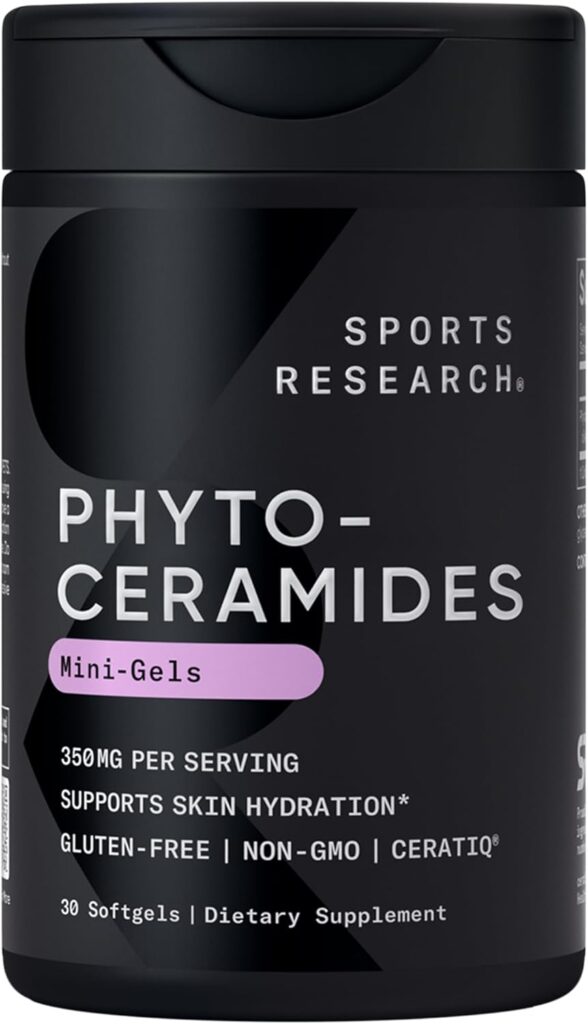
If there’s one product in this roundup where the dose, the science, and the formulation all align without compromise, this is it. Sports Research delivers Ceratiq® — the most clinically studied oral ceramide ingredient globally — at exactly 350 mg per serving. That’s not a coincidence. It’s the precise dose used in multiple peer-reviewed RCTs.
Key Ingredients & Dosage
| Ingredient | Amount | Notes |
|---|---|---|
| Ceratiq® wheat oil extract | 350 mg | Glycolipids, phytoceramides, glycosylceramides |
| MCT oil (veggie cap version) | Present | Lipid carrier; improves fat-soluble absorption |
| Mixed tocopherols | Present | Oxidative stability; natural vitamin E |
Why It’s the Best Overall
The 350 mg dose isn’t arbitrary. It’s the exact amount used in a double-blind, placebo-controlled trial published in International Journal of Cosmetic Science (Guillou et al., 2011) — 51 women, 3 months, significant improvement in TEWL and skin dryness. A separate supplier-run 12-week RCT showed 88% of women reported visible wrinkle reduction by week 8.
Ceratiq® won the Nutraingredients Ingredient of the Year award in the Healthy Aging category in 2018. That’s not a marketing sticker — it reflects independent industry recognition of the clinical evidence base.
The liquid softgel form matters more than most people realize. Ceramides are fat-soluble lipid molecules. A liquid oil-based delivery vehicle improves absorption compared to dry-pressed capsules. The MCT oil in the veggie capsule version serves the same purpose. This formula has no synthetic vitamins, no fillers, no artificial colorings, no hexane, no soy. Clean label, clear purpose.
The one honest caveat: this product contains wheat. The oil extraction process largely removes gluten protein, but the wheat allergen declaration stands. Anyone with a confirmed wheat allergy should skip this one.
Safety & Side Effects
- Wheat allergen present — not suitable for wheat allergy
- Phytoceramides are lipid-based; caution in individuals with dyslipidemia or familial hypercholesterolemia, per Dr. Tsippora Shainhouse, board-certified dermatologist
- Small subset of users report mild drowsiness; mechanism unclear
- Consult physician if pregnant, nursing, or managing a chronic condition
How to Take It
One softgel or veggie capsule daily. Taking it with a small fat-containing meal — avocado, olive oil, nuts — may improve absorption of these fat-soluble ceramide molecules. Expect 8–12 weeks for meaningful results; skin lipid turnover isn’t fast.
Pros & Cons
- ✅ Clinically validated dose (350 mg Ceratiq®)
- ✅ Liquid softgel for superior lipid absorption
- ✅ Minimal, filler-free formula
- ✅ Non-GMO verified, third-party tested
- ❌ Contains wheat — not for gluten-sensitive users
- ❌ 30-count softgel bottle requires frequent reordering
What Customers Are Saying
Amazon reviewers consistently highlight improved skin texture and reduced dryness within 6–8 weeks. Several users with chronically dry legs note this works where topical lotions don’t. A recurring complaint is the small bottle size relative to the price — the 60-count veggie capsule version addresses this.
2. Vitauthority Phytoceramides+ — Best for Dual Hydration
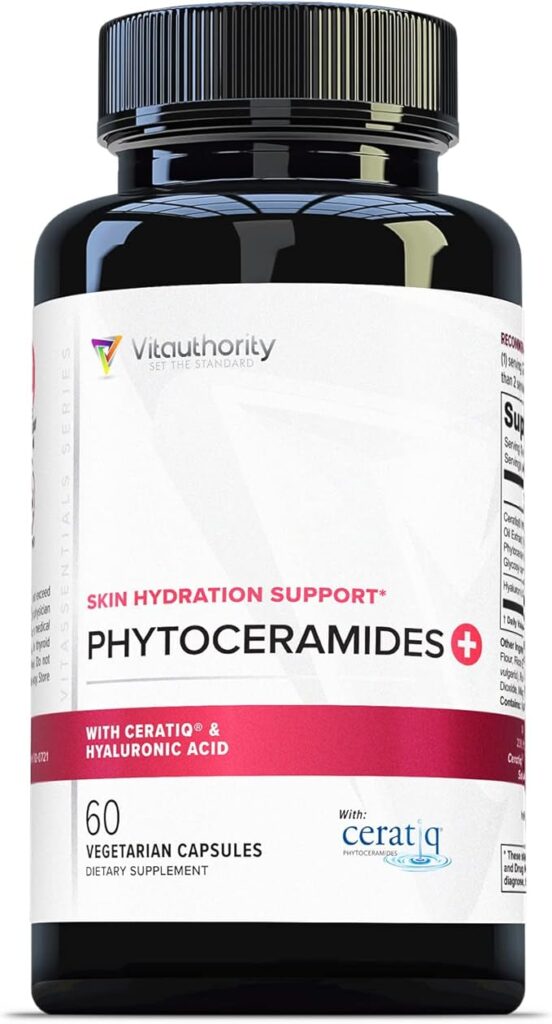
For women aged 40–60 dealing with both persistent skin dryness and fine line progression, Vitauthority takes the logical next step: it pairs Ceratiq® with hyaluronic acid in a single daily serving. Two mechanisms, one capsule.
Key Ingredients & Dosage
| Ingredient | Amount | Notes |
|---|---|---|
| Ceratiq® wheat oil extract | 750 mg | Double the 350 mg clinical benchmark |
| Hyaluronic acid (sodium hyaluronate) | 50 mg | Humectant; different mechanism from ceramides |
| Bamboo extract | Present | Silica source; connective tissue support |
| Rosemary extract | Present | Natural antioxidant preservative |
Why It’s Best for Dual Hydration
Here’s the mechanistic logic. Ceramides rebuild the barrier — they act as the lipid seal preventing water from escaping. Hyaluronic acid attracts and binds water — it’s a humectant that draws moisture into skin cells. They operate at different layers and through different pathways. Together, they address hydration from both directions.
The 750 mg of Ceratiq® exceeds the clinical dose. There’s no RCT comparing 350 mg vs. 750 mg head-to-head, so proportional benefit isn’t guaranteed. But for someone with moderate-to-severe dryness, the higher dose is a reasonable clinical decision.
Be transparent with yourself about the hyaluronic acid. At 50 mg, it’s below the 120–240 mg range studied in the Journal of Clinical and Aesthetic Dermatology (Göllner et al., 2017). It’s additive, not full-dose HA therapy. Still meaningful — just not a replacement for dedicated HA supplementation.
The bamboo and rosemary in the inactive ingredients aren’t padding. Bamboo extract is a functional silica source; rosemary is a natural antioxidant preservative that replaces synthetic additives. Both are justifiable formulation choices.
Safety & Side Effects
- Contains wheat — not for wheat allergy
- Magnesium stearate present — GRAS; rare GI sensitivity in a small population
- Consult physician if managing cardiac, kidney, liver, or thyroid conditions, or diabetes (label warning)
How to Take It
Two capsules once daily, ideally with morning breakfast. The label specifies not to exceed two servings in 24 hours. Consistency over 8–12 weeks is where results accumulate.
Pros & Cons
- ✅ Ceratiq® + hyaluronic acid dual-action formula
- ✅ Non-GMO, soy-free, vegetarian capsule
- ✅ 88% visible wrinkle reduction in Ceratiq® clinical trial by week 8
- ✅ Bamboo + rosemary as clean functional excipients
- ❌ Contains wheat
- ❌ HA dose (50 mg) below full clinical range
- ❌ 30-serving bottle; moderately priced
What Customers Are Saying
A frequent theme in reviews: users say this outperforms standalone ceramide products they’d tried before, crediting the HA combination. Several perimenopausal women specifically mention reduced “crepe-paper” skin texture after 6–8 weeks.
3. We Like Vitamins 700mg — Best Value & Best Gluten-Free
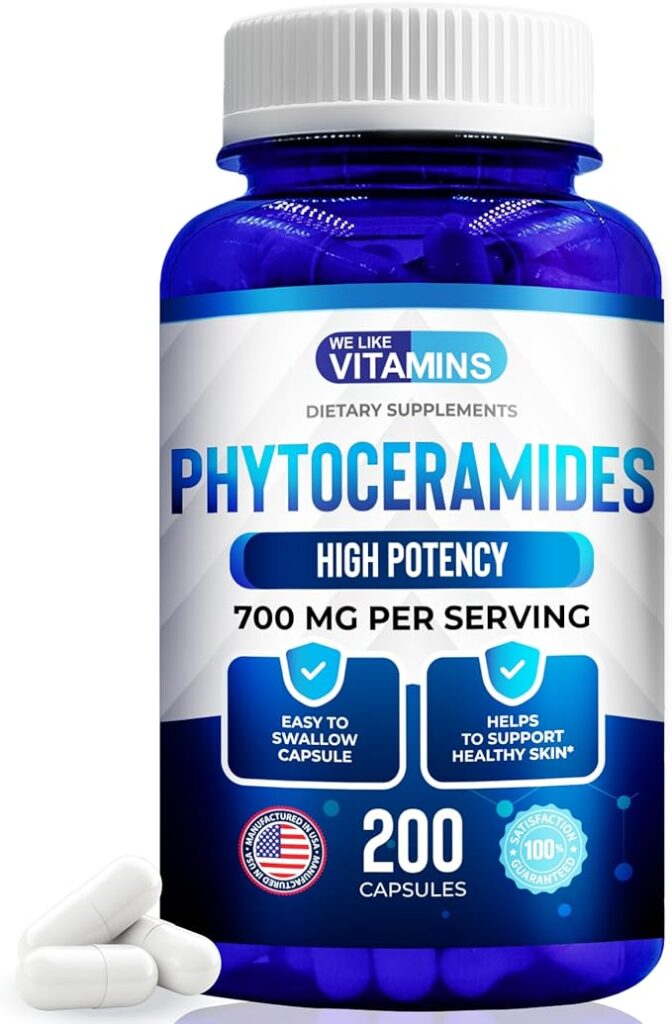
At ~$0.10 per capsule with a 100-day supply, this is the best cost-per-day ceramide option on Amazon. Completely wheat-free — sourced from sweet potato (Ipomoea batatas) and rice.
Key Ingredients
| Ingredient | Amount | Notes |
|---|---|---|
| Phytoceramides (sweet potato + rice) | 700 mg per 2 caps | No standardized extract |
Important: 700 mg of sweet potato/rice blend ≠ 700 mg of standardized wheat oil extract. Ceramide density per milligram varies significantly by source. Clinical benchmarks used concentrated wheat oil. This product trades clinical precision for allergen-free accessibility — a valid trade-off for the right reader.
Both sources contain glucosylceramides. Miyazaki et al. showed rice glucosylceramide improved skin smoothness in a small human trial. The dual-source approach covers a broader ceramide subtype range than single-source products.
Safety
No wheat, no gluten — safe for celiac disease. No fat-soluble vitamins added — no stacking risk if you already take a multivitamin.
How to Take It
Two capsules daily. Give it the full 90 days before evaluating — non-standardized ceramide sources work more gradually than clinical extracts. This is the right phytoceramides dosage approach for this product.
Pros & Cons
- ✅ 100-day supply; best value per dose on Amazon
- ✅ Completely wheat-free and gluten-free
- ✅ No preservatives or artificial ingredients
- ✅ Made and bottled in the USA
- ❌ No standardized extract — ceramide concentration per mg not disclosed
- ❌ Limited clinical evidence specifically for sweet potato oral ceramides
- ❌ Results may take longer vs. Ceratiq®-based products
Customers say: Gluten-sensitive and eczema-prone users rate this highly. Results appear at 6–10 weeks. Best-reviewed for value in the category.
4. Life Extension Skin Restoring Ceramides — Best for Science-Minded Buyers
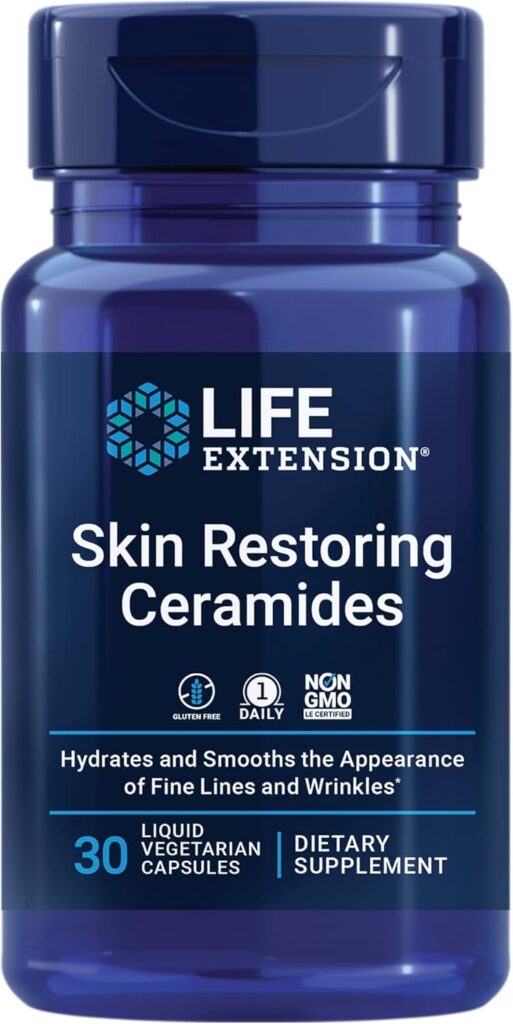
NSF GMP registered. Certificate of Analysis per batch. 99% USA manufactured. Life Extension has been doing evidence-based supplementation since 1980. Their ceramide product shows it.
Key Ingredients
| Ingredient | Amount | Notes |
|---|---|---|
| Ceratiq® wheat oil extract | 350 mg | Exact RCT dose |
| Rice bran oil | Present | Lipid carrier; gamma-oryzanol content |
| Rosemary extract | Present | Natural preservative |
| Silica | Present | Flow agent |
Four excipients total. No magnesium stearate, no titanium dioxide. The rice bran oil isn’t inert filler — it’s a lipid vehicle rich in gamma-oryzanol that aids fat-soluble ceramide dissolution. That’s a smarter carrier than neutral oils.
A 12-week double-blind RCT showed ceramide benefits persisting 8 weeks after the study ended — that durability signal is rarely reported elsewhere. NSF GMP registration means independent facility audits and batch-level testing — a quality tier above standard cGMP.
Safety
Contains wheat. Rosemary: extremely rare sensitivity. Consult physician if pregnant or managing chronic conditions.
How to Take It
One capsule daily with food. Consistent timing supports ceramide integration into epidermal lipid architecture.
Pros: NSF GMP · cleanest inactive ingredient list in roundup · 350 mg Ceratiq® · CoA available Cons: Contains wheat · premium price per serving count
Customers say: Long-term Life Extension users describe this as a “trusted staple.” Dermatologist-recommended appears in reviews more than any other product here.
5. NusaPure Phytoceramide Complex — Best Broad-Spectrum Formula
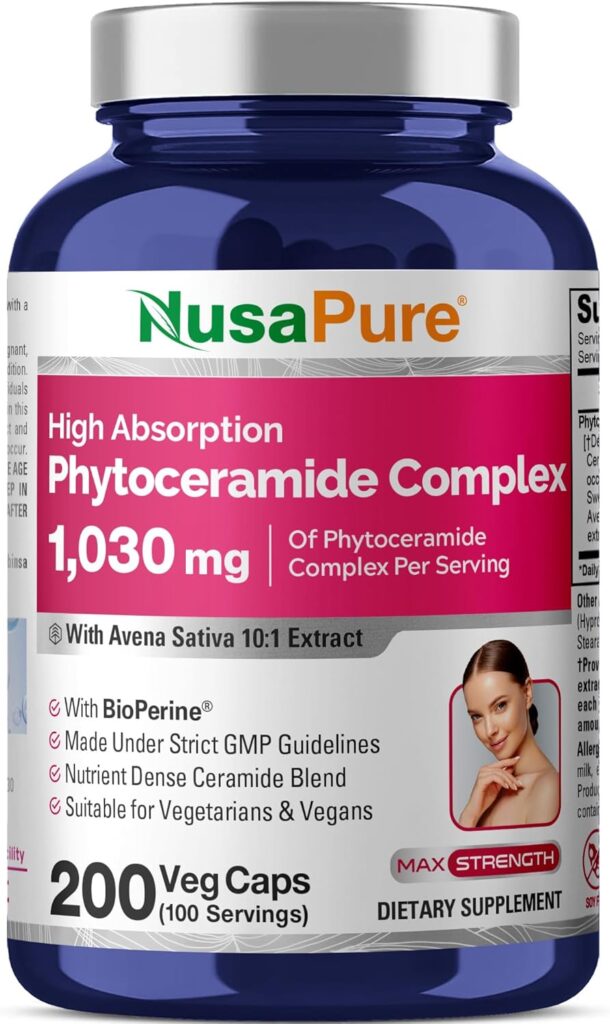
Five ceramide plant sources. BioPerine® for absorption. 100-day supply. NusaPure’s approach is breadth over precision — and it works for the right user.
Key Ingredients
| Ingredient | Amount | Notes |
|---|---|---|
| Apple, sweet potato, wheat germ, oat, konjac blend | 1,030 mg | 10:1 extract; labeled 4,000 mg equiv. |
| BioPerine® (black pepper extract) | ~5 mg | Piperine; 20–60% absorption enhancement |
The “4,000 mg equivalent” is a 10:1 extract ratio calculation — not 4,000 mg of active ceramides. No single source hits the 350 mg Ceratiq® benchmark. What compensates is BioPerine® — the only absorption enhancer in this entire roundup. Piperine inhibits intestinal efflux transporters and enhances mucosal permeability for fat-soluble compounds. Studies document 20–60% improved bioavailability for co-administered nutrients.
When comparing wheat phytoceramides vs rice ceramides, this product bypasses the debate entirely by using both — plus konjac, apple, and oat for multi-subtype coverage.
Critical note: Contains wheat and oats. Not gluten-free despite older listings. Gluten-sensitive readers: choose #3, #7, or #8.
Safety
Not gluten-free. BioPerine® may enhance prescription medication absorption — discuss with physician if on regular medication.
How to Take It
Two capsules daily with meals. BioPerine® requires food co-ingestion to work optimally.
Pros: Only product with BioPerine® · 5 ceramide sources · 100-day supply Cons: Not gluten-free · no single source at validated dose · proprietary blend
Customers say: Faster-than-expected results reported at 3–4 weeks. Eczema-adjacent skin conditions mentioned positively. High repeat purchase rate.
6. Andrew Lessman Phytoceramides with Biotin — Best Additive-Free Formula
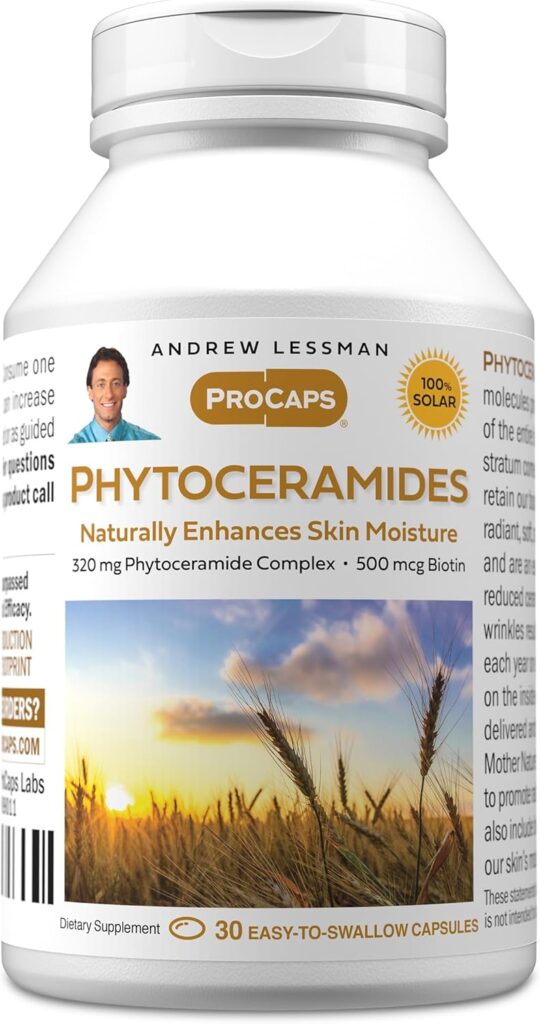
Zero additives. Not “minimal additives” — literally none. No binders, fillers, lubricants, coatings, preservatives, colors, or flavors. For chemically sensitive individuals, this is the only realistic option.
Key Ingredients
| Ingredient | Amount | Notes |
|---|---|---|
| Phytoceramide Complex | Undisclosed | ProCaps micro-granulated; bioactive form |
| Biotin | 500 mcg | Physiological dose; supports skin lipid synthesis |
The undisclosed ceramide dose is the one limitation — you can’t benchmark it against clinical data. ProCaps has 40+ years of clinical-grade formulation history, and the micro-granulated powder format dissolves rapidly without a coating delay. Biotin at 500 mcg supports fatty acid synthesis — directly relevant to ceramide production in skin cells.
The ethical story is also real: 100% solar-powered facility, LEED Gold certified, largest global donor of prenatal vitamins (2 billion+ capsules donated). If brand integrity matters to you when buying oral ceramide supplements, this is the standard.
Safety
Gluten-free, soy-free, dairy-free, corn-free — broadest allergen-free profile in roundup. Note: Even 500 mcg biotin can theoretically interfere with thyroid and cardiac troponin immunoassays. Pause 48 hours before blood work.
How to Take It
One softgel daily, with a fat-containing meal.
Pros: Zero additives · broadest allergen-free profile · ethical brand · flexible dosing Cons: Ceramide dose undisclosed · premium price · no third-party certification listed
Customers say: Sensitive-skin users who react to other supplements tolerate this flawlessly. Consistent praise for soft, fast-dissolving capsules.
7. NeoCell Phytoceramide Complex — Best Fully Vegan Formula
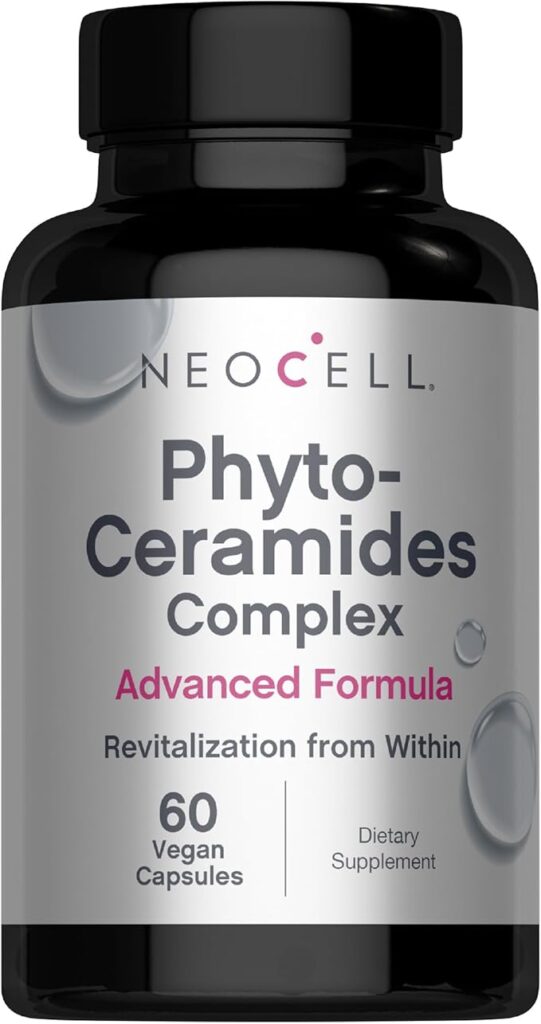
Strict vegans have limited options in this category. NeoCell fills that gap with a certified vegan, allergen-clean formula from a brand with 30 years of beauty supplement credibility.
Key Ingredients
| Ingredient | Amount | Notes |
|---|---|---|
| Phytoceramide complex (oat hull, spinach, sweet potato, apple, konjac, oat straw) | 1,500 mg equiv. | 6-plant sources; vegan capsule |
Six plant ceramide sources. No gelatin. No gluten, wheat, soy, or lactose. The konjac extract specifically has solid supporting data — Aoi et al. (2006) ran a 100-person double-blind RCT showing significant TEWL improvement vs. placebo over 12 weeks. This makes NeoCell a strong pick for phytoceramides for dry skin and eczema, where barrier dysfunction is the primary concern.
Standardized ceramide concentration isn’t disclosed — characteristic of multi-botanical blends. Position this as broad-spectrum plant support, not precision-dose therapy.
Safety
Clean across all major allergens. Note: contains oat extract — individuals with oat-specific intolerance should flag this.
How to Take It
One vegan capsule daily with food.
Pros: Fully vegan · 6 ceramide sources · allergen-free · NeoCell brand credibility Cons: No standardized ceramide dose · oat extract may concern oat-intolerant users
Customers say: Vegan buyers describe this as the best ceramide option they’ve found. Skin hydration improvements noted within 4–6 weeks.
8. Carlyle Phytoceramide Complex 1500mg — Best Organic-Sourced Formula

Organic sweet potato as the lead ceramide source. Organic rice extract and rice fiber as excipients. Even the inactive ingredients carry organic certification here — rare in this category.
Key Ingredients
| Ingredient | Amount | Notes |
|---|---|---|
| Phytoceramide complex (organic sweet potato, konjac, oat straw, apple, spinach) | 1,500 mg | Organic primary source |
| Organic rice extract blend | Excipient | Organic carrier |
| Organic rice fiber | Excipient | Clean organic filler |
Organic certification on sweet potato means no synthetic pesticide residue in the ceramide source material. That’s a genuinely meaningful distinction for clean-label buyers. Carlyle has 40+ years of supplement manufacturing experience and laboratory-tests every product. The 90-day supply at an accessible price gives this strong long-term value.
No standardized ceramide extraction — same limitation as other multi-botanical blends. But the organic sourcing and clean excipient profile set it apart from conventional options.
Safety
Free of gluten, wheat, dairy, soy, and yeast. Low risk profile. Standard supplement precautions apply.
How to Take It
One capsule daily, preferably with a meal.
Pros: Organic ceramide source · organic excipients · 90-day supply · allergen-free Cons: No standardized dose · ceramide concentration undisclosed
Customers say: Clean-label buyers appreciate the organic sourcing. Gradual but consistent skin improvement reported over 60–90 days.
9. Purely Holistic Phytoceramides — Best with Added Skin Vitamins
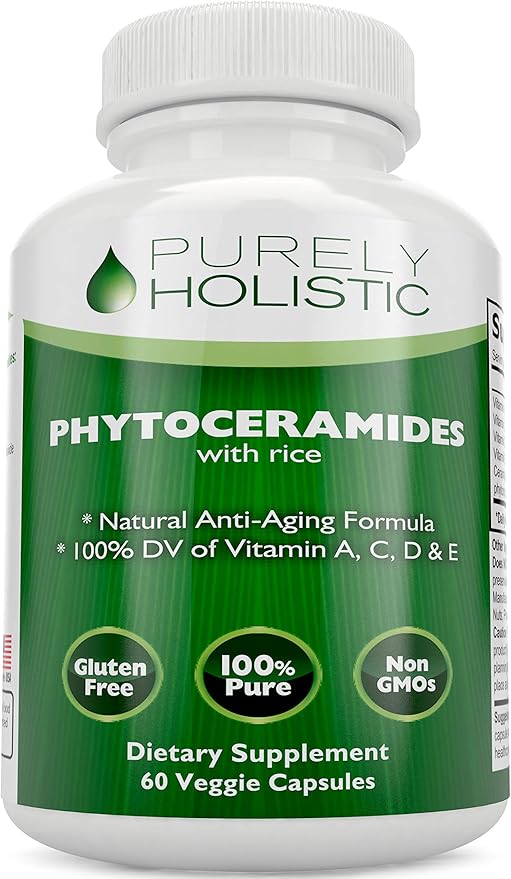
The practical choice for anyone who doesn’t already take a multivitamin. Rice-based ceramides paired with 100% RDA of vitamins A, C, D, and E — four nutrients directly supporting skin health.
Key Ingredients
| Ingredient | Amount | Notes |
|---|---|---|
| Rice-derived phytoceramides | Not disclosed | Gluten-free source |
| Vitamin A | 5,000 IU | 100% DV — do not stack with retinol |
| Vitamin C | 60 mg | Collagen synthesis cofactor |
| Vitamin D | 400 IU | Below current therapeutic guidance |
| Vitamin E | 30 IU | Protects ceramides from oxidative degradation |
Vitamin C supports collagen scaffolding while ceramides maintain the lipid mortar — dual skin barrier support. Vitamin E directly protects ceramide integrity in the stratum corneum. The D dose (400 IU) is worth noting: current evidence supports 1,000–2,000 IU for most adults. It meets the old RDA, not modern clinical practice.
Stacking flag: If already on a multivitamin, check total vitamin A. Exceeding 10,000 IU daily from all sources chronically raises toxicity risk.
Safety
Gluten-free, vegan. Vitamin A caution if combining with retinol supplements or multivitamins. Not for children. Physician consultation during pregnancy — vitamin A is teratogenic at high doses.
How to Take It
One capsule daily with food. Reassess total fat-soluble vitamin intake before adding.
Pros: 100% DV of 4 skin vitamins · rice-based · 2-month supply · gluten-free Cons: Ceramide dose undisclosed · vitamin D below current guidance · vitamin A stacking risk
Customers say: Popular with users transitioning away from multivitamins. Skin and nail improvement frequently mentioned together.
10. Herbal Nutrition Phytoceramides with Biotin — Best for Hair, Skin & Nails
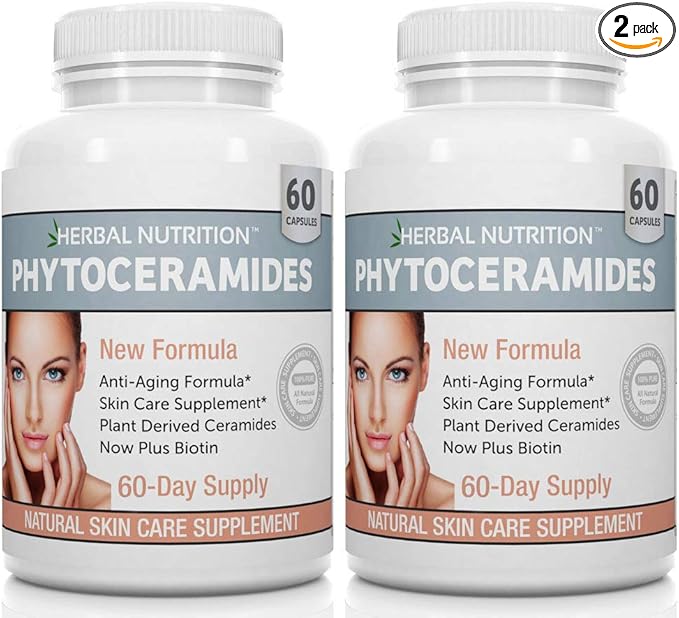
For the common triad — hair thinning, brittle nails, dry skin — this combination addresses all three. Particularly relevant for women over 40, post-partum, or with thyroid conditions.
Key Ingredients
| Ingredient | Amount | Notes |
|---|---|---|
| Rice-derived phytoceramides | 40 mg | Sub-clinical vs. 350 mg benchmark |
| Biotin | 5,000 mcg | High-dose; hair/nail support range |
| Vitamins A, C, D, E | 100% DV each | Same profile as Purely Holistic |
Be direct about the ceramide dose: 40 mg is well below the 350 mg clinical benchmark. Even accounting for rice extract concentration, this is a sub-therapeutic ceramide dose. The primary drivers here are biotin and vitamins — the ceramides are supportive, not central.
That repositioning makes it the strongest product in this roundup for oral phytoceramides combined with hair and nail benefits. High-dose biotin (5,000 mcg) has supporting data in Trüeb (2016), Int J Trichology for hair support in deficiency states.
Safety
Critical flag: Biotin at 5,000 mcg interferes with troponin, TSH, T3/T4, and vitamin D immunoassays. Pause supplementation 48–72 hours before any blood work. Vitamin A stacking caution applies here too.
How to Take It
One capsule daily. Always pause before lab tests.
Pros: High-dose biotin · hair/skin/nail trifecta · rice-based · gluten-free Cons: 40 mg ceramide dose is sub-therapeutic · vitamin A stacking risk · biotin-lab interference
Customers say: Hair growth and nail strengthening are the most-cited benefits. Skin hydration improvements appear slower, consistent with the low ceramide dose.
Ceramide Source Comparison — Wheat vs. Rice vs. Konjac vs. Sweet Potato
| Source | Evidence Level | Gluten-Free | Best For |
|---|---|---|---|
| Wheat (Ceratiq®/Lipowheat) | Strongest — multiple RCTs | No | Efficacy-first buyers |
| Konjac | Good — 100-person RCT | Yes | TEWL/eczema-prone skin |
| Rice | Moderate — small trials | Yes | Gluten-sensitive users |
| Sweet potato | Limited — animal + small human | Yes | Clean-label, broad-spectrum |
| Apple/oat/spinach | Minimal human data | Mostly yes | Multi-source blends |
Wheat-derived standardized extracts have the strongest clinical evidence — full stop. Rice and konjac are meaningful, evidence-backed alternatives for those who can’t use wheat. Multi-botanical blends offer source diversity but sacrifice dosing precision.
Doctor’s Buying Guide — 5 Things That Actually Matter
1. Source and standardization. Branded extracts (Ceratiq®, Lipowheat) deliver predictable ceramide concentrations. Generic plant powders don’t.
2. Dose. 350 mg of standardized wheat extract is the clinical benchmark. Higher milligrams of unstandardized blends don’t automatically translate to higher ceramide bioavailability.
3. Delivery form. Liquid softgel > pressed capsule for fat-soluble lipid absorption.
4. Allergen status. Wheat-derived = most evidence; rice/konjac = strong gluten-free alternatives. Know which camp you’re in before buying.
5. Stack compatibility. Check total fat-soluble vitamins A and D if combining with a multivitamin. Pause biotin before blood work.
Phytoceramides FAQ
How long do phytoceramides take to work? Hydration improvements: 4–6 weeks. Visible wrinkle reduction: 8–12 weeks. Skin lipid turnover is slow — patience matters.
Can I take phytoceramides if I have high cholesterol? Phytoceramides are lipid-based. Dr. Shainhouse notes animal data shows ceramides can be detected in blood after ingestion, potentially affecting lipid levels. Discuss with your physician before starting.
Are phytoceramides safe during pregnancy? Limited safety data exists. Consult your physician — especially products containing high-dose vitamins A or biotin.
Do phytoceramides help with eczema? Konjac and rice ceramide research shows TEWL improvement in barrier-compromised skin — relevant to eczema. Not a treatment, but supportive of skin barrier repair.
Can I take phytoceramides with collagen? Yes — complementary mechanisms. Ceramides restore the lipid mortar; collagen supports the protein scaffold. Vitauthority specifically recommends pairing their ceramides with collagen.
Are gluten-free phytoceramides as effective as wheat-based? Honest answer: wheat-derived standardized extracts have stronger clinical evidence. Rice and konjac are legitimate alternatives with meaningful but less extensive data.
Will biotin in my supplement affect lab results? Yes. Biotin ≥1,000 mcg can interfere with troponin, TSH, and thyroid hormone immunoassays. Pause 48–72 hours before any blood test.
What’s the difference between oral phytoceramides and topical ceramide creams? Cream provides immediate surface-level benefit. Oral supplementation works systemically and may deliver longer-lasting results — Dr. Pierre (Healthline) recommends both for best outcomes.
Final Verdict
For most people: Sports Research (#1) or Life Extension (#4) — both deliver Ceratiq® at the validated 350 mg dose with minimal, clean formulas. If you want a dual-action hydration approach, Vitauthority (#2) is the clear pick. Gluten-sensitive? We Like Vitamins (#3) is your best value option. Strict vegan? NeoCell (#7). Chemically sensitive? Andrew Lessman (#6) with its zero-additive formula stands alone.
Phytoceramides are a supportive tool, not a skincare replacement. Sun protection, adequate hydration, and a consistent topical routine still matter. What best phytoceramides supplements can do — particularly the Ceratiq®-based options — is address the barrier decline that starts from within, where no moisturizer can reach.