
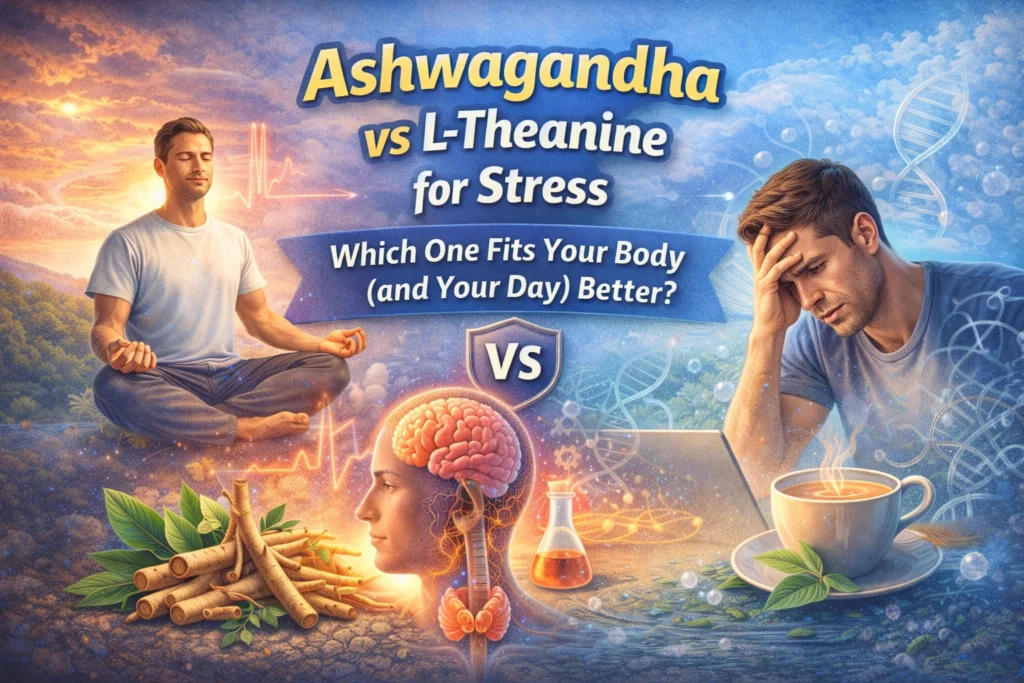
Stress is sneaky. Sometimes it shows up as racing thoughts. Sometimes it’s jaw tension, a short fuse, or that “tired-but-awake” feeling at 1:37 a.m.
Two supplements get mentioned a lot for stress support: ashwagandha and L-theanine. They’re not the same type of ingredient, they don’t feel the same, and they’re not equally “right” for every person.
This guide breaks down what each one may do for stress, how the evidence compares, and how to choose without falling for dramatic label promises.
First: What They Are (in normal-human language)
Ashwagandha
Ashwagandha (Withania somnifera) is an herbal ingredient commonly used in Ayurvedic traditions. Modern research often looks at it for stress and sleep outcomes, but results depend a lot on the extract used and how long people take it. (NCCIH)
L-Theanine
L-theanine is an amino acid naturally found in tea (especially green tea). It’s commonly discussed for calm focus—relaxation without feeling “knocked out.” Human studies often examine short-term stress response and mood measures. (PMC)
The “Feel” Difference Most People Notice
This is not a medical claim—more like a pattern you’ll hear repeatedly:
- Ashwagandha tends to be described as stress resilience: less reactive over time, smoother days, sometimes better sleep.
- L-theanine is often described as quick calm: taking the edge off, helping focus feel less jittery.
That difference makes sense when you look at the research style:
- Ashwagandha trials often run for weeks.
- L-theanine studies often look at acute (short) effects around stress tasks or daily mood.
How They May Help Stress in the Body
Ashwagandha: stress systems + sleep support (often together)
NCCIH summarizes that some ashwagandha preparations may be effective for stress and insomnia, while evidence is less clear for anxiety specifically. (NCCIH)
The NIH Office of Dietary Supplements also notes that a small number of studies suggest improvements in aspects of sleep (which matters because poor sleep amplifies stress). (Office of Dietary Supplements)
Think of it like this: if stress is a daily “load,” sleep is your nightly “repair.” Ashwagandha often sits right at that intersection.
L-theanine: calm focus and stress reactivity
Human research suggests L-theanine may influence relaxation-related brain activity and stress responses. A controlled study found L-theanine attenuated stress-related blood-pressure changes in high-stress responders. (PMC)
A 2025 review paper also discusses potential roles in relaxation/selective attention and stress reduction, while emphasizing the need to interpret results carefully across study designs. (University of Padua Research)
A simple way to picture it: L-theanine is often used for the moment, not a full lifestyle rebuild.
Evidence Match-Up: What’s Stronger for Stress?
Ashwagandha: better “overall stress” signal
If you’re looking specifically for stress reduction over time, ashwagandha has a fairly consistent signal in summaries from major health sources (with the reminder that “preparations vary,” so results can vary). (NCCIH)
Best fit when: your stress feels chronic, sleep is off, and you want steady support rather than a quick “calm button.”
L-theanine: better “in-the-moment calm” signal
L-theanine’s research often lines up with acute stress response, attention, and calmness (including in situations where caffeine is in the picture). (PMC)
Best fit when: stress spikes at predictable times (school deadlines, presentations, social pressure) and you want calmer focus.
Side Effects and Safety: This Part Deserves Your Attention
Ashwagandha safety notes
NCCIH and NIH ODS both highlight that ashwagandha is often well tolerated short-term, but they also note important cautions (including medication interactions and special populations). NCCIH also points out the evidence is mixed and products differ. (NCCIH)
One more reason to take it seriously: there are publications discussing rare cases of liver injury linked to ashwagandha supplements (rare, but real enough to be mentioned in professional summaries). (Office of Dietary Supplements)
If you ever notice yellowing of eyes/skin, dark urine, severe fatigue, or persistent nausea after starting any supplement, that’s a stop-and-get-checked situation.
L-theanine safety notes
L-theanine is generally described as well tolerated in many studies, and it’s found naturally in tea. Still, “safe for most” isn’t the same as “safe for everyone.” If you tend to have low blood pressure, get drowsy easily, or take medications that affect the nervous system, you should be cautious and ask a clinician. (University of Padua Research)
Quick teen-specific note
Because you’re under 18, it’s smarter to avoid experimenting with stacks or high-dose routines. A clinician or pharmacist can help you avoid interactions—especially if you take any meds or have thyroid/liver issues.
Which One Should You Pick for Stress?
Choose ashwagandha if…
- your stress feels “always on”
- sleep has become lighter, shorter, or broken
- you want gradual, steady support
- you’re okay being patient (it’s typically not a same-day “wow”)
Backed by NCCIH/NIH summaries for stress and sleep support in some preparations. (NCCIH)
Choose L-theanine if…
- your stress comes in waves (before events, studying, social pressure)
- you want calm focus rather than sedation
- you’re sensitive to caffeine jitters and want a smoother feel (some people pair it with tea/caffeine, though responses vary)
Supported by human research on stress response and attention/relaxation discussions in reviews. (PMC)
Can You Take Them Together?
Some people do. But “people do” isn’t the same as “everyone should.”
If you’re choosing for stress:
- Try one at a time, so you can actually tell what helps.
- Give it a fair trial (without jumping products every two days).
- Stop if you feel off—especially with ashwagandha because product variability is real and rare adverse effects have been reported. (Office of Dietary Supplements)
If you’re a teen, I’d treat combinations as “clinician-supervised only,” especially if you have any medical history or take medications.
What to Look for in a Product (without turning into a supplement detective)
For ashwagandha
- Clear labeling of the extract type and standardization (products vary, and studies use specific extracts)
- Fewer “kitchen sink” blends (harder to know what caused what)
- Third-party testing if possible
NIH ODS specifically notes that research uses different extracts and there’s no single standard formula. (Office of Dietary Supplements)
For L-theanine
- Look for L-theanine (not vague “tea extract” unless the label is very clear)
- Avoid heavy stimulant blends if your goal is stress calm (some products hide a lot of caffeine)
The Stress Reality Check: Supplements Help More When the Basics Aren’t Fighting You
This isn’t a lecture. It’s just the truth.
If sleep is chaotic, screens are late-night, caffeine is high, and meals are irregular, your stress system is already working overtime. In that situation:
- L-theanine may help a little in the moment.
- Ashwagandha may help some people over time.
But neither one is a substitute for fixing the “inputs.”
Even small upgrades matter:
- consistent sleep/wake time
- sunlight in the morning
- protein + carbs at breakfast (many people feel calmer with steadier energy)
- 10-minute walk after stressful periods
Bottom Line
If stress is your only target:
- Ashwagandha tends to be the better “long-game” option for stress + sleep support in some preparations, according to major health summaries. (NCCIH)
- L-theanine tends to be the better “right-now calm focus” option, with human studies showing effects on stress response and relaxation-related outcomes. (PMC)