

Medically reviewed by Dr. A.S.M. Masum Billah, MBBS
We only recommend products we love and that we think you will, too. We may receive a portion of sales from products purchased from this article.

Hunting for the best multivitamin for women over 60 is its own special kind of frustration.
The shelves are crammed with formulas built for 30-year-olds. “Senior” multis that haven’t been reformulated since the Clinton administration. Gummies that are 60% sugar and 40% wishful thinking.
Here’s the thing. The body past 60 plays by different rules.
Iron needs drop after menopause. Stomach acid declines. Vitamin B12 absorption weakens — about 30% of older adults absorb it poorly from food alone. Bones ask for more than just calcium.
I pulled the Supplement Facts panels for every multi below. Checked iron content, vitamin A forms, B12 forms, biotin doses against current peer-reviewed research.
Eleven products cleared the filter. Two are explicitly labeled for women over 60. The rest are 50+ or 55+ formulas that fit the demographic just as well.
Why Women Over 60 Need Multivitamins
The body past 60 plays by different rules — and the research is clear.
Vitamin D Drops Off
A NHANES analysis of 6,261 adults aged 60+ found vitamin D inadequacy is significantly more common in women, especially during fall and winter (NIH/NCBI). A separate 2023 NHANES study linked vitamin D deficiency to higher all-cause mortality in older adults (NCBI, 2023).
A multi delivering at least 1,000 IU of D3 is foundational, not optional.
B12 Absorption Quietly Breaks Down
B12 deficiency affects 10–15% of adults over 60 (Annual Reviews of Nutrition) — driven largely by atrophic gastritis, which affects 20–50% of older adults and reduces the stomach acid needed to release B12 from food (Hong Kong Medical Journal).
Long-term PPI users for reflux are at higher risk too (Am J Clin Nutr, 2021). Crystalline or methylcobalamin B12 in supplements bypasses this absorption block.
Iron Needs Drop — But Most Labels Don’t Reflect It
The iron RDA drops from 18 mg to 8 mg/day after menopause (NCBI Bookshelf). Most diets already cover that. Excess iron in this population is linked to oxidative stress and cardiovascular risk — making iron-free the right default unless your doctor documents otherwise.
Calcium Demand Climbs
Women lose ~1% of bone mineral density per year after menopause, and 30% of postmenopausal women have osteoporosis (NIH ODS — Calcium). The calcium RDA jumps to 1,200 mg/day after 50.
Multis can’t fit clinical calcium doses into one tablet — pair your multi with calcium-rich foods or a separate supplement.
Other Nutrients Quietly Run Low
Postmenopausal diets routinely fall short on vitamin D, E, B6, folate, magnesium, calcium, and selenium (Nutrition Journal, 2014) — even when total calories look fine.
What This Means for Your Multi
The right multivitamin for women over 60 is built around five realities:
- Vitamin D ≥1,000 IU (ideally 1,500–2,000 IU)
- Methylated B12 to bypass absorption decline
- Iron-free unless bloodwork says otherwise
- 5-MTHF folate for the ~40% with MTHFR variants
- Vitamin K2 (MK-7) to route calcium to bone, not arteries
That’s the lens we used to evaluate the eleven below.
What to Look For After 60
Iron-free is the rule. Postmenopausal RDA drops from 18 mg to 8 mg. Excess iron is linked to oxidative stress and cardiovascular risk.
Methylated B vitamins. About 40% of people carry an MTHFR gene variant that limits folic acid activation. 5-MTHFfolate and methylcobalamin B12 bypass it.
Beta-carotene over retinyl palmitate. Cohort data from the Iowa Women’s Health Study link high preformed retinol intake to elevated hip-fracture risk in older women.
Vitamin D3 ≥1,000 IU. Bischoff-Ferrari et al. (Arch Intern Med, 2009): 800+ IU/day reduced non-vertebral fractures by ~20% in adults 65+.
Mind biotin doses. The FDA’s 2019 communication confirmed that 1,000+ mcg interferes with troponin and TSH lab assays.
Vitamin K2 is underrated. MK-7 helps direct calcium to bone rather than arteries (Knapen et al., Osteoporos Int, 2013).
That’s the lens. On to the eleven.
Top Picks at a Glance
Best Overall → Designs for Health Twice Daily Multi — practitioner-grade formula with full-spectrum K2, chelated minerals, and tocotrienol vitamin E.
Best Strict 60+ Label → ACTIF Organic Multivitamin for Women Age 60+ — one of the few US multis genuinely formulated for women over 60, not a rebadged 50+ formula.
Best Budget Pick → Freeda Geri-Freeda — kosher, iron-free, with Betaine HCl for older-adult digestion at roughly $0.10 per serving.
Best Gummy → Lunakai 50 Plus Women’s Multivitamin Gummies — methylated folate, beta-carotene only, just 1 g of sugar.
Best for Statin Users → Inessa Methylated Multivitamin — therapeutic 100 mg CoQ10 plus 2,000 IU D3 in a single tablet.
Best Whole-Food Formula → Garden of Life Vitamin Code 50 & Wiser — broadest nutrient panel with probiotics, enzymes, and 23-fruit/veg blend.
Best Modern/Minimalist → Ritual Essential for Women 50+ — vegan, traceable, with algal DHA built in.
Best Age-Precise Targeting → New Chapter Every Woman’s One Daily 55+ — fermented whole-food formula gentle enough for empty-stomach use.
Best Clean-Label One-a-Day → MegaFood Women’s 55+ One Daily — NSF and glyphosate-residue-free certified, 1,600 IU D3.
Best with Adaptogens → True Grace One Daily Women’s 40+ — ashwagandha, lion’s mane, and reishi alongside the basics.
Best Sugar-Free Gummy → MaryRuth’s Multivitamin for Women 40+ — vegan, allergen-free, lemonade-flavored (see chasteberry caveat in full review).
11 Best Multivitamins for Women Over 60
1. Lunakai 50 Plus Women’s Multivitamin Gummies
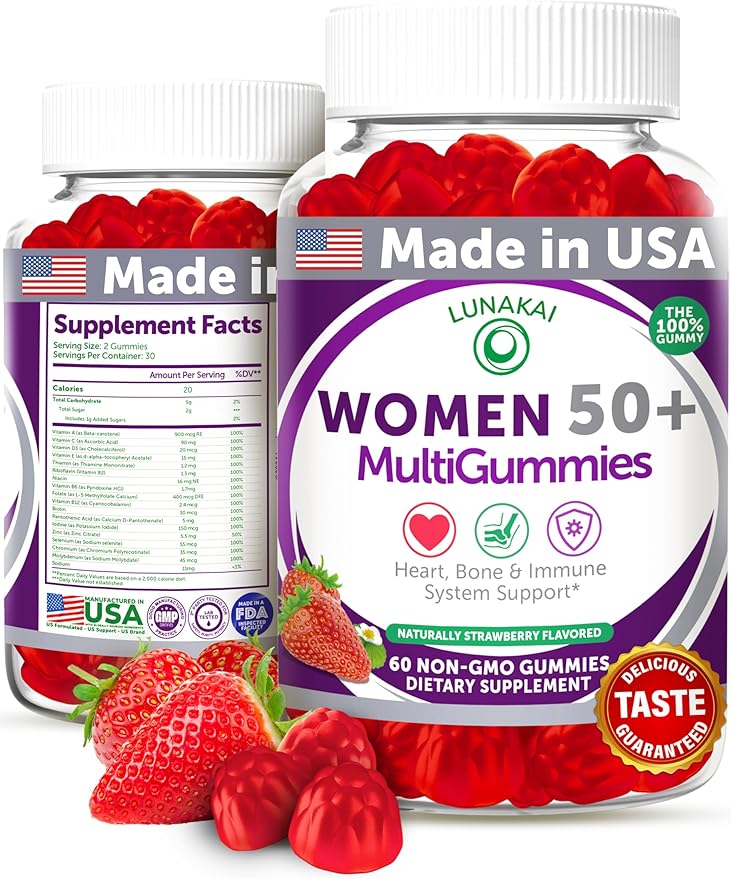
If pills have started feeling like a daily small assault, Lunakai’s strawberry gummies are the gentlest landing on this list. And surprisingly clean for a chewable.
Key Ingredients & Dosage (per 2 gummies)
- Folate 400 mcg as L-5-MTHF (methylated)
- Vitamin A 900 mcg RAE (beta-carotene only)
- Vitamin D3 800 IU
- B12 2.4 mcg (cyanocobalamin)
- Iron-free. 1 g added sugar.
Why It’s Best for Women over 60
Methylated folate in a gummy at this price is genuinely uncommon — most chewables settle for cheaper folic acid. The all-beta-carotene vitamin A also sidesteps the preformed-retinol fracture signal that matters for older women.
For someone whose diet already covers calcium and protein, this fills the gaps gummies can fill. Vegan and gelatin-free helps if animal gelatin upsets your stomach.
Safety & Side Effects
The B12 is basic cyanocobalamin — fine for healthy users, less ideal on metformin or long-term PPIs. Vitamin D at 800 IU is conservative. Gummies physically cannot fit calcium, magnesium, or vitamin K — chemistry, not a brand failure.
How to Take It
Two gummies with breakfast. Dietary fat matters since gummies have no oil base.
What Customers Are Saying
Buyers consistently praise the soft texture and clean strawberry taste, with several noting the gummies don’t stick to teeth like competitors. Some adult children mention buying them for their mothers who refuse to swallow pills. Common critique: a few reviewers wish the dose was higher than two-gummies-daily.
Pros
- Methylated folate (rare in gummies)
- Beta-carotene only — no preformed retinyl
- Just 1 g added sugar
- Vegan, gelatin-free, US-made
- Pill-averse-friendly
Cons
- Cyanocobalamin instead of methylcobalamin B12
- Vitamin D only 800 IU
- No calcium, magnesium, or vitamin K possible
- Daily sugar exposure adds up over years
2. Inessa Methylated Multivitamin
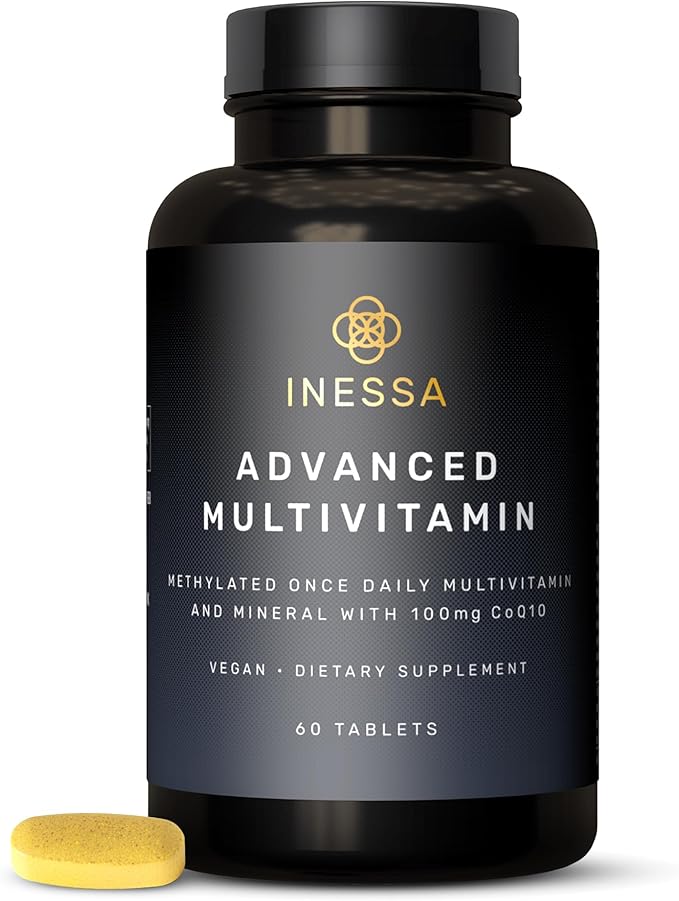
The rare one-tablet-daily multi that earns its 25-ingredient label. The pick for women who’d rather get their CoQ10, K2, and full D dose in a single swallow.
Key Ingredients & Dosage (per 1 tablet)
- CoQ10 100 mg as ubiquinone (therapeutic dose)
- Vitamin D3 2,000 IU
- Vitamin K2 75 mcg as MK-7
- B12 500 mcg methylcobalamin, 5-MTHF folate
- Iron-free, copper-free
Why It’s Best for Women over 60
The 100 mg CoQ10 is the headline. Mortensen et al. — the Q-SYMBIO trial in JACC: Heart Failure (2014) — found 100 mg CoQ10 reduced major cardiovascular events in heart failure patients. CoQ10 is also depleted by statins, which a real share of women over 60 take without their CoQ10 ever getting replaced.
The 2,000 IU D3 sits in the fracture-prevention range. Add MK-7 K2 and an active B-complex, and this consolidates supplements women over 60 often buy separately into one tablet.
Safety & Side Effects
CoQ10 has structural similarity to vitamin K and may modestly reduce warfarin’s effect — the 75 mcg K2 matters here too. Tell your anticoagulation clinic. The tablet is genuinely large.
How to Take It
One tablet daily with the largest fat-containing meal. CoQ10 absorption can drop by half without dietary fat.
What Customers Are Saying
Reviewers highlight noticeably steadier afternoon energy and reduced reliance on separate CoQ10 capsules. The Informed Sport certification draws older athletes and former competitive runners. Recurring complaint: the tablet size is large enough that some women report cutting them in half.
Pros
- Therapeutic 100 mg CoQ10
- 2,000 IU D3 in a single tablet
- MK-7 vitamin K2 included
- Fully methylated B-complex
- Informed Sport certified
Cons
- Tablet is genuinely large
- Marketed unisex, not postmenopause-tuned
- Premium price point
- Small amount of retinyl acetate
3. Designs for Health Methylated Multivitamin (Twice Daily)
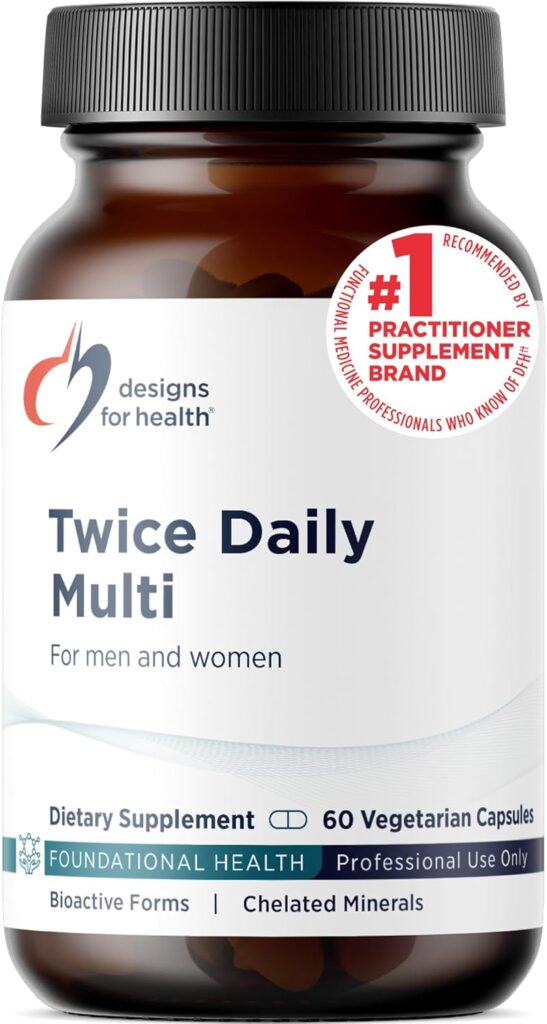
The most clinically sophisticated formula on this list. Designs for Health is a practitioner-grade brand sold mainly through functional medicine clinicians. It shows.
Key Ingredients & Dosage (per 2 capsules)
- Vitamin K 120 mcg as full-spectrum K1 + MK-4 + MenaQ7®
- Folate 680 mcg as Quatrefolic® 5-MTHF
- B12 500 mcg methylcobalamin, B6 as P-5-P
- Vitamin E as DeltaGold® annatto tocotrienols
- All trace minerals as TRAACS® chelates
- Iron-, calcium-, magnesium-free (by design)
Why It’s Best for Women over 60
Best-in-class on three fronts. Full-spectrum K2 rather than just MK-7. Tocotrienol vitamin E — clinically distinct from the alpha-tocopherol most multis use. All-chelated minerals, which absorb better than oxide or sulfate.
The deliberate omission of calcium, magnesium, and iron isn’t a gap. It’s a “build your stack” philosophy that pairs with separate Ca/Mg supplements — exactly how functional medicine clinicians prescribe.
Safety & Side Effects
Niacin 50 mg may cause mild flushing. Selenium 200 mcg is meaningful — fine alone, but track if you also eat Brazil nuts (UL 400 mcg). Full-spectrum K2 needs to be reported to anticoagulation clinics.
How to Take It
Two capsules daily, ideally split (one AM, one PM) with food.
What Customers Are Saying
Buyers — many introduced to the brand by their naturopath or functional medicine provider — describe noticeable energy improvement within 2–3 weeks. The full-spectrum K2 and tocotrienols come up often as differentiators. Critique: the price point is roughly double mass-market drugstore options.
Pros
- Full-spectrum K2 (best on this list)
- All-chelated TRAACS® minerals
- Tocotrienol-form vitamin E
- Practitioner-grade quality
- Twice-daily split absorbs better
Cons
- No calcium or magnesium (deliberate)
- Premium price point
- Selenium on the high side
- Two capsules twice daily — some prefer once
4. True Grace One Daily Women’s Multivitamin 40+
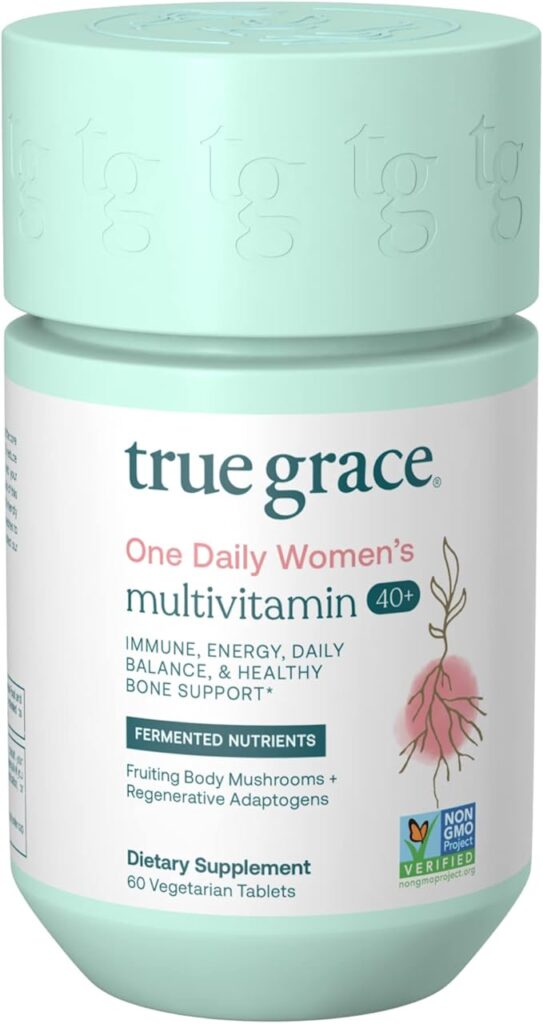
The only multi here pairing the basics with adaptogens and medicinal mushrooms — from a Carbon Neutral, Regenerative Organic Certified® supply chain.
Key Ingredients & Dosage (per 1 tablet)
- Adaptogen blend 100 mg (Ashwagandha + Tulsi)
- Organic mushroom blend (Reishi, Chaga, Lion’s Mane, Maitake)
- Vitamin D3 1,200 IU from algae (vegan)
- 5-MTHF folate, methylated B12
- MenaQ7® MK-7
- Iron-free
Why It Works for Women Over 60
Adaptogens + medicinal mushrooms in a daily multi is genuinely rare. Lion’s mane — Mori et al. (Phytother Res, 2009) — showed cognitive improvements at 3 g/day. The dose here is lower, but contributes alongside ashwagandha’s cortisol-modulating effects.
For women juggling stress, sleep changes, and cognitive load, the extras earn their place. Algal D3 also makes it strict-vegan friendly.
Safety & Side Effects
Ashwagandha is contraindicated in hyperthyroidism and may potentiate thyroid hormone replacement — important if you’re on levothyroxine. Tulsi has weak antiplatelet activity. B12 at 10 mcg is on the lower end for women 60+.
How to Take It
One tablet daily with food.
What Customers Are Saying
Reviewers consistently report calmer mornings and better stress tolerance — likely the ashwagandha at work. The refill-pouch sustainability is praised by environmentally-conscious buyers. Common complaint: the organic herb blend gives the tablet a distinct earthy smell some find off-putting.
Pros
- Adaptogens + medicinal mushrooms in one multi
- Algal vegan D3
- Coenzyme-form B-complex
- Carbon Neutral, sustainable packaging
Cons
- B12 modest at 10 mcg
- Ashwagandha thyroid caution
- “40+” framing not 60-specific
- Earthy smell from herb blend
5. New Chapter Every Woman’s One Daily 55+
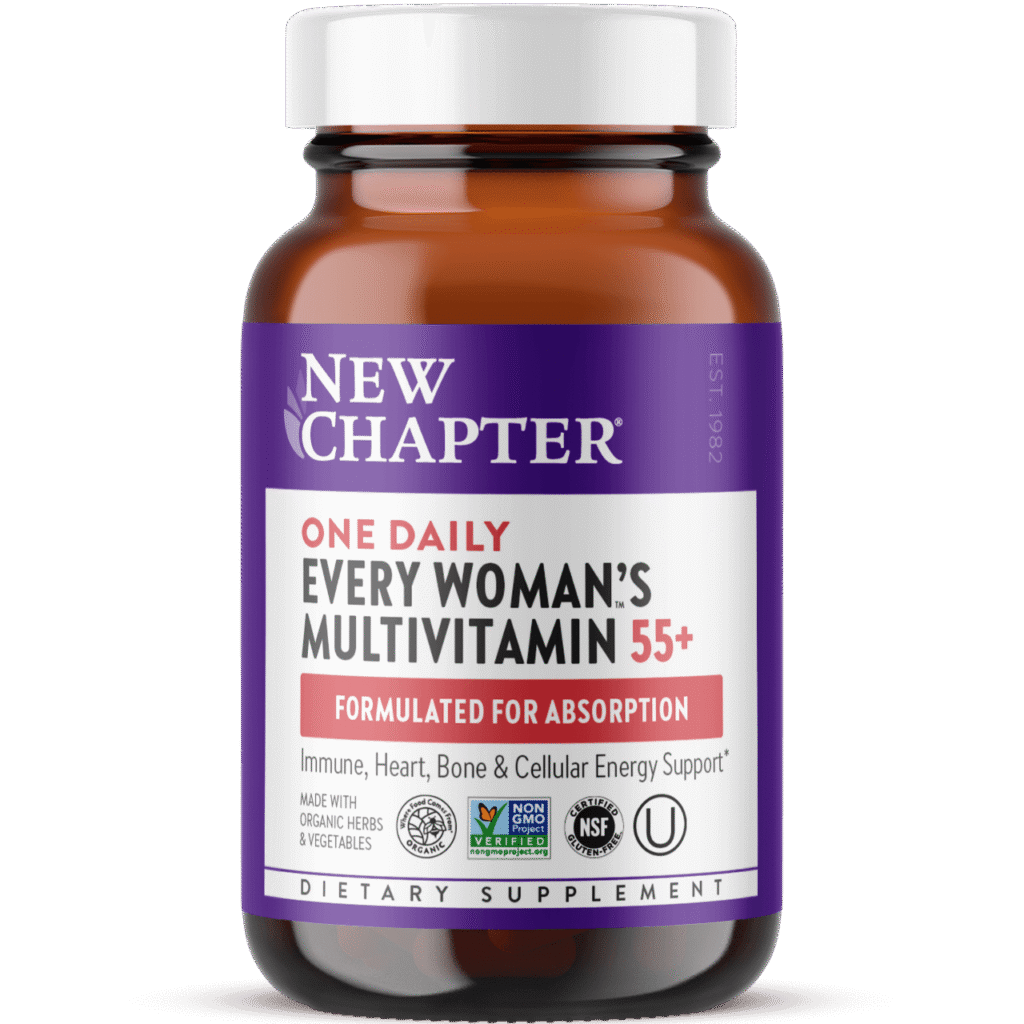
The most age-precise targeting on this list — 55+ rather than the generic 50+. A fermented whole-food formula gentle enough to take on an empty stomach.
Key Ingredients & Dosage (per 1 tablet)
- Vitamin D3 1,000 IU
- Vitamin K 61 mcg (K1 + MK-7)
- 8 fermented B vitamins (methylated folate + B12)
- Astaxanthin from organic algae
- Organic herb blends — turmeric, ginger, elderberry, chaste tree berry
- Iron-free
Why It Works for Women Over 60
The age precision matters — 55+ targets postmenopausal physiology more honestly than vague “50+” formulas. Astaxanthin (Yoshida et al., Atherosclerosis, 2010) showed HDL improvement and triglyceride reduction at higher doses.
Empty-stomach tolerance is a real win for older adults whose morning medications must be taken without food. The fermented form claims better gentle digestion — the brand’s strongest marketing point, though head-to-head trial evidence is limited.
Safety & Side Effects
Chaste tree berry in the blend carries the same caveat noted later for #11: caution in hormone-sensitive cancer histories and with dopamine antagonists. Contains fermented soy and trace fermented wheat (gluten below 20 ppm threshold but worth noting for severe sensitivities).
How to Take It
One tablet daily, anytime. With food still slightly improves fat-soluble vitamin absorption.
What Customers Are Saying
Long-time New Chapter loyalists praise gentle digestion compared to drugstore multis that previously gave them nausea. The empty-stomach tolerance is regularly cited as a differentiator. Critique: the 50% DV dosing on several nutrients (the brand’s “fermented bioavailability” thesis) frustrates buyers who expect 100% DV across the board.
Pros
- Age-precise 55+ targeting
- Empty-stomach tolerance
- Astaxanthin included
- Organic herb blend with real doses
- Reliable B Corp brand
Cons
- Chaste tree berry caution for some
- Many nutrients at 50% DV not 100%
- B12 dose modest
- Premium price
6. MegaFood Women’s 55+ One Daily Multivitamin
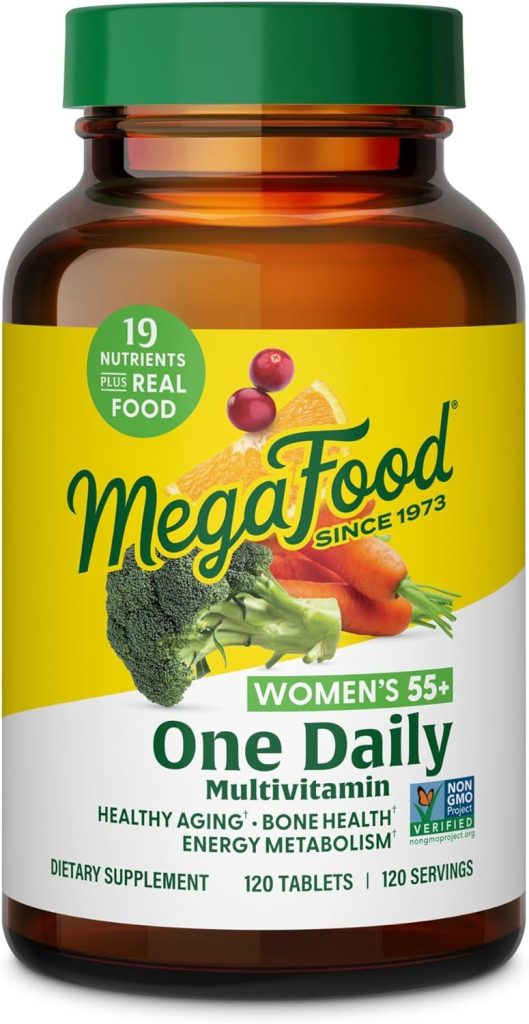
One of the cleanest mass-market profiles available. NSF certified, glyphosate-residue-free, B Corp — and a vitamin D dose that actually meets the demographic’s needs.
Key Ingredients & Dosage (per 1 tablet)
- Vitamin D3 1,600 IU (200% DV) — the highest D dose on this list
- B12 as methylcobalamin (food-paired)
- Folate as L-5-MTHF (paired with broccoli)
- Vitamin A as beta-carotene only, paired with carrot
- Iron-free, calcium-free, magnesium-free
Why It Works for Women Over 60
The 1,600 IU vitamin D3 is the most clinically aligned dose on this list — Bischoff-Ferrari and others have argued repeatedly that 1,500–2,000 IU is the sweet spot for postmenopausal women.
Glyphosate-residue-free certification is rare in supplements and meaningful given that herbicide residues appear in plant-derived nutraceuticals. The food-paired approach is more marketing than proven biochemistry, but it does no harm.
The deliberate omission of calcium and magnesium is intentional — those minerals interact with iron and zinc and are often better taken at separate times.
Safety & Side Effects
Vitamin K is K1 only, not K2 — adequate for clotting, suboptimal for bone-vascular calcium routing. Patients on warfarin should report any K-containing supplement.
The empty-stomach tolerance is a real practical advantage.
How to Take It
One tablet daily, anytime. Pair separately with calcium-magnesium at bedtime if dietary intake is inadequate.
What Customers Are Saying
Buyers note clean ingredient transparency and lack of GI upset, with several mentioning successful switching from drugstore multis that previously caused nausea. The “made with real food” branding resonates strongly with buyers seeking whole-food alternatives. Critique: the absence of calcium/magnesium frustrates buyers who expect a “complete” formula.
Pros
- 1,600 IU D3 — highest on this list
- Methylcobalamin B12 + 5-MTHF folate
- NSF + Glyphosate-Residue-Free certified
- B Corp, allergen-free
- Empty-stomach friendly
Cons
- K1 only, no K2
- No calcium or magnesium
- “Food-paired” claims marketing-driven
- Mid-range price point
7. Freeda Geri-Freeda Senior Multivitamin
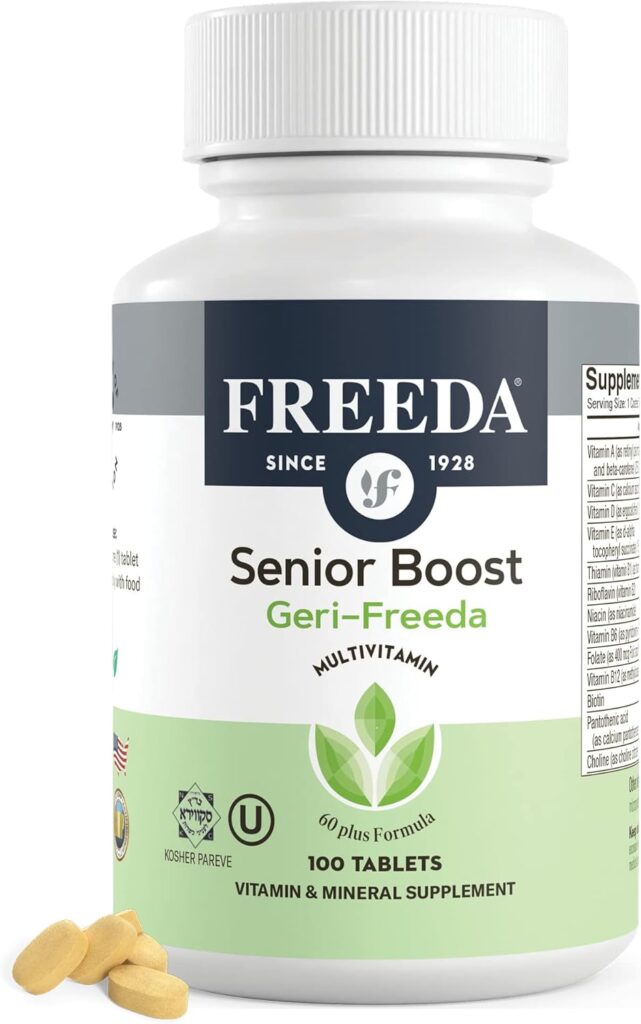
A nearly century-old US brand (since 1928) with an unusually thoughtful inclusion: Betaine HCl for digestive support — clinically meaningful for older adults with declining stomach acid.
Key Ingredients & Dosage (per 1 coated tablet)
- Folate as L-5-MTHF
- B12 methylcobalamin (in updated formula)
- Betaine HCl (digestive aid for hypochlorhydria)
- Choline (supports cognitive function)
- Calcium, Magnesium, Zinc, Selenium
- Iron-free
Why It Works for Women Over 60
The Betaine HCl is the standout. Roughly 30% of adults over 60 have hypochlorhydria — low stomach acid — from atrophic gastritis or chronic PPI use. This impairs B12, calcium, and protein absorption. Betaine HCl helps restore gastric acidification (Yago et al., Mol Pharm, 2013).
The kosher OU certification differentiates for observant Jewish customers. Coated tablets ease swallowing — the most common complaint among adults 65+ with dysphagia. And it’s affordable (~$0.10–0.15 per serving in the 250-count).
Safety & Side Effects
Betaine HCl is contraindicated in active peptic ulcer disease and works against H2 blockers/PPIs — separate doses by 2 hours if you take either. Folate at therapeutic doses can mask B12 deficiency anemia on CBC, but the methylcobalamin B12 inclusion is the protective design choice.
How to Take It
One tablet daily with the meal containing the most protein. Avoid taking with antacids or PPIs.
What Customers Are Saying
Long-term Freeda customers — some buying since the brand’s original Manhattan pharmacy days — value the company’s heritage and quality consistency. Reviewers often describe it as “easy to digest with no aftertaste” compared to other senior multis. Most common complaint: limited Amazon visibility (the listing currently appears under an unusual category).
Pros
- 97-year-old US heritage brand
- Betaine HCl for older-adult digestion
- Kosher (OU) certified
- Coated for easy swallowing
- Excellent price-per-serving
Cons
- Proprietary blend not fully dose-disclosed
- Not appropriate alongside PPIs/H2 blockers
- Lower brand awareness
- Amazon category classification quirk
8. ACTIF Organic Multivitamin for Women Age 60+
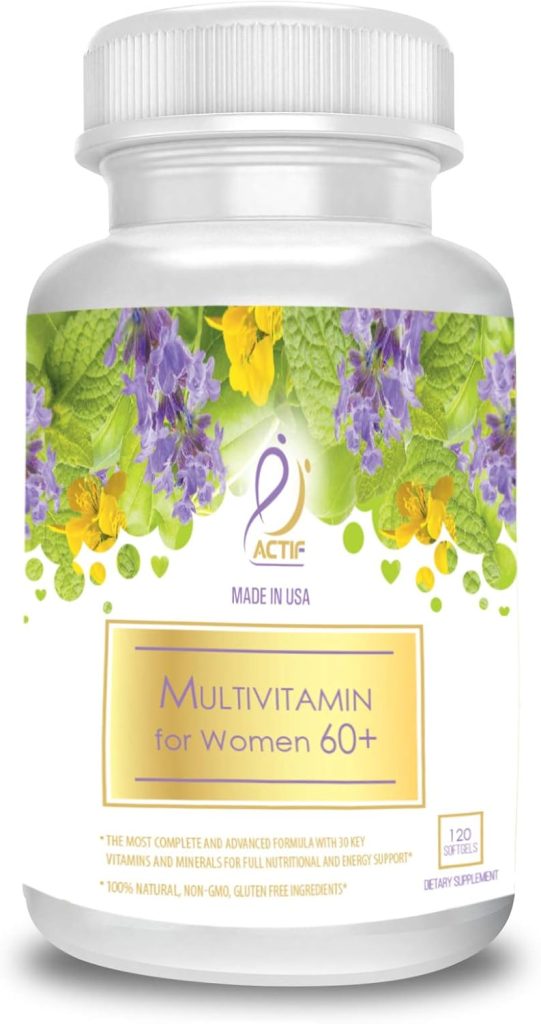
One of the very few products on Amazon US that explicitly labels “for Women Age 60+” rather than the generic 50+ marketing.
Key Ingredients & Dosage (per serving)
- 30 organic vitamins, minerals, and herbal blend
- Vitamin A as beta-carotene (no preformed retinyl)
- Vitamin D3, full B-complex including B12
- Calcium, Magnesium, Zinc, Selenium
- Advanced Biotin Complex for hair/skin
- Iron-free
Why It Works for Women Over 60
The age-targeted formulation is the headline — not “50 and over” hand-waving but a deliberate 60+ formula. Sister products (ACTIF for Women 70+, 80+) show the brand has segmented age physiology more granularly than competitors.
The organic herbal blend covers hair, skin, energy, immunity, bones, colon, eyes, and heart — comprehensive scope, though the proprietary blend means individual herb doses aren’t fully disclosed.
Safety & Side Effects
The proprietary herbal blend is the main caveat. Women on tamoxifen, aromatase inhibitors, or with hormone-sensitive cancer histories should request a lot-specific Certificate of Analysis from the brand to verify exact herb composition. NSF certification provides quality assurance but doesn’t override individual contraindication review.
How to Take It
Per label, with food. Take with a meal containing dietary fat — herb extracts and fat-soluble vitamins benefit substantially from concurrent fat.
What Customers Are Saying
Reviewers cite renewed energy and improved skin/nail quality after 4–6 weeks of consistent use. The age-specific labeling resonates strongly — buyers feel “seen” by a formula made for them rather than for a 30-year-old. Critique: the proprietary blend frustrates supplement-savvy buyers who want exact herb doses.
Pros
- Genuinely formulated for Women 60+
- 30 organic vitamins + herb blend
- NSF certified, third-party tested
- Made in USA, cGMP facility
- Iron-free, beta-carotene only
Cons
- Proprietary blend lacks full dose disclosure
- Multiple capsules per serving
- Mid-premium price point
- “Kidney health” claim is positioning
9. Ritual Essential for Women 50+
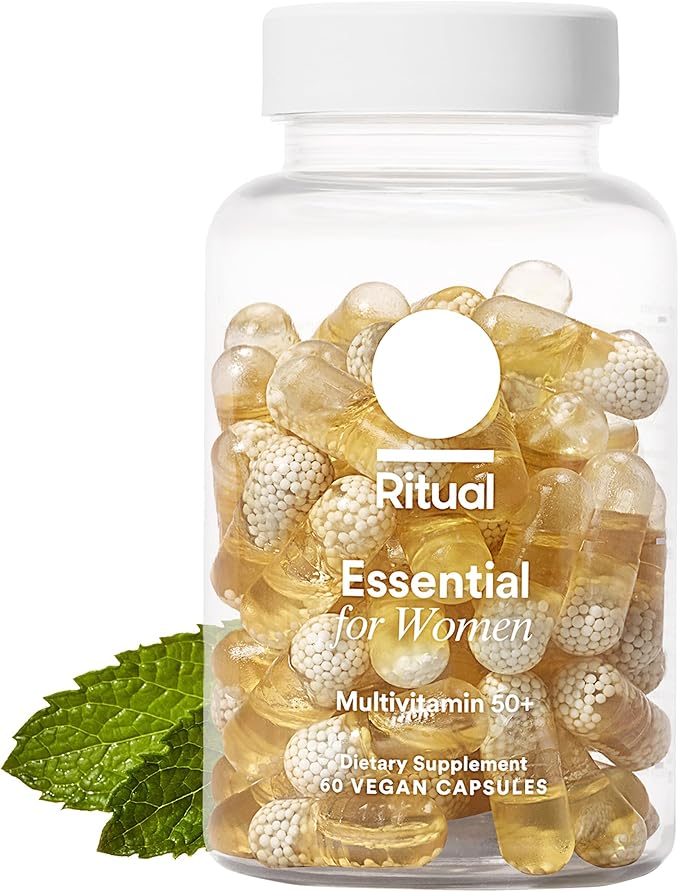
A modern, minimalist 9-nutrient formula with a patented delayed-release “beadlet-in-oil” capsule — and one of the few multis to include algae-derived DHA in the same pill.
Key Ingredients & Dosage (per 2 capsules)
- Vitamin D3 2,000 IU from lichen (rare vegan source)
- Vitamin K2 100 mcg as MK-7
- Folate as 6S-5-MTHF, B12 methylcobalamin
- Magnesium as dimagnesium malate
- Omega-3 DHA 330 mg from microalgae (rare in a multi)
Why It Works for Women Over 60
The DHA + multi-in-one is genuinely useful — most multis force a separate fish or algal oil. The MIDAS trial (Yurko-Mauro et al., Alzheimers Dement, 2010) showed 900 mg DHA improved memory in age-related cognitive decline; 330 mg here is a foundational dose.
Ritual’s intentional omission of calcium rests on Bolland et al.’s 2010 BMJ meta-analysis linking calcium supplementation to ~30% increased MI risk (still debated). The minimalist design assumes you’ll get C, B-complex, and zinc from diet.
Safety & Side Effects
The minimalism is the trade-off. A 60-year-old with limited appetite or restrictive eating may have real gaps in vitamin C, full B-complex, and zinc that this formula won’t fill. K2 100 mcg is meaningful for warfarin patients.
How to Take It
Two capsules together, AM or PM, with or without food. The delayed-release shell makes food genuinely optional.
What Customers Are Saying
Subscribers love the vegan algal DHA included and the no-fishy-aftertaste delayed-release format. Some complain about an occasional faint mint or “off” odor from the capsule. The transparency-first ingredient sourcing resonates strongly with younger 60-somethings.
Pros
- Algal DHA included (rare in multis)
- Lichen-derived vegan D3
- Delayed-release capsule
- Traceable ingredient sourcing
- Subscription convenience
Cons
- Only 9 nutrients — significant gaps
- No vitamin C, A, or full B-complex
- Premium subscription pricing
- Occasional capsule-odor complaints
10. Garden of Life Vitamin Code Women 50 & Wiser
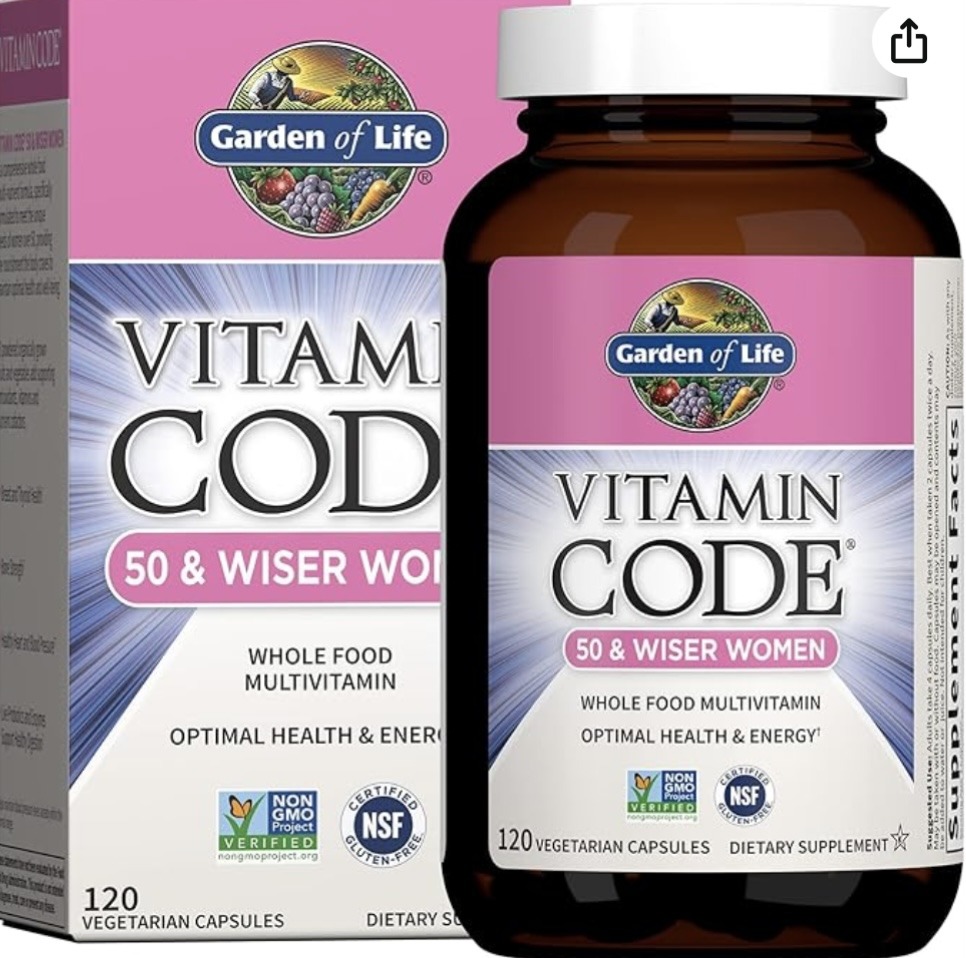
The whole-food category leader, with the broadest ingredient panel on this list — 23-fruit/veg blend, probiotics, digestive enzymes, and antioxidant complex.
Key Ingredients & Dosage (per 4 capsules)
- Vitamin D3 2,000 IU
- B12 500 mcg, Folate 600 mcg DFE (food-cultured)
- Vitamin A as beta-carotene only
- 23 organic fruits & vegetables blend
- Probiotics + digestive enzymes
- Iron-free
Why It Works for Women Over 60
The breadth is the differentiator. Beyond core vitamins, you get probiotic + enzyme support, glutathione precursors, and a fruit/veg phytonutrient profile no other multi here matches.
The lutein and beta-carotene combination loosely echoes the AREDS2 antioxidant approach for age-related eye health. Capsules can be opened and mixed into water — useful for older adults with swallowing difficulty.
Safety & Side Effects
California Prop 65 lead warning appears on this product — common in plant-based supplements due to soil uptake; actual exposure is well below FDA action limits but worth disclosing. Biotin 300 mcg is at the lower end of the immunoassay-interference range.
The 4-capsule daily serving is a real adherence barrier — the most common negative review theme.
How to Take It
Four capsules daily, ideally split (2 AM, 2 PM), with or without food. Capsules can be opened.
What Customers Are Saying
Long-time loyalists love the comprehensive whole-food profile and the option to open capsules into smoothies. The probiotic + enzyme inclusion is regularly praised. Most common critique: 4 capsules per day is a lot for some, especially those already on multiple medications.
Pros
- Broadest nutrient + phytonutrient panel
- Probiotics + enzymes integrated
- Capsules openable for swallowing difficulty
- USDA Organic + Non-GMO certifications
- Strong eye-health antioxidant profile
Cons
- 4-capsule serving (adherence barrier)
- Prop 65 warning on label
- Biotin at lower edge of assay interference
- Higher per-day pill count
11. MaryRuth’s Multivitamin for Women 40+ (Sugar-Free Gummy)
A vegan, sugar-free chasteberry-containing gummy — included for completeness with an honest caveat below.
Key Ingredients & Dosage (per 2 gummies)
- Full B-complex with B12 (methylcobalamin in newer batches)
- Vitamin D3, Vitamin C, Zinc, Iodine
- Vitex agnus-castus (chaste tree berry) — primary differentiator
- Iron-free, sugar-free (sweetened with xylitol)
Why It Works for Women Over 60
The vegan, sugar-free, allergen-free profile is broad and accessible. The lemonade flavor is well-rated. Methylcobalamin B12 is appropriate.
However — and this is honest: Vitex (chaste tree berry) has documented evidence in PMS and cyclic mastalgia in premenopausal women (Daniele et al., Drug Saf, 2005). Evidence in postmenopausal women is minimal. The marketing of this SKU as a 40+ multi works for women in their 40s; for women over 60 specifically, the chasteberry inclusion is more question mark than benefit.
Safety & Side Effects
Chasteberry is contraindicated in patients on dopamine antagonists (antipsychotics, metoclopramide) and in hormone-sensitive cancer histories (ER+ breast cancer, endometrial cancer). Both populations are well-represented at 60+. Xylitol is acutely toxic to dogs even in small amounts — store carefully if you have pets.
How to Take It
Two gummies daily with meals.
What Customers Are Saying
MaryRuth’s loyalists love the lemonade flavor and the sugar-free, vegan formulation. Buyers appreciate the brand’s B Corp values and women-owned heritage. Critique: many reviewers don’t realize the chasteberry inclusion before buying — relevant for the populations flagged above.
Pros
- Vegan, sugar-free, allergen-free
- Methylcobalamin B12
- B Corp certified, women-owned brand
- Pleasant lemonade flavor
Cons
- Chasteberry caution for hormone-sensitive cancer history
- Chasteberry caution if on dopamine antagonists
- Xylitol pet-toxic warning applies
- “40+” framing — 60+ evidence is weaker
How to Choose the Right Multivitamin for You
If you want one quick recommendation: for most women over 60 without specific medical conditions, Designs for Health Methylated Multivitamin or MegaFood Women’s 55+ One Daily offer the cleanest combination of clinical formulation and demographic fit.
If you can’t swallow pills → Lunakai gummies. If you want an explicitly 60+ formula → ACTIF Women 60+ or Freeda Geri-Freeda. If you take statins → Inessa for the CoQ10. If you want functional medicine grade → Designs for Health. If you want minimalism + DHA → Ritual. If you want maximum whole-food nutrition → Garden of Life.
Best Multivitamins for Men over 70
Best Menopause Supplements for Weight Loss
Best Collagen for Women over 60 for Skin, Hair, Joints
How to Choose the Best Multivitamin for Women Over 60
1. Look for Age-Specific Formulas
Not every multivitamin is tailored to the unique needs of women over 60. At this stage, your nutritional priorities differ from younger women’s. Age-specific multivitamins often include higher doses of bone-supporting nutrients like calcium, magnesium, and vitamin D3, as well as brain-boosting elements like B12 and omega-3s. Skip the generic multivitamin aisle—your body deserves better.
2. Check for High-Quality Ingredients
When it comes to supplements, quality is everything. Look for third-party testing certifications like USP (United States Pharmacopeia) or NSF International to confirm that the product is free from harmful contaminants. Bonus points if the multivitamin uses bioavailable forms of nutrients, like methylcobalamin for B12 or cholecalciferol for vitamin D3, as these are easier for your body to absorb.
3. Prioritize Clean Labels
You wouldn’t want fillers or artificial colors in your food, so why tolerate them in your supplements? Opt for multivitamins labeled as non-GMO, gluten-free, and free of unnecessary additives. A cleaner formula reduces the risk of adverse reactions and ensures you’re only getting what your body truly needs.
4. Consider Your Lifestyle and Preferences
If swallowing pills feels like a chore, you might prefer gummies, powders, or liquid options. Keep in mind, though, that some alternative forms may lack certain key nutrients or add extra sugar. Similarly, if you follow a vegan or vegetarian diet, make sure your multivitamin is plant-based and avoids animal-derived ingredients like gelatin.
5. Value Doesn’t Always Equal Cost
While premium multivitamins often come with a higher price tag, they tend to deliver better quality and efficacy. Still, there are budget-friendly options that strike a good balance between cost and nutrient density. Think of it as an investment in your long-term health—worth every penny.
6. Read the Label Like a Pro
The fine print matters. Make sure the multivitamin includes the recommended daily values for essential nutrients and isn’t overloaded with ingredients that exceed safe limits. For example, too much vitamin A can be harmful, while excessive iron might be unnecessary for women post-menopause unless you’re anemic.
Final Thoughts
Choosing the right multivitamin for women over 60 is all about aligning your supplement with your health priorities. Whether you’re focused on boosting bone health, improving energy levels, or supporting overall well-being, a high-quality multivitamin can make a significant difference. Look for options that offer key nutrients like vitamin D, calcium, magnesium, and B vitamins, and pay attention to formulations that enhance absorption and digestion.
Remember, nutritional needs vary, and what works best for one person may not suit another. Always consider factors like ingredient quality, certifications, and specific health benefits to find the multivitamin that fits your lifestyle. Consulting with a healthcare professional can provide personalized guidance to help you make the most informed choice for your health journey.
FAQs About Multivitamins for 60 years old Women
1. Why do women over 60 need multivitamins?
As women age, their bodies face new challenges, including bone loss, decreased energy, and weaker immunity. Multivitamins help address these issues by providing key nutrients that may be lacking in your diet, supporting overall health and vitality.
2. What nutrients are most important in multivitamins for women over 60?
Look for multivitamins containing vitamin D, calcium, magnesium, and B-complex vitamins for bone health, energy, and brain function. Antioxidants like vitamins C and E, along with probiotics or omega-3s, can also provide additional benefits for aging bodies.
3. Should postmenopausal women avoid multivitamins with iron?
Yes, most postmenopausal women no longer need additional iron unless directed by a doctor. Excess iron can lead to health issues, making iron-free multivitamins a better choice for this age group.
4. Are whole-food multivitamins better than synthetic ones?
Whole-food-based multivitamins are often easier to digest and more bioavailable. However, synthetic multivitamins can still be effective if they are high quality and include key nutrients in absorbable forms.
5. How can I tell if a multivitamin is high quality?
Look for third-party certifications like USP Verified or NSF Certified to ensure safety and potency. Researching reputable brands and reading customer reviews can also help you identify trusted products.
6. Can multivitamins replace a healthy diet?
No, multivitamins are meant to supplement a healthy diet, not replace it. A balanced diet rich in whole foods is still the best way to get essential nutrients, while multivitamins fill any remaining gaps.
7. Are gummy multivitamins a good option for women over 60?
Gummy multivitamins can be a tasty and convenient choice, but they often contain added sugars and may not provide as many nutrients as tablets or capsules. Check labels to ensure they meet your nutritional needs.
8. Is it safe to take multivitamins with prescription medications?
While multivitamins are generally safe, some nutrients may interact with medications. It’s always wise to consult your healthcare provider before starting any new supplement, especially if you take regular medications.
9. How long does it take to see results from multivitamins?
You may notice subtle improvements in energy or mood within a few weeks. However, benefits like stronger bones or improved immune function typically require consistent use over several months.
10. Can you take too many vitamins from multivitamins?
Yes, excessive intake of certain vitamins, such as A, D, E, or K, can cause toxicity and health problems. Always follow the recommended dosage and speak with a healthcare professional for guidance.