
Caring for an aging parent is a strange kind of love letter. You watch the person who once packed your school lunches forget where they put their reading glasses, and somewhere along the way you start managing their pill schedule, their groceries, and yes — their multivitamin.
Here’s the catch. Most “senior” multivitamins on Amazon are quietly built for healthy 55-year-olds at the gym. They aren’t built for an 82-year-old on a blood thinner who skips lunch and sometimes forgets dinner.
That gap is what this guide closes.
I’m a practicing physician who’s spent over a decade reviewing supplements, and I’ve checked every label below against published nutrition data, geriatric drug-interaction tables, and absorption research specific to older adults. Whether you’re shopping for an elderly parent, an aging patient, or yourself in your late seventies — these are the 11 best multivitamins for elderly adults that hold up to clinical scrutiny in 2026.
A quick honesty check before we dig in: a multivitamin is a supplement, not a substitute for breakfast. The U.S. Preventive Services Task Force does not recommend multivitamins for general disease prevention in healthy older adults. But the same Task Force concedes what every primary-care doctor sees daily — many elderly people genuinely under-eat, mal-absorb, or both. For those folks, a smart multivitamin is one of the cheapest pieces of preventive medicine money can buy.
Let’s get into it.
Best Multivitamins for Men over 60
Best Multivitamins for Women over 50
Why Elderly Adults Often Need a Multivitamin (and When They Don’t)
Aging changes how the body handles nutrients. Three shifts matter most.
Stomach acid drops. Up to 30% of adults over 60 develop atrophic gastritis, where the stomach makes too little acid to release vitamin B12 from food protein. The NIH Office of Dietary Supplements explicitly recommends that adults over 50 get most of their B12 from supplements or fortified foods, because food-bound B12 simply doesn’t dissociate the way it used to.
Skin makes less vitamin D. A 70-year-old’s skin produces about a quarter of the D3 a 20-year-old’s does for the same sun exposure. Combine that with less time outdoors, and deficiency becomes the rule rather than the exception — particularly in the homebound elderly.
Appetite shrinks. Caloric intake can drop 25% by age 75 — but vitamin and mineral targets don’t drop with it. Less food, same nutrient needs. Math problem.
Add in polypharmacy. Metformin depletes B12. PPIs (Prilosec, Nexium) blunt B12 and magnesium absorption. Loop diuretics flush out potassium, magnesium, and thiamine. Statins may reduce CoQ10. By the time an 80-year-old has been on five medications for a decade, their micronutrient panel often looks nothing like the textbook adult.
That’s where a multivitamin earns its place. The COSMOS-Mind randomized trial in adults aged 65+ reported modest cognitive benefits with daily multivitamin use over three years (Baker et al., Alzheimer’s & Dementia, 2023). Cataract incidence has shown small improvements with multivitamin use in meta-analyses too.
That said — a multivitamin is not appropriate for every elderly person. Skip ahead to “When NOT to Give a Multivitamin” before you click buy.
What to Look for When Buying a Multivitamin for an Elderly Parent
Here’s what I check on every label I recommend to a patient or a relative.
Pill size and format. This is the boring detail nobody puts on the front of the box, but it determines whether your mom actually takes the thing. If swallowing is hard, a liquid or chewable beats a horse-pill tablet every single time. Capsules that can be opened and stirred into applesauce are a quiet superpower.
Iron-free unless prescribed. Iron is the most over-supplemented nutrient in older adults. Postmenopausal women and most older men do not need extra iron, and excess iron can worsen oxidative stress and constipation. Look for “iron-free” on the label. If your loved one has confirmed iron-deficiency anemia, that’s a clinician’s call — not a multivitamin’s job.
Methylated B12 and folate. Methylcobalamin (B12) and L-5-methyltetrahydrofolate (folate) are the active forms that bypass the conversion steps weakened by age and MTHFR genetic variants. Cyanocobalamin works for most people but is a slightly weaker pick after 70.
Third-party verification. Look for USP Verified, NSF Certified, or ConsumerLab seals. These mean the label matches what’s actually in the bottle. Without them, you’re trusting marketing.
Mineral form matters. Glycinate, citrate, and bisglycinate forms absorb better and are gentler on the stomach than oxides and carbonates. Magnesium oxide, for example, is famously poorly absorbed and tends to act as a laxative — which is sometimes exactly what an elderly patient does not need on top of constipating opioids.
Vitamin K and warfarin. If your parent takes warfarin (Coumadin), the multivitamin’s vitamin K content has to stay consistent day to day. NIH guidance is clear here — sudden swings in K intake can destabilize INR and trigger a clot or a bleed.
If your parent takes warfarin, see #3 — it’s the only multivitamin on this list formulated without vitamin K.
Calcium content is fine when modest. Most multivitamins include only 100–200 mg calcium, which is appropriate. A multivitamin should not be your loved one’s primary calcium source. Adults over 70 need ~1,200 mg/day total, which means food first, separate supplementation second if blood work flags a gap.
OK. Buying-guide done. On to the rankings.
The 11 Best Multivitamins for Elderly Adults in 2026, Reviewed
1. Nature’s Lab Gold One Daily Multivitamin — Best Premium Pick for Elderly Adults
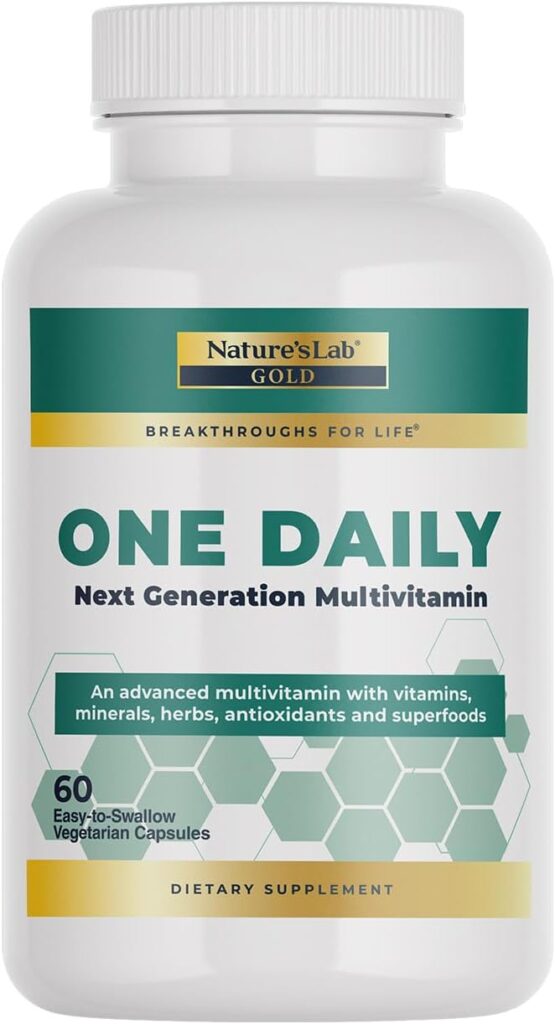
This is the multivitamin I’d put in my own father’s pill organizer. Nature’s Lab took everything that made their Six Daily formula clinically interesting — CoQ10, methylated B12, alpha-lipoic acid, resveratrol, quercetin — and condensed it into one capsule a day
For an elderly audience where pill burden is half the battle, that single change is the difference between a multivitamin that gets taken and one that gathers dust on the bathroom counter.
It’s also the rare premium formula where the ingredient list reads like a geriatric pharmacist wrote it: high-dose vitamin D3, methylated B12, lutein and zeaxanthin for the eyes, three forms of zinc, and BioPerine to help the rest absorb.
Key Ingredients & Dosage (per 1 capsule daily)
| Nutrient | Amount | Notes |
|---|---|---|
| Vitamin D3 (cholecalciferol) | 4,000 IU / 100 mcg | High-end clinical dose — relevant for homebound elderly |
| Vitamin B12 (methylcobalamin) | 1,500 mcg | Active form, very high dose for age-related malabsorption |
| Folate (5-MTHF + folic acid blend) | 1,360 mcg DFE | Methylated form bypasses MTHFR conversion issues |
| Vitamin A (beta-carotene + palmitate) | 1,500 mcg | Mixed-form for safety |
| Vitamin C (ascorbic acid) | 100 mg | Standard antioxidant dose |
| Vitamin E (d-alpha tocopheryl) | 20 mg | Natural form |
| Vitamin K (incl. K2) | 300 mcg | Bone + vascular calcium handling — warfarin caution |
| Full B-complex | 100–800% DV | Riboflavin in active 5-phosphate form |
| Zinc (L-OptiZinc + carnosine + oxide) | 136% DV | Triple-form for absorption + retention |
| Selenium SeLECT, ChromeMate, Iodine | Branded forms | Bioavailable trace minerals |
| CoQ10 | 100 mg | Clinically meaningful for statin users |
| Lutein + Zeaxanthin | Included | Eye health — AMD support |
| Alpha lipoic acid, resveratrol, quercetin, turmeric, green tea, grape seed | Included | Antioxidant network |
| Prebiotic fermented superfood complex | Included | Gut support |
| BioPerine (black pepper extract) | Included | Improves absorption of multiple nutrients |
What Makes It Stand Out
Three things genuinely set this apart in the elderly category. First, once-daily dosing matches the adherence reality of older adults.
Second, the 4,000 IU vitamin D3 dose is unusual — most multis stop at 800–1,000 IU, but homebound elderly with chronic D deficiency often need this much to actually correct serum 25-OH vitamin D levels.
Third, lutein and zeaxanthin are included, which directly addresses age-related macular degeneration risk. Few once-daily multis at any price include all three.
Add in 100 mg CoQ10 and methylated B12, and this becomes the rare premium multivitamin that’s actually appropriate for a frail 80-year-old, not just a 55-year-old biohacker.
How It Supports Healthy Aging
Vitamin D3 at 4,000 IU directly addresses muscle preservation, immune function, and bone health — three of the most clinically meaningful concerns in adults over 75. Methylcobalamin B12 at 1,500 mcg saturates the absorption pathway even in patients with atrophic gastritis or on long-term PPI therapy.
Lutein and zeaxanthin support macular pigment density (the AREDS2 trial showed real benefit in older adults with early AMD). CoQ10 100 mg matters especially for the millions of elderly patients on statins, where myocardial CoQ10 levels demonstrably decline.
The herbal antioxidant trio (resveratrol, quercetin, turmeric) is at modest doses here — present enough to contribute, low enough to keep the interaction profile manageable.
Safety & Side Effects
Three honest cautions. Vitamin D 4,000 IU is at the U.S. tolerable upper intake limit.
If your loved one already takes a separate D3 supplement, this multivitamin alone replaces it — don’t stack them without a serum 25-OH vitamin D check. Vitamin K at 300 mcg is high enough to matter for warfarin patients — keep daily intake consistent and loop in the anticoagulation clinic before starting.
Allergen disclosure: the label discloses tree nuts (cashew, Brazil), wheat/barley/rye, sesame, and soybean. For elderly users with confirmed allergies in any of those categories, choose product #2 (MaryRuth Liquid) or #10 (MegaFood) instead.
Mild antiplatelet activity from the herb blend is worth a clinician’s attention if your parent is on aspirin, clopidogrel, or a DOAC. Avoid in advanced kidney disease without nephrology input.
How to Take It
One capsule daily with a meal — preferably the largest meal of the day, since multiple fat-soluble vitamins (A, D, E, K) absorb better with dietary fat.
Capsule can be opened and contents stirred into applesauce, yogurt, or a smoothie if swallowing is challenging — though some users find the taste assertive when opened. For most elderly adults, swallowing the intact capsule with breakfast or lunch is the cleanest route.
Pros & Cons
Pros
- Once-daily dosing — solves the adherence problem
- Methylated B12 + 5-MTHF folate — right forms for older absorption
- High-dose vitamin D3 (4,000 IU) — clinically meaningful for elderly
- CoQ10 100 mg — matches statin-using older adults’ need
- Lutein + zeaxanthin — rare in once-daily multis, AMD-relevant
- Three forms of zinc + BioPerine for absorption
- USP/NSF third-party audited facility
- Vegetarian capsule, no titanium dioxide, no synthetic dyes
Cons
- Allergen disclosure (tree nuts, wheat, sesame, soy) — disqualifies allergic users
- Vitamin D 4,000 IU is at the upper limit — don’t stack with separate D supplements
- Vitamin K 300 mcg is high — strict consistency required for warfarin patients
- Pricier than drugstore tablets (~$20/month)
- Herbal antioxidants warrant attention if on multiple anticoagulants or antiplatelets
2. MaryRuth Organics Liquid Morning Multivitamin — Best Multivitamin for Elderly with Swallowing Difficulty
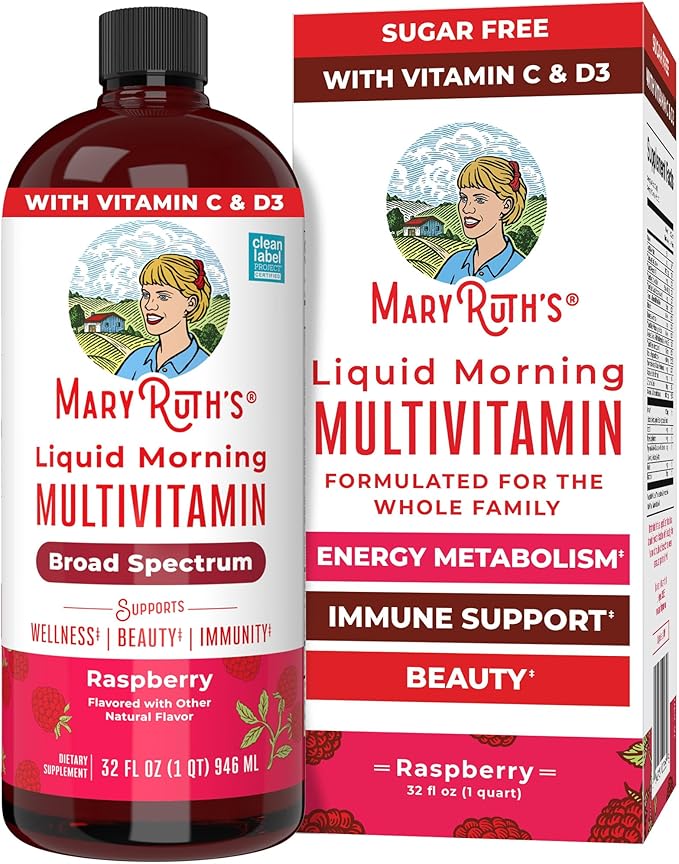
If your loved one struggles with pills — and roughly 15–20% of adults over 70 do, per published dysphagia data — this is the multivitamin to buy first. MaryRuth’s liquid format takes pill swallowing off the table entirely. Two tablespoons in a glass of juice, done.
It’s also one of the rare liquid multivitamins that uses methylcobalamin B12 and methylfolate — the same active forms a geriatrician would order on a blood panel. Most liquid multis use cheaper synthetic equivalents, which makes this one a quiet standout for the 75-and-up crowd.
Key Ingredients & Dosage (per 2 tbsp / 30 mL serving)
| Nutrient | Amount | % DV | Form/Notes |
|---|---|---|---|
| Vitamin A (beta-carotene) | 1,012 mcg | 112% | Plant-derived |
| Vitamin C | 90 mg | 100% | Ascorbic acid |
| Vitamin D3 (lichen-derived) | 20 mcg / 800 IU | 100% | Vegan-friendly D3 |
| Vitamin E | 18 mg | 120% | D-alpha tocopherol (natural) |
| B-complex (B1, B2, B3, B6) | 200–500% DV | — | Generous, full panel |
| Folate (Calcium L-5-MTHF) | 510 mcg DFE | 128% | Methylated, active |
| Vitamin B12 (methylcobalamin) | 12 mcg | 500% | Active, well-absorbed |
| Biotin | 300 mcg | 1,000% | See lab caveat below |
| Pantothenic acid | 10 mg | 200% | — |
| Zinc (citrate) | 1 mg | 9% | Low — see notes |
| Choline, Inositol, BCAAs, MSM, Hesperidin | Various | — | Bonus actives |
What Makes It Stand Out
Three things. Liquid format for dysphagia. Methylated B12 and folate for older absorption issues. And the clean-label profile — sugar-free, vegan, allergen-free, Clean Label Project Certified, B Corp Certified — which matters if your parent has multiple food sensitivities or follows a restricted diet.
It’s also one of the few liquid multis with a real BCAA + amino acid component, which is incidentally helpful for older adults at risk of sarcopenia (age-related muscle loss).
How It Supports Healthy Aging
The methylated B-vitamin profile addresses the most common deficiency in adults over 75 (B12) and the second most common (folate). The 800 IU vitamin D3 covers baseline bone and immune support — not a high-dose replacement, but reasonable for a multivitamin. The lower zinc dose is the formula’s main weakness; zinc deficiency runs common in the elderly, and you may want a separate 15 mg zinc supplement on top of this if blood work flags a gap.
Safety & Side Effects
Biotin at 300 mcg can interfere with troponin, thyroid, and several hormonal blood tests — flag this to your parent’s cardiologist or endocrinologist before any scheduled labs, and pause the supplement 48 hours before testing if instructed. The product needs refrigeration after opening. Some users report a strong herbal taste; mixing it into orange juice or a smoothie covers it well. No iron, no calcium, no magnesium — fine for a multivitamin, but plan separately for those if they’re indicated.
How to Take It
Shake well. Take 2 tablespoons (30 mL) in the morning, alone or mixed into juice, water, or a smoothie. With or without food. Caregiver hack: pre-pour the dose into a small medicine cup the night before and leave it in the fridge next to the breakfast plate. Removes the morning friction entirely.
Pros & Cons
Pros
- Genuine liquid format — no pill swallowing required
- Methylated B12 and folate (rare in liquid multis)
- Sugar-free, vegan, allergen-friendly, Clean Label Project Certified
- Lichen-sourced D3 (vegan)
- Built-in BCAAs help mitigate sarcopenia risk
Cons
- Low zinc (1 mg) — may need separate supplementation
- No calcium or magnesium
- Needs refrigeration after opening
- Biotin may interfere with blood tests
- Pricier per serving than tablet multis
3. One A Day Proactive 65+ Multivitamin — Best Multivitamin for Elderly on Warfarin (No Vitamin K)
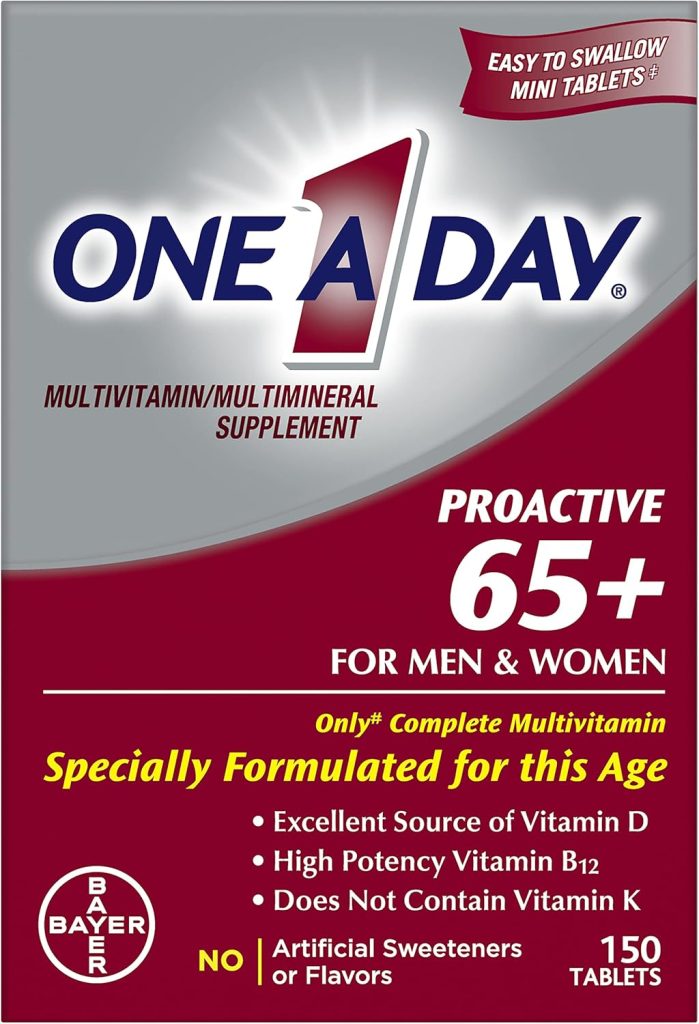
This is the multivitamin I’d recommend to any caregiver whose elderly parent takes warfarin (Coumadin) — and it’s the only product on this list that earns that recommendation cleanly. One A Day Proactive 65+ is deliberately formulated without vitamin K, which removes the single biggest drug-interaction headache in geriatric supplementation. No more daily-consistency dance, no more INR swings from a missed pill or a stacked salad.
It’s also the only multivitamin on this list specifically formulated for adults 65 and older rather than the generic “50+” demographic. Higher vitamin D, higher B12 content, no iron — the formula reads like the brand actually thought about what changes between 55 and 75.
Key Ingredients & Dosage (per 2-tablet daily serving)
| Nutrient | Notes |
|---|---|
| Vitamin A (beta-carotene + acetate blend) | Antioxidant + vision support |
| Vitamin C | Standard antioxidant dose |
| Vitamin D (cholecalciferol) | Higher than the brand’s 50+ formula |
| Vitamin B12 (cyanocobalamin) | High-potency dose to offset age-related malabsorption |
| Folic Acid | Standard form |
| Riboflavin, Thiamin, Niacin, B6, Biotin, Pantothenic Acid | Full B-complex |
| Calcium (calcium carbonate) | Modest, supplemental |
| Magnesium (oxide) | Muscle/nerve support |
| Zinc, Selenium, Copper, Manganese, Chromium, Iodine | Trace minerals |
| NO Vitamin K | Designed for warfarin users |
| NO Iron | Appropriate for adults 65+ |
What Makes It Stand Out
The absence of vitamin K is the clinical headline. Roughly 2–3 million Americans take warfarin, and most are elderly. Every other multivitamin on this list — every single one — contains vitamin K, which means consistency conversations with the anticoagulation clinic before any switch. Proactive 65+ skips that conversation entirely. The label even states the formula is built specifically for patients whose physicians have instructed them to avoid vitamin K.
The 65+ age-targeting is the second standout. Most “senior” multivitamins aim at 50+, which is generous. Proactive 65+ is calibrated for the 65–85 demographic — higher D, higher B12, calcium and magnesium adjusted for the real bone-and-muscle priorities of that age.
How It Supports Healthy Aging
Higher vitamin D supports muscle, bone, and immune function in adults whose skin synthesis has dropped to a quarter of its young-adult capacity. The high-dose B12 (cyanocobalamin) addresses the absorption decline from atrophic gastritis — the form is suboptimal compared to methylcobalamin, but the dose is generous enough that even partial absorption clears clinical thresholds. Calcium plus magnesium provides modest bone backup. The lack of vitamin K means INR stability for warfarin-managed patients, which is a real quality-of-life win.
Safety & Side Effects
The compromises are honest. Cyanocobalamin is the cheaper, less-active form of B12 — fine for most users, suboptimal for confirmed B12 absorption issues. Folic acid is similarly basic, not methylfolate. The label includes FD&C Yellow #6 Aluminum Lake, titanium dioxide, and mica as colorants — a turnoff for clean-label buyers.
The good news: no iron, no vitamin K, gluten-free, dairy-free. Mineral content (calcium, magnesium oxide) still warrants 4-hour spacing from levothyroxine, alendronate, and fluoroquinolone antibiotics.
How to Take It
Two tablets daily with food. Best taken with the largest meal of the day for fat-soluble vitamin absorption. The 2-tablet dose is slightly more pill burden than once-daily competitors, but the tablets are smooth-coated and reasonably easy to swallow.
Pros & Cons
Pros
- No vitamin K — the only formula on this list safe-by-default for warfarin patients
- Specifically formulated for adults 65+ (not the generic “50+” lane)
- Higher vitamin D and B12 content vs. brand’s 50+ formula
- Iron-free, gluten-free
- Affordable: ~$11–13 for 150 tablets (75-day supply)
- Widely available at any pharmacy
Cons
- Cyanocobalamin (not methylcobalamin) B12
- Folic acid (not methylfolate)
- Synthetic dyes (FD&C Yellow #6, titanium dioxide)
- 2 tablets daily (slightly higher pill burden)
- No CoQ10, no advanced antioxidants
4. Centrum Silver Men 50+ — Best Trusted Drugstore Pick for Elderly Men
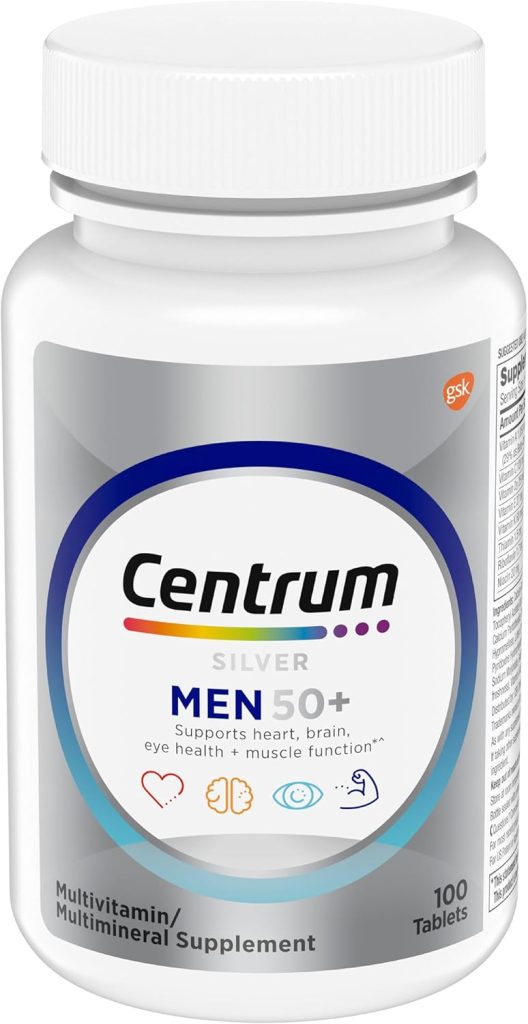
If your elderly father has been buying his own vitamins for thirty years, odds are this is what he already trusts. There’s something to that. Centrum Silver Men 50+ is one of the most-studied general multivitamins on the market — it was the formulation used in the COSMOS-Mind cognition trial in adults aged 65+.
It’s not the most exciting formula on this list. But “exciting” isn’t always what you want for an 80-year-old dad. Predictable, affordable, available at any pharmacy in the country — those are what you want when adherence and reliability matter more than novelty.
Key Ingredients & Dosage
The Men 50+ formula provides a once-daily smooth-coated tablet with:
- Vitamin D — bone, muscle, immune support
- Vitamin B6 — protein metabolism, helpful for older men trying to preserve muscle
- Full B-complex including B12 (cyanocobalamin form)
- Magnesium — muscle and nerve function
- Zinc — immune function, taste/smell preservation
- Vitamins A, C, E — antioxidant trio
- Lutein — eye health, AMD support
- Iron-free — appropriate for older men
What Makes It Stand Out
The research backing is the answer. Centrum Silver was the multivitamin used in COSMOS-Mind, which reported small but real cognitive benefits in older adults over three years of daily use. Few competitors can point to a randomized clinical trial of their specific product — Centrum can. For an evidence-conscious caregiver or doctor making a recommendation, that’s reassuring.
How It Supports Healthy Aging
Coverage of the basics: bone (D), heart (B6, B12, folate, magnesium), eye (lutein, A, C, E), muscle (D, B6, magnesium), and immune (zinc, A, C, D). It’s not a longevity stack. It’s a sensible nutritional floor — and for the median elderly man, that’s the right altitude.
Safety & Side Effects
Contains vitamin K — warfarin patients must keep daily intake consistent (don’t stop suddenly, don’t double up). Calcium and other minerals may need 4-hour spacing from levothyroxine, alendronate, and certain antibiotics (fluoroquinolones, tetracyclines). The formula uses cyanocobalamin and folic acid rather than methylated forms, so for elderly men with confirmed B12 absorption issues or known MTHFR variants, products higher on this list (#1, #2, #8, #10) are better picks.
How to Take It
One tablet daily, with the largest meal of the day for best fat-soluble vitamin (A, D, E, K) absorption. Lunch or dinner usually beats breakfast for elderly adults whose morning appetite is small.
Pros & Cons
Pros
- Backed by a published cognition trial in adults 65+ (COSMOS-Mind)
- Affordable; widely available at any pharmacy
- Once-daily smooth-coated tablet — easy adherence
- Verified non-GMO, gluten-free, iron-free
- Trusted brand familiarity reduces hesitation in older patients
Cons
- Uses cyanocobalamin (B12) and folic acid, not methylated forms
- Includes synthetic dyes some buyers prefer to avoid
- No CoQ10, no advanced antioxidants
- Calcium content modest — not a bone-disease stand-in
5. One A Day Women’s 50+ Multivitamin — Best Budget Pick for Elderly Women
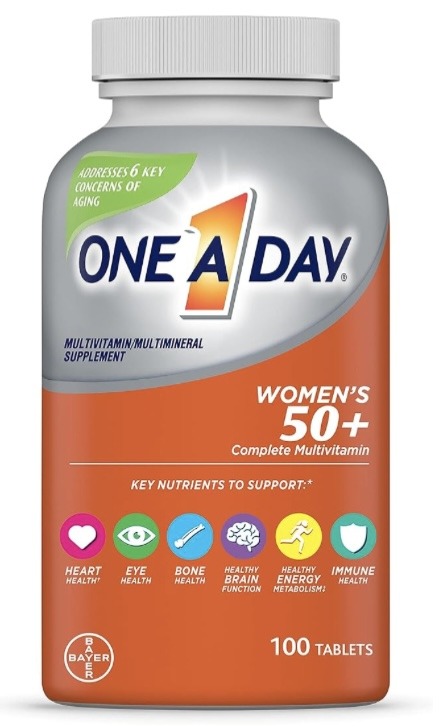
If your mom is the kind of person who reads supplement labels with a magnifying glass and rolls her eyes at “longevity stacks,” this is her bottle. One A Day Women’s 50+ is the supplement-aisle equivalent of a sensible cardigan — familiar, affordable, dependable, and surprisingly hard to argue against for an elderly woman who simply wants to fill nutrient gaps without any drama.
It also happens to be one of the cheapest entries on this list per pill. For caregivers managing a fixed-income parent, that math matters.
Key Ingredients & Dosage
| Nutrient | Notes |
|---|---|
| Vitamin A (incl. beta-carotene), C, D, E | Standard antioxidant coverage |
| Full B-complex (B6, B12, folate, biotin) | B12 as cyanocobalamin |
| Calcium | Modest dose, supplemental role |
| Magnesium, Zinc, Selenium | Standard mineral panel |
| Lutein | Eye health (AMD support) |
| Iron-free | Appropriate for postmenopausal women |
What Makes It Stand Out
The benefit-led labeling. One A Day puts the six concerns of aging right on the bottle: heart, energy metabolism, eye, brain, bone, and immune. For an 80-year-old reading the label without her glasses, that plain-English framing beats a chemistry textbook every time. It’s also widely available — every pharmacy, every grocery store, every Amazon delivery in two days.
How It Supports Healthy Aging
Covers the post-menopausal basics. Vitamin D supports bone density (a real concern for women in their 70s and 80s). B-vitamins help with energy metabolism, which is relevant given how often fatigue presents as a vague geriatric complaint. Lutein supports macular health.
Safety & Side Effects
Contains synthetic dyes (FD&C colors, titanium dioxide) — a turn-off for buyers who prefer cleaner labels. Vitamin K is present, so warfarin patients need to keep intake consistent. Calcium and other minerals should be spaced 4 hours from levothyroxine and bisphosphonates. The B12 is cyanocobalamin, which is fine for most elderly users but suboptimal for anyone with confirmed B12 absorption issues.
How to Take It
One tablet daily with food. The largest meal of the day works best.
Pros & Cons
Pros
- Inexpensive — one of the cheapest per-pill on this list
- Once daily, smooth tablet, easy to swallow
- Available at any drugstore, gluten-free
- Iron-free
- Plain-language label clarity
Cons
- Synthetic dyes
- Cyanocobalamin and folic acid (not methylated)
- No CoQ10 or advanced antioxidants
- Modest calcium content
6. One A Day Men’s 50+ Healthy Advantage Multivitamin — Best Budget Pick for Elderly Men
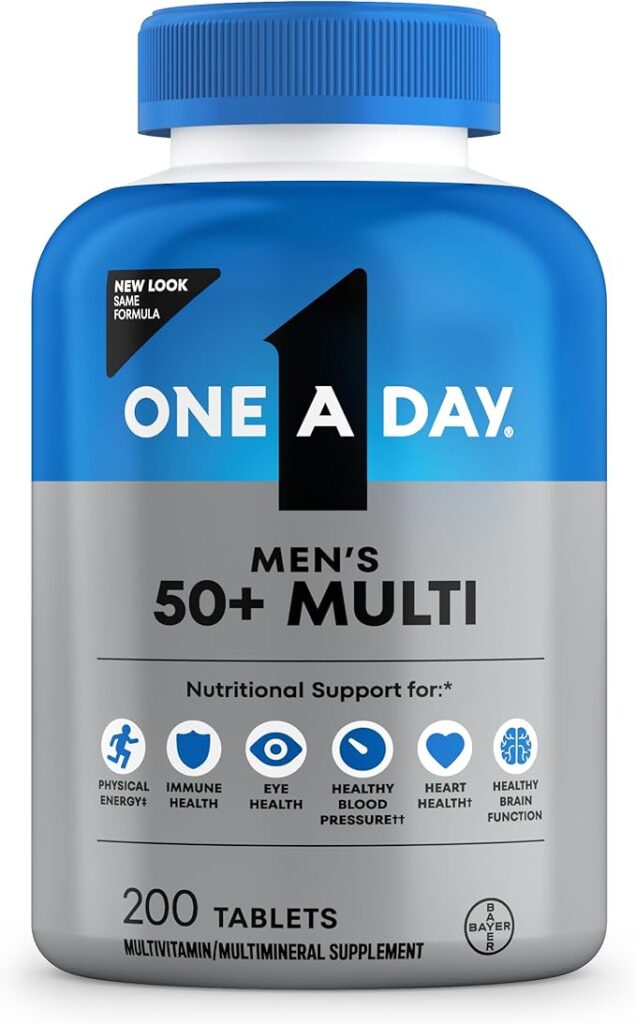
The companion piece to #4. Same drugstore-staple ethos, same caregiver-friendly price tag, with one notable male-targeted addition: lycopene — a carotenoid linked in observational research to prostate and cardiovascular health markers in older men.
If your dad is content with what he’s been taking for the last decade and you just want to make sure it’s still appropriate at 78, this is a low-friction pick.
Key Ingredients & Dosage
A through K coverage, full B-complex (cyanocobalamin B12), magnesium, zinc, selenium, copper, manganese, chromium, molybdenum, plus lycopene. Iron-free, as it should be for older men.
What Makes It Stand Out
The lycopene addition. It’s not in most generic multis, and while the prostate-cancer-prevention data on lycopene is mixed, the cardiovascular signal is real (small to moderate). Combine that with broad antioxidant coverage and a price point under $0.10 per pill, and the value is hard to beat.
How It Supports Healthy Aging
Hits the six concerns the brand markets: physical energy, heart health, eye health, brain function, healthy blood pressure, and immune health. Vitamin D (for muscle and immune), B6/B12/folate (for cardiovascular homocysteine support), and selenium/zinc (for antioxidant defense) form the practical backbone.
Safety & Side Effects
The same caveats as #4 — synthetic dyes (FD&C Blue, titanium dioxide), vitamin K considerations for warfarin, mineral spacing from levothyroxine. No iron, which is the right call. The cyanocobalamin form is the main clinical compromise.
How to Take It
One tablet daily with food. Take it with the meal where dad is most consistent — for many older men that’s lunch, not breakfast.
Pros & Cons
Pros
- Includes lycopene, which most generic multis skip
- Cheap and widely available
- Once-daily, no swallowing drama
- Iron-free
- Familiar trusted brand
Cons
- Synthetic dyes
- Cyanocobalamin B12 and folic acid
- No CoQ10 (notable for statin users)
- No methylated B-vitamins
7. Nature Made Multi for Her 50+ — Best USP-Verified Pick for Elderly Women
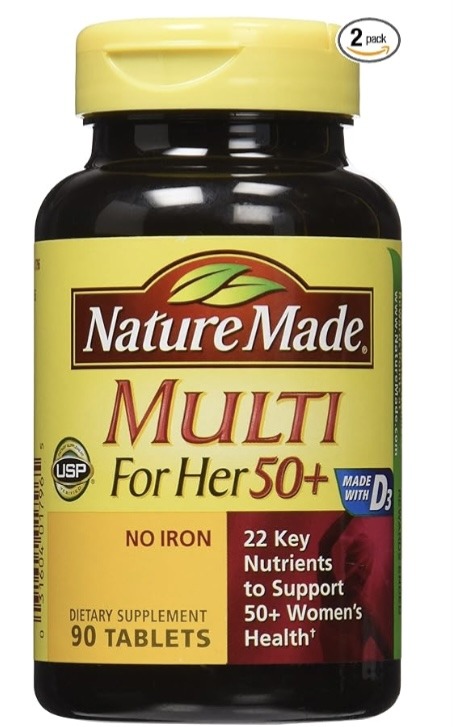
If you’re shopping for an elderly mom and you genuinely want to know that what’s printed on the label is what’s in the bottle, this is the multivitamin to put in your cart. Nature Made Multi for Her 50+ carries the USP Verified seal — meaning the United States Pharmacopeia has independently tested the product for ingredient identity, potency, and the absence of harmful contaminants.
That’s not marketing. That’s an audit. And in a supplement industry famous for sloppy quality control, it’s worth real money.
Key Ingredients & Dosage (per tablet)
| Nutrient | Amount | Notes |
|---|---|---|
| Vitamin A | 750 mcg (60% beta-carotene) | Mixed-form for safety |
| Vitamin C | 180 mg | Generous |
| Vitamin D3 | 25 mcg (1,000 IU) | Hits postmenopausal target |
| Vitamin E | 27 mg | Antioxidant range |
| Vitamin K | 80 mcg | Warfarin caution flag |
| B-complex | Full panel | Folic acid + cyanocobalamin |
| Vitamin B12 | 25 mcg | Well above RDA — addresses absorption decline |
| Calcium | 200 mg | Top-up dose |
| Iodine | 150 mcg | Thyroid coverage |
| Magnesium | 100 mg | Muscle/nerve support |
| Zinc | 15 mg | Immune-relevant dose |
| Selenium | 70 mcg | Standard antioxidant level |
| Iron-free | — | Appropriate for postmenopausal women |
What Makes It Stand Out
The USP Verified seal is the headline. Most drugstore competitors carry vague “GMP” claims; very few carry the actual USP audit. The 25 mcg B12 (over 1,000% of the RDA) directly addresses the age-related absorption decline geriatricians worry about. The 1,000 IU vitamin D3 is the right baseline dose for women over 70.
How It Supports Healthy Aging
Solid bone-and-muscle coverage (D3 + calcium + magnesium). High B12 helps mitigate the absorption issues that get worse after 70. Zinc at 15 mg supports the taste-and-smell changes that often quietly worsen elderly nutrition. The antioxidant trio (A, C, E) covers the standard aging-cell oxidative-stress base.
Safety & Side Effects
Iron-free, which is correct for postmenopausal women without a clinician’s iron prescription. Contains 80 mcg vitamin K — keep intake steady on warfarin. Folic acid (not methylfolate) is adequate for most users but suboptimal for confirmed MTHFR variants. Calcium-containing tablets should be spaced ~4 hours from thyroid medication and bisphosphonates.
How to Take It
One tablet daily with water and a meal. Most fat-soluble vitamins absorb better with dietary fat — meaning lunch or dinner edges out coffee-and-toast breakfast.
Pros & Cons
Pros
- USP Verified seal — meaningful third-party quality audit
- Generous B12 (25 mcg) for age-related malabsorption
- Appropriate D3 dose (1,000 IU)
- Iron-free, gluten-free, no artificial flavors
- Affordable mid-range price
Cons
- Cyanocobalamin and folic acid (not methylated)
- No CoQ10 or advanced antioxidants
- Calcium is modest — not a bone-disease replacement
- Tablet size is on the larger end for swallowing-sensitive users
8. Nature Made Multi for Him 50+ — Best USP-Verified Pick for Elderly Men
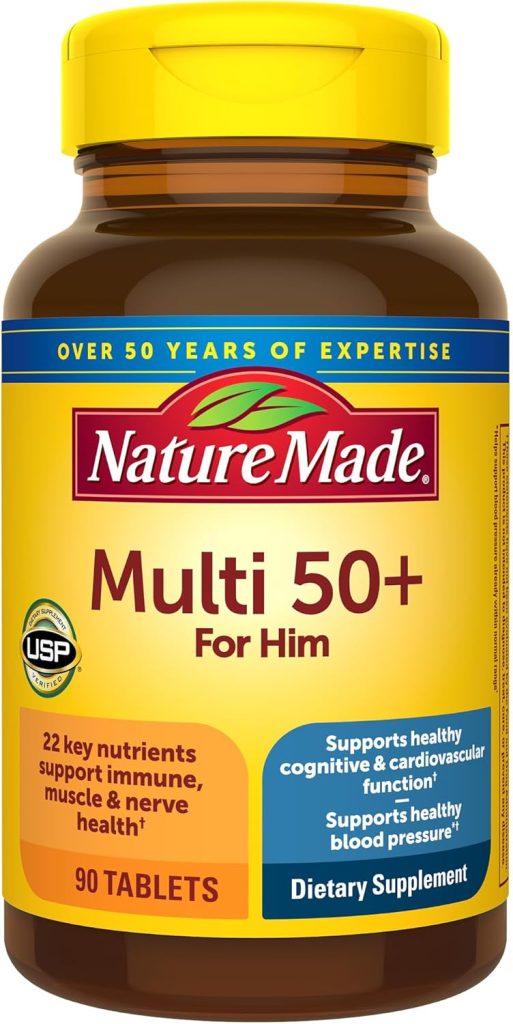
The male-tuned counterpart to #6. Same USP backbone, same iron-free positioning, but with two clinically meaningful tweaks: lower calcium (160 mg) because older men generally need less, and higher selenium (105 mcg) which sits at the upper end of the clinical antioxidant range and supports both thyroid function and male reproductive health markers.
For elderly men whose primary requirement is reliable nutrient floor with verified quality, this is the cleanest one-tablet pick.
Key Ingredients & Dosage (per tablet)
Vitamin A 750 mcg, C 180 mg, D3 25 mcg (1,000 IU), E 27 mg, K 80 mcg, full B-complex with B12 at 25 mcg, Calcium 160 mg, Iodine 150 mcg, Magnesium 100 mg, Zinc 15 mg, Selenium 105 mcg, Copper 2 mg, Manganese 4 mg, Chromium 120 mcg, Molybdenum 75 mcg.
What Makes It Stand Out
Selenium at 105 mcg is the differentiator. Most multivitamins land around 55–70 mcg. The 105 mcg level aligns with research suggesting better antioxidant defense and thyroid hormone conversion in older adults. Combined with the USP Verified seal, the value-to-quality ratio here is excellent.
How It Supports Healthy Aging
Vitamin D3 at 1,000 IU supports muscle preservation — a real defense against sarcopenia, which silently shrinks an older man’s strength year over year. The high-end B12 dose helps with age-related absorption decline, and the higher selenium contributes to the antioxidant defense that gets weaker after 65. Modest calcium is appropriate — older men do not need calcium loading and can run into vascular calcification concerns at high doses.
Safety & Side Effects
Iron-free. Vitamin K (80 mcg) — warfarin patients need consistency. Mineral spacing from thyroid meds, bisphosphonates, and certain antibiotics. The cyanocobalamin form is the main downside for elderly men with confirmed absorption problems.
How to Take It
One tablet daily with water and a meal — preferably the day’s largest meal for fat-soluble vitamin uptake.
Pros & Cons
Pros
- USP Verified quality assurance
- Selenium 105 mcg is rare and clinically relevant
- Appropriate D3 dose for muscle and bone
- Iron-free, gluten-free
- Affordable for the quality
Cons
- Cyanocobalamin and folic acid (not methylated)
- No CoQ10
- Tablet size may be challenging for swallowing-sensitive elderly users
- Modest calcium — fine, but worth knowing
9. Garden of Life Vitamin Code 50 & Wiser Women — Best Whole-Food Multivitamin for Elderly Women
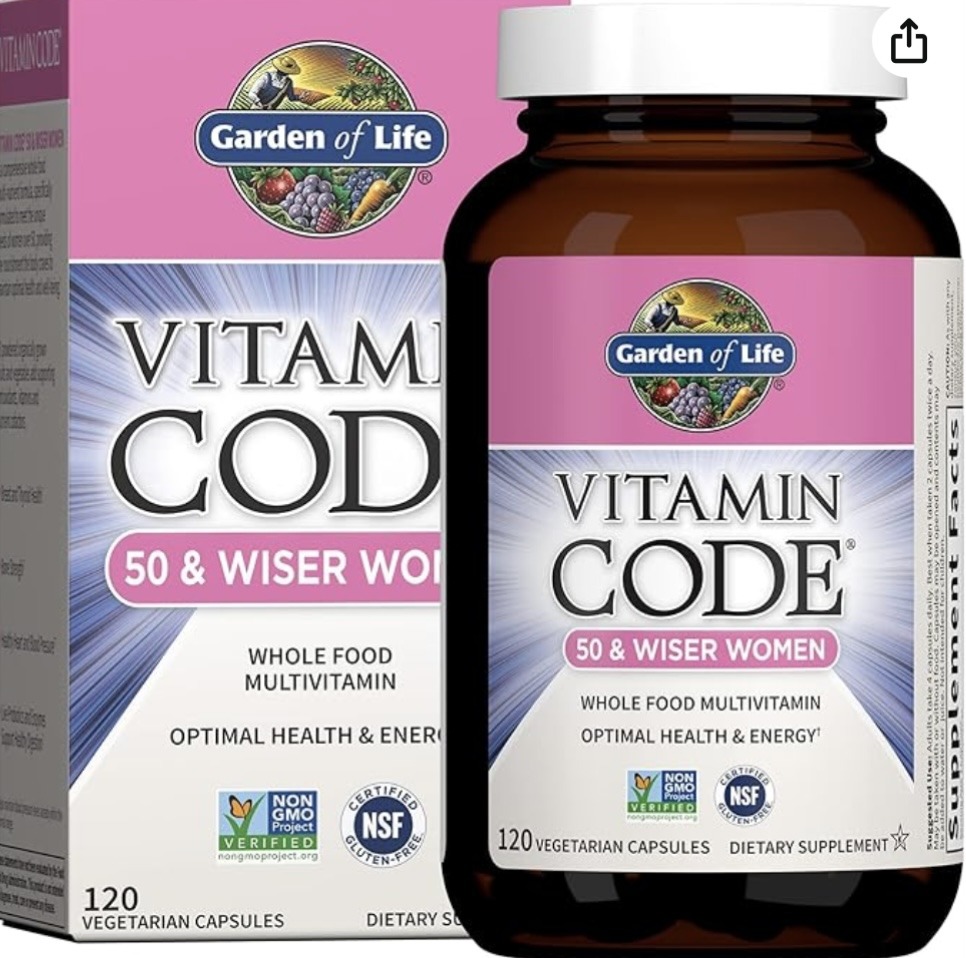
If your mom is the type who reads “synthetic dyes” on a label and puts the bottle right back on the shelf, this is her brand. Garden of Life Vitamin Code 50 & Wiser Women is built around raw, whole-food nutrients plus a 23-strong organic fruit-and-vegetable blend, live probiotics, and digestive enzymes. It’s about as close as a capsule comes to a salad.
It’s also one of the few multis on this list with CoQ10, methylcobalamin B12, and food-form folate all in the same bottle — a combination that genuinely matters in an 80-year-old’s biochemistry.
Key Ingredients & Dosage (per 4-capsule daily serving)
| Nutrient | Amount | Notes |
|---|---|---|
| Vitamin A (beta-carotene) | 6,000 IU | Plant-derived |
| Vitamin C | 60 mg | Modest, food-form |
| Vitamin D3 | 1,000 IU | Postmenopausal target |
| Vitamin E | 30 IU | Mixed tocopherols |
| Vitamin K (K1 + K2) | 50 mcg | Bone & vascular support |
| Folate (food-form, not folic acid) | 400 mcg | Methylated equivalent |
| Vitamin B12 (methylcobalamin) | 200 mcg | Active form, very high dose |
| Selenium | 125 mcg | Upper antioxidant range |
| Zinc | 10 mg | Modest |
| Boron, Vanadium, Chromium, Molybdenum | Trace minerals | Often missed in budget multis |
| CoQ10 | 425 mcg | Small but present |
| Organic Moringa, Vitex, 23-fruit/veg blend | Various | Whole-food cofactors |
| Live probiotics + digestive enzymes | 500M CFU | Lactobacillus blend |
What Makes It Stand Out
Three things. First, active B12 and food-form folate — the right forms for older absorption. Second, the digestive enzyme and probiotic inclusion, which is genuinely useful for elderly users with reduced stomach acid (atrophic gastritis hits ~30% of adults over 60, remember). Third, the clean-label profile: Non-GMO Project Verified, NSF Certified Gluten-Free, Kosher, vegetarian, no synthetic binders.
For an elderly mom who eats sparingly and worries about digestion, the enzyme/probiotic combo is the quiet selling point most reviewers miss.
How It Supports Healthy Aging
Methylated B12 at 200 mcg is well above what most older women get from food and bypasses age-related malabsorption. Food-form folate skips the MTHFR conversion step. K1 + K2 together support bone and arterial calcium handling — relevant given postmenopausal women’s elevated cardiovascular and osteoporosis risk. The probiotic inclusion may modestly support gut motility, which is often sluggish in the elderly on opioids or anticholinergics.
Safety & Side Effects
Two real cautions. California Prop 65 lead warning appears on the label — clinically below action levels and consistent with whole-food supplements (plants pull trace metals from soil), but worth disclosing. Vitamin K in the formula means warfarin patients need consistency. The four-capsule daily load is the biggest adherence hurdle for elderly users — but the capsules can be opened and stirred into yogurt or applesauce, which is a real caregiver win.
How to Take It
Two capsules in the morning, two in the evening. May be taken with or without food. Capsules can be opened and contents mixed into water, juice, yogurt, or applesauce — this is the killer feature for elderly women with swallowing trouble who want a whole-food formula but can’t manage the capsule shells.
Pros & Cons
Pros
- Methylated B12 + food-form folate (rare in this price range)
- CoQ10 and trace minerals (boron, vanadium) included
- Probiotics + digestive enzymes support older-adult digestion
- Capsules can be opened — caregiver-friendly workaround
- Clean label, organic, vegetarian, kosher
Cons
- Four capsules a day — adherence hurdle
- California Prop 65 lead warning (low clinical concern, but transparent disclosure needed)
- Modest vitamin C and zinc doses
- Pricier per serving than drugstore tablets
10. New Chapter Every Man’s One Daily 55+ — Best Fermented Multivitamin for Elderly Men
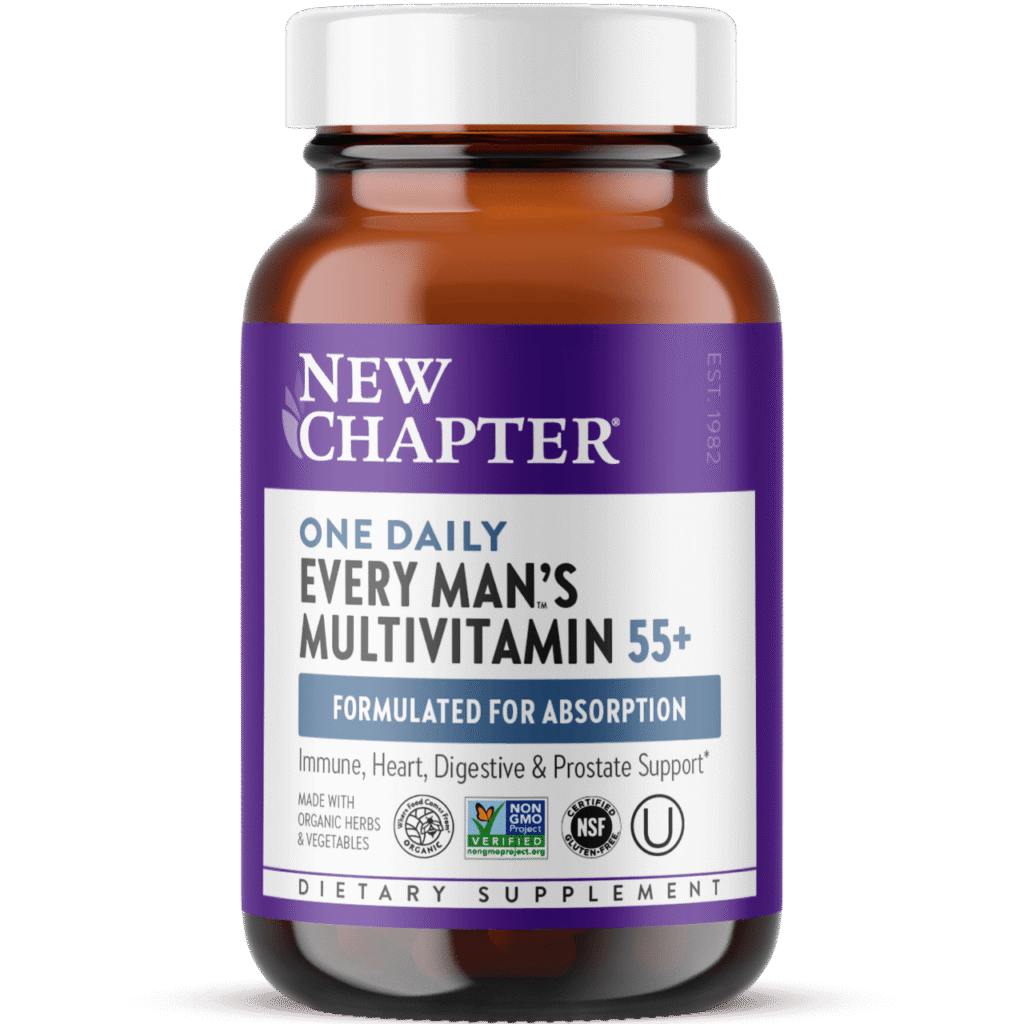
Here’s the multivitamin for the elderly dad who refuses to take pills on an empty stomach because “it makes my gut feel awful.” New Chapter ferments the entire formula with probiotics and whole foods, which the brand argues helps the body recognize the nutrients as food rather than as raw isolated compounds.
The clinical evidence on fermented vitamins specifically is modest, but the practical reality is undeniable: most users tolerate this formula on an empty stomach when they can’t tolerate other multis. For an older man with a sensitive gut, that’s not a marketing claim — that’s quality of life.
Key Ingredients & Dosage (per tablet)
| Nutrient | Amount | Notes |
|---|---|---|
| Vitamin A (beta-carotene + ferment) | 450 mcg | 50% DV |
| Vitamin C | 67.5 mg | 75% DV |
| Vitamin D3 | 25 mcg / 1,000 IU | 125% DV |
| Vitamin E | 7.5 mg | 50% DV |
| Vitamin K (K1 + K2 MK-7) | 61 mcg | Rare K2 inclusion |
| Full B-complex | Fermented | Active forms |
| Folate (food-form) | Active | Methylated equivalent |
| B12 (methylcobalamin) | Active | Right form for elderly |
| Fermented Zinc, Selenium | Trace | Small but bioavailable |
| Astaxanthin (organic algae) | Included | Strong xanthophyll antioxidant |
| Saw palmetto, pumpkin seed oil, nettle | Prostate blend | Standardized extracts |
| Hawthorn, ginger, turmeric, chamomile, schizandra, eleuthero, astragalus, elderberry | Herbal blends | Cardio, immune, stress, digestion |
What Makes It Stand Out
The prostate-support blend (saw palmetto + pumpkin seed + nettle) is the male-targeted differentiator. Saw palmetto has decades of clinical research for benign prostatic hyperplasia symptoms — meta-analyses are mixed but suggest modest benefit on lower urinary tract symptoms in older men. The K2 MK-7 inclusion is unusual and supports vascular calcium handling. Astaxanthin is a potent antioxidant that crosses the blood-brain barrier.
This is also the only multivitamin on the list that’s genuinely gentle enough to take on an empty stomach — which matters when an elderly man doesn’t always remember to eat breakfast.
How It Supports Healthy Aging
The fermented format may improve tolerability in older guts. Saw palmetto addresses a near-universal concern in men over 70 (BPH symptoms). K2 MK-7 supports the right place for calcium (bones) and away from the wrong places (arteries). Methylated B12 + folate covers the elderly absorption decline. The herbal stress-and-immune blend (astragalus, elderberry, schizandra) is a soft pillow of adaptogenic support.
Safety & Side Effects
Saw palmetto can interact with anticoagulants — warfarin, apixaban, aspirin. Get clinician sign-off if your dad’s on any of those. Vitamin K is in the formula, so warfarin users also need consistency. Contains fermented soy — flag for soy-allergic users. The herbal load is high; for elderly men on more than four prescription medications, run the ingredient list past their pharmacist or geriatrician.
How to Take It
One tablet daily, any time, with or without food. Genuinely flexible.
Pros & Cons
Pros
- Tolerable on an empty stomach (rare and valuable for elderly users)
- Methylated B12 and folate
- K2 MK-7 inclusion supports bone and vascular health
- Saw palmetto for BPH, astaxanthin for antioxidant defense
- Certified organic herbs, NSF gluten-free, Non-GMO
Cons
- Saw palmetto interacts with blood thinners — consult clinician
- Contains fermented soy
- Many herbs = polypharmacy interaction potential
- Lower vitamin C and E doses than drugstore competitors
- Pricier per tablet
11. MegaFood Men’s 55+ One Daily Multivitamin — Best Allergen-Free, Methylated Multivitamin for Elderly Men
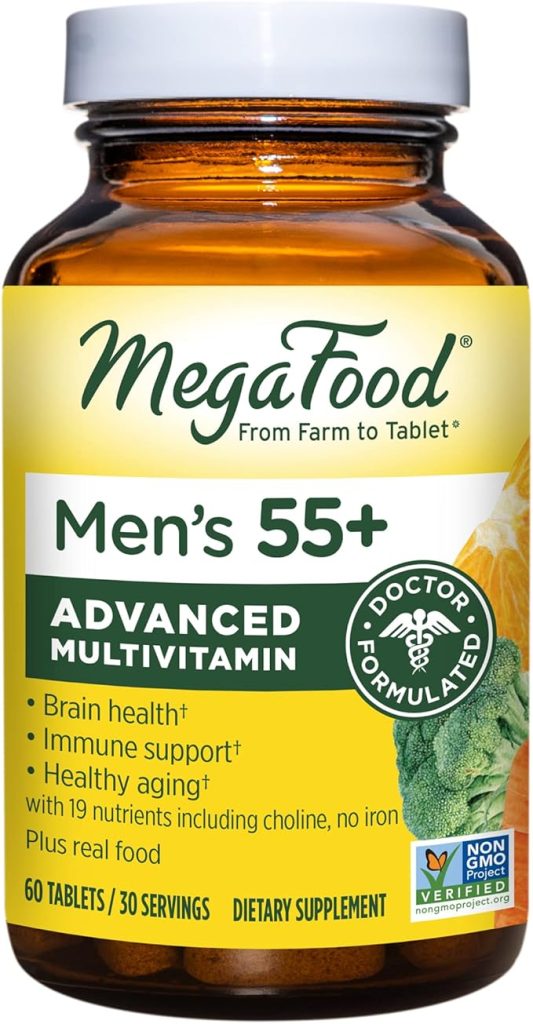
This is the multivitamin I’d pick for an elderly man with multiple food sensitivities, a methylation issue, or a long medication list. MegaFood made deliberate choices that matter clinically: methylcobalamin B12, L-5-methyltetrahydrofolate, fermented glycinated minerals, no calcium or magnesium (so it doesn’t fight with thyroid meds or antibiotics), and free of the 9 major food allergens.
It’s also Glyphosate Residue Free — which sounds like marketing but reflects real third-party residue testing of a kind most brands don’t bother with.
Key Ingredients & Dosage (per tablet)
| Nutrient | Amount | Form/Notes |
|---|---|---|
| Vitamin A (beta-carotene) | Standard | Plant-derived |
| Vitamin C | Standard | Ascorbic acid |
| Vitamin D3 (fermented) | 40 mcg / 1,600 IU | Generous, clinically meaningful |
| Vitamin E (sunflower-derived) | Standard | Natural d-alpha |
| Vitamin K | Phytonadione | — |
| Full B-complex | Fermented | — |
| Folate (L-5-MTHF) | Active form | Methylated |
| B12 (methylcobalamin) | Active form | Methylated |
| Zinc (bisglycinate) | Chelated | Excellent absorption |
| Selenium (glycinate) | Chelated | Excellent absorption |
| GTF Chromium, Manganese, Molybdenum, Iodine | Glycinated | Better tolerated than oxides |
| Real-food blend (organic orange, brown rice, cranberry, blueberry, carrot, cabbage, broccoli) | Cofactors | — |
| Iron-free, calcium-free, magnesium-free | — | Reduces drug interactions |
What Makes It Stand Out
The mineral form. Almost every mineral on this label is glycinated or bisglycinated — chelated forms with notably better absorption and tolerance than the cheap oxides found in budget multis. The 1,600 IU vitamin D3 is one of the highest doses on this list and lands near the high end of typical clinical recommendations for elderly men.
The deliberate omission of calcium and magnesium is also smart for elderly users on levothyroxine, fluoroquinolones, or bisphosphonates — those drugs require 4-hour spacing from those minerals, and not having them in the multivitamin avoids the timing dance entirely.
How It Supports Healthy Aging
Methylated B12 + folate cover the most common deficiencies in adults over 75. The 1,600 IU D3 dose addresses the near-universal vitamin D shortfall in homebound elderly. Fermented zinc bisglycinate supports immune and taste/smell function (older men with low zinc often complain food “tastes like nothing” — a quietly damaging contributor to under-eating). The B Corp certification and 125-substance contaminant testing are quality signals worth real money.
Safety & Side Effects
Biotin may interfere with troponin and thyroid lab assays — important for cardiac and thyroid patients, particularly any elderly man with a pacemaker, recent MI, or known thyroid disease. Pause supplement 48 hours before scheduled blood work if instructed. Iron-free, which is correct. No calcium/magnesium spacing concerns. Safe profile overall.
How to Take It
One tablet daily, any time of day, even on an empty stomach. Genuinely flexible — which is exactly what elderly users with inconsistent meal patterns need.
Pros & Cons
Pros
- Methylated B12 + folate in tablet form (rare combination)
- Fermented, chelated minerals = better absorption
- 1,600 IU vitamin D3 — clinically meaningful
- No calcium or magnesium = no drug-spacing headaches
- Free of 9 major allergens, glyphosate-residue tested
- Tolerable on empty stomach
- B Corp Certified
Cons
- Biotin may interfere with blood tests
- No calcium or magnesium (good for some, a gap for others)
- Pricier per tablet than drugstore options
- Less brand recognition with older patients
Best Multivitamin for Elderly with Specific Conditions
Not every recommendation fits every situation. Here’s how to match the formula to the person.
Best Multivitamin for Elderly with Poor Appetite or Dementia
Pick: MaryRuth Liquid (#2) or Garden of Life Vitamin Code 50 & Wiser (#9) with capsules opened.
Elderly patients with dementia, poor appetite, or significant weight loss often resist pills. A liquid you can stir into morning juice — or a capsule whose contents you can sprinkle into yogurt — beats a refused tablet every single time. The honest goal here is adherence, not the perfect supplement-facts panel.
Best Multivitamin for Elderly on Warfarin or Blood Thinners
Pick: One A Day Proactive 65+ (#3) — first choice. Centrum Silver Men 50+ (#4), One A Day Women’s 50+ (#5), or One A Day Men’s 50+ (#6) — second choices.
Most multivitamins contain vitamin K, which means daily-intake consistency is non-negotiable for warfarin patients — sudden swings can destabilize INR and trigger a clot or a bleed. One A Day Proactive 65+ is deliberately formulated without vitamin K, which makes it the safest default for an elderly parent on warfarin. The label even states it’s intended for patients whose physicians have instructed them to avoid vitamin K.
If your parent dislikes Proactive 65+ for some reason, drugstore alternatives with predictable, fixed, lower-K content (#4, #5, #6) are reasonable runner-ups. Avoid herbal-heavy formulas like Nature’s Lab Gold One Daily (#1) — which contains 300 mcg vitamin K plus turmeric, quercetin, and resveratrol — or New Chapter 55+ (#10), which adds saw palmetto and ginger. Both are usable on warfarin but require strict daily consistency and a clinician’s blessing first. Loop in the anticoagulation clinic before any switch.
Best Multivitamin for Elderly with Swallowing Difficulty
Pick: MaryRuth Liquid (#2) — first choice. Garden of Life Vitamin Code (#9) — second choice if you want a whole-food capsule whose contents can be opened.
Roughly 15–20% of adults over 70 have some degree of dysphagia. Forcing tablets is a known aspiration risk. A liquid is the safest format. Capsules that can be opened are the next best thing. Hard-shell tablets are last on the list.
Best Multivitamin for Elderly on PPIs or Metformin
Pick: MegaFood Men’s 55+ One Daily (#11), Garden of Life Vitamin Code 50 & Wiser (#9), or MaryRuth Liquid (#2).
PPIs (Prilosec, Nexium, Protonix) and metformin are the two medications most likely to deplete B12 in older adults. The right multivitamin for someone on either drug uses methylcobalamin at a generous dose. All three picks above qualify. If your parent has been on a PPI or metformin for over five years, ask their doctor for a serum B12 + methylmalonic acidcheck — a multivitamin alone may not be enough.
Best Multivitamin for Frail Elderly Adults Over 80
Pick: MaryRuth Liquid (#2), Nature’s Lab Gold One Daily (#1), or MegaFood Men’s 55+ One Daily (#11).
Frailty + sarcopenia + reduced appetite is a different clinical picture than “healthy 60-year-old.” For frail elderly adults, prioritize:
- Liquid or single-tablet/capsule format (not 4-capsule formulas)
- Methylated B12 and folate
- Iron-free
- Vitamin D3 at 800–1,600 IU at minimum
- No conflict with thyroid meds
All three picks above hit those boxes. Multi-capsule formulas like Garden of Life #9 (4 capsules daily) are usually wrong for frail 80+ patients — too many pills, too much complexity.
Best Multivitamin for Elderly with Diabetes or Cardiovascular Disease
Pick: MegaFood Men’s 55+ One Daily (#11) or Nature Made Multi for Her/Him 50+ (#8, #7).
Diabetic elderly patients benefit from chromium and magnesium (where present), and methylated B-vitamins help manage homocysteine — a cardiovascular risk marker that elevates with age. USP-Verified or Glyphosate-Residue-Free formulas reduce the contaminant load an already-burdened cardiovascular system doesn’t need.
How to Give a Multivitamin to an Elderly Parent: 7 Caregiver Tips That Actually Work
After a decade of recommending supplements to older adults and watching what sticks, here’s what genuinely improves adherence:
- Pair it with an existing daily anchor. Coffee, breakfast, the morning newspaper, the 9 a.m. medication. Brains over 75 don’t form new habits well — they attach new behaviors to old ones.
- Use a weekly pill organizer with day-and-time labels. The cheap plastic kind from any pharmacy. Refill every Sunday. This single $3 tool prevents more missed doses than any high-end app.
- Pre-pour liquid doses the night before. A small medicine cup of MaryRuth liquid in the fridge, next to the orange juice. Removes the decision and the measurement from a tired morning brain.
- Open capsules into food when needed. Garden of Life Vitamin Code capsules can be opened and sprinkled into yogurt, applesauce, or oatmeal. Confirm with the brand or your pharmacist before opening any capsule — but for the products listed here, it’s allowed and labeled.
- Don’t bury the vitamin in a 12-pill morning routine. If your parent is already taking blood pressure meds, statin, baby aspirin, eye drops, and reflux medication, the multivitamin should visually stand apart. Different bottle, different colored pill organizer slot. Otherwise it gets lost.
- Track adherence with a checkmark calendar. Old-school. Hangs on the fridge. Mark an X every day the multivitamin is taken. Visible accountability beats invisible intention.
- Loop in their pharmacist annually. Most pharmacists will run a free medication therapy management reviewfor elderly patients on five or more medications. Bring the multivitamin bottle. The pharmacist will flag any new interactions and confirm dosing fits the rest of the regimen.
When NOT to Give a Multivitamin to an Elderly Person
A multivitamin isn’t always appropriate. These are the situations where I’d actively pause and ask the patient’s physician first.
- Hereditary hemochromatosis or transfusion-dependent iron overload. All listed products are iron-free, which helps — but vitamin C in a multi can increase iron absorption from food, which becomes a real problem in iron-overload conditions.
- Advanced chronic kidney disease (Stage 4–5) or dialysis. Vitamin A, vitamin K, and certain minerals can accumulate when kidneys can’t clear them efficiently. Renal patients usually need a specialized renal multivitamin— not anything on this list.
- Active cancer treatment. Some chemotherapy regimens require avoiding antioxidants (vitamin C, E, beta-carotene at high doses) because they may interfere with the oxidative mechanism of the chemo. Always check with the oncology team before starting.
- Severe hepatic disease. Fat-soluble vitamins (A, D, E, K) accumulate when liver function is impaired. Routine multivitamins can become harmful in late-stage cirrhosis.
- Recent major surgery or planned bariatric procedures. Pre- and post-op vitamin and mineral needs differ from baseline. The surgical team should direct supplementation, not a generic over-the-counter multi.
- On methotrexate. Folic acid timing and dose must be coordinated with the prescribing rheumatologist — a multivitamin’s folate may interfere with the drug’s mechanism if not dosed properly.
- Confirmed vitamin A toxicity risk (some hepatic conditions, retinoid medications). Beta-carotene-only formulas (#2, #9) are safer here than products using preformed vitamin A acetate.
When in doubt, take a photograph of the multivitamin’s Supplement Facts panel and text it to your parent’s primary care doctor. Most will respond within 24 hours with a yes, no, or “let me check.”
Frequently Asked Questions: Multivitamins for Elderly Adults
Should elderly people take a multivitamin every day?
The honest answer is it depends. For an elderly adult eating a varied diet, fully ambulatory, with no malabsorption issues, a multivitamin offers small benefit. For an elderly adult who under-eats, has reduced stomach acid, takes medications that deplete nutrients (PPIs, metformin, loop diuretics), or has a confirmed deficiency, a daily multivitamin offers real value. Have the conversation with their doctor — and ideally check serum B12, vitamin D, and a basic metabolic panel before starting.
What is the best multivitamin for the elderly over 80?
For most adults over 80, prioritize a liquid or single-tablet/capsule format, methylated B12 and folate, vitamin D3 of at least 800 IU, and iron-free. MaryRuth Liquid (#2), Nature’s Lab Gold One Daily (#1), and MegaFood Men’s 55+ One Daily (#11) fit this profile best. Avoid four-capsule formulas at this age unless the contents will be mixed into food.
If your parent over 80 is also on warfarin, One A Day Proactive 65+ (#3) is the cleanest pick because it’s formulated without vitamin K.
Can elderly people take regular adult multivitamins instead of senior formulas?
Technically, yes — but most adult multivitamins contain iron, which is rarely needed in older men or postmenopausal women and can worsen oxidative stress. Senior-specific formulas typically remove iron and boost vitamins B12 and D, which directly addresses age-related absorption decline. The senior label is meaningful for once.
Are gummy multivitamins okay for elderly people?
Generally not the best choice. Gummies often contain less-complete nutrient profiles (no iron, low magnesium, no fat-soluble vitamins at full dose) and added sugar — a concern for diabetic elderly patients. They’re acceptable for an elderly user who refuses every other format, but a liquid (#2) is a better swallowing-friendly alternative.
How do I know if my elderly parent actually needs a multivitamin?
Three signs warrant a doctor’s conversation: unexplained fatigue or cognitive fog (consider B12), frequent falls or muscle weakness (consider vitamin D), and slow wound healing or recurrent infections (consider zinc, vitamin C). A serum B12, 25-OH vitamin D, and complete blood count are inexpensive starting tests.
Can a multivitamin interact with my parent’s blood pressure medication?
Most multivitamins are safe with common antihypertensives. The one to watch is potassium — multivitamins generally contain little, but combining one with potassium-sparing diuretics (spironolactone, eplerenone) or ACE inhibitors warrants a clinician’s check. Vitamin K is the bigger concern for warfarin specifically, not blood pressure meds.
What’s the difference between “multivitamin for seniors” and “multivitamin for elderly”?
In clinical practice, senior often means 50–70 and active. Elderly often means 75+ and dealing with the realities of polypharmacy, frailty, and reduced absorption. The 10 picks in this guide are chosen with the elderly framing in mind. For broader senior options, [link to your “best multivitamins for seniors” article].
Can I open the capsules and mix the contents into food?
For Garden of Life Vitamin Code 50 & Wiser (#8), yes — the brand explicitly allows it, and it’s a real caregiver win. For Nature’s Lab Gold One Daily (#1), it’s allowed but the formula is dense and may taste unpleasant. For tablet-format products (#3, #4, #5, #6, #7, #9, #10), no — splitting or crushing tablets disrupts the coating and dosing. If swallowing is the issue, switch to MaryRuth Liquid (#2).
Do I need a separate calcium supplement on top of a multivitamin?
If your elderly parent’s calcium intake from food (dairy, fortified plant milks, leafy greens) plus their multivitamin’s 100–200 mg falls short of the 1,200 mg/day target for adults over 70, then yes. Bone-density status, kidney function, and cardiovascular risk all factor in. Have their doctor decide — calcium isn’t a “more is better” situation. Excess can drive vascular calcification.
How long until my elderly parent feels a difference?
Energy improvements from B12 correction can show within 2–4 weeks. Vitamin D restoration takes 8–12 weeks of consistent use. General “I feel better” is rarely dramatic — multivitamins fill quiet gaps, not big ones. If a parent feels dramatically better within a week, consider that a confirmation deficiency was real, not that the multivitamin is magical.
Final Verdict: The Best Multivitamin for Elderly Adults in 2026
Here’s the honest summary, by use case:
- Best overall premium pick for elderly users: Nature’s Lab Gold One Daily Multivitamin (#1)
- Best for elderly with swallowing difficulty: MaryRuth Organics Liquid Morning Multivitamin (#2)
- Best trusted drugstore pick: Centrum Silver Men 50+ (#4) — or its Women’s counterpart
- Best budget option: One A Day Women’s / Men’s 50+ (#5 #6)
- Best USP-Verified mid-range: Nature Made Multi for Her / Him 50+ (#8, #7)
- Best whole-food formula: Garden of Life Vitamin Code 50 & Wiser Women (#9)
- Best for elderly men with prostate concerns: New Chapter Every Man’s One Daily 55+ (#10)
- Best methylated, allergen-free pick: MegaFood Men’s 55+ One Daily (#11)
- Best for elderly on warfarin or blood thinners: One A Day Proactive 65+ (#3) — the only no-vitamin-K formula on this list
If you want one rule of thumb to take with you: the best multivitamin for an elderly parent is the one they’ll actually take consistently, in a form they can swallow, with the right active forms of B12 and folate, that doesn’t fight with their medications. Match the format and the formula to the person, not to the marketing.
And whatever you choose — loop their doctor in before you click buy. A two-minute photo text to a primary care provider can save weeks of guessing.
For broader senior multivitamin coverage by gender or age band, see our companion guides on [best multivitamins for seniors], [best multivitamins for women over 70], and [best multivitamins for men over 60]. This guide focuses specifically on the elderly + caregiver lens — which is a different clinical reality than “active 55-year-old taking responsibility for their own aging.”
Take care of yourself, too. Caring for an elderly parent is one of the hardest jobs in the world. The right multivitamin is a small piece of that — but small pieces, repeated daily, are how the long work gets done.